Indigenous Corn Domestication
Interactive passage with audio narration, comprehension questions, and printable PDF.
By completing this purchase you agree to our Terms of Use and Privacy Policy. Your subscription renews automatically until you cancel. You can cancel anytime from your account settings. All sales are final and non-refundable. Digital content is available for download in your account immediately upon purchase.
What's included
Indigenous Corn Domestication preview and details
About this printable Indigenous Corn Domestication reading passage (Grades 5-8)
Sample passage and quiz from Indigenous Corn Domestication
Reading passage and comprehension quiz preview
Indigenous Corn Domestication
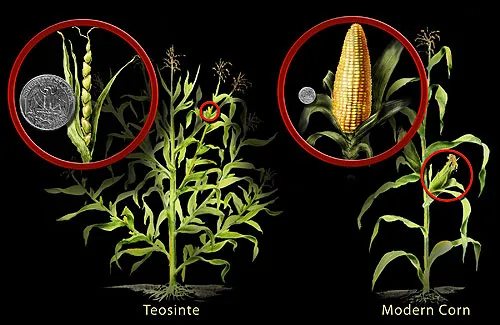
"Teosinte and Modern Corn Comparison" by National Science Foundation / Wikimedia Commons (Public domain).
About 9,000 years ago, Indigenous peoples living in what is now southern Mexico began the challenging process of domesticating maize, or corn, from a wild grass called teosinte. This transformation is considered one of the most important agricultural achievements in world history. Archaeological evidence, such as ancient cobs and pollen samples found in caves like Guilá Naquitz, confirms that early farmers used careful selection to change teosinte’s tiny, hard seeds into the large, nutritious kernels of maize we know today.
The process of domestication required generations of observation and experimentation. Early farmers noticed that some teosinte plants produced larger or softer seeds. By saving and planting these seeds, they slowly guided the evolution of the plant. Genetic studies show that the first maize cobs appeared more than 6,000 years ago. Over time, maize became adaptable to different climates and soils, which made it possible for Indigenous communities to grow it from Central America up into present-day Canada.
The domestication of maize had major effects on Indigenous societies. With a reliable staple crop, people could settle in larger, more permanent villages. This allowed for the growth of complex societies such as the Maya, Olmec, and later the Mississippian cultures of North America. Maize became central to daily life, religious ceremonies, and trade networks. Archaeological finds from the site of San Marcos Cave and paintings on Mayan pottery show the importance of maize in both diet and culture. Farming maize also required new tools and irrigation methods, which encouraged further innovation and the development of social hierarchies.
The spread of maize changed the Americas. As knowledge of maize farming traveled north and south, different groups adapted it to local environments. For example, the Ancestral Puebloans used terracing in the Southwest, while the Iroquois in the Northeast grew maize alongside beans and squash in a method called the “Three Sisters.” This new food source supported growing populations and allowed societies to flourish even in challenging environments.
Today, the domestication of maize is recognized as a turning point in human history. It demonstrates how careful observation, environmental knowledge, and innovation can lead to major changes in society. The story of maize connects world history, geography, and science, showing how Indigenous peoples shaped their environment to meet their needs.
Interesting Fact: Maize is now one of the world’s most widely grown crops, feeding billions of people and animals around the globe.
This topic links to broader themes like the development of agriculture, technological change, and the relationship between humans and the environment.
Comprehension quiz (8 questions)
1. Where did maize originate?
2. What is teosinte?
3. Which culture relied on maize farming?
4. Why was maize important?
5. What did irrigation help with?
6. How did maize spread?
7. Maize is a main food crop. True or false?
8. What does "innovation" mean?
Perfect for the way you teach
- Build comprehension skills
- Auto-graded quiz
- Differentiated reading
- Read together at home
- Improve fluency
- Quiet reading time
- Reading curriculum support
- Independent practice
- Track Lexile growth