Reading PassagePremium

Life on a Colonial Farm

Interactive passage with audio narration, comprehension questions, and printable PDF.

No ratings yet
Grades 3–5ReadingElaSocial-studiesHistoryEnglish · SpanishInteractive · Printable
Just this resource
$1.50
One-time purchase
Best value
Unlock everything
$49.99$29.99/yr
40% off until Aug 1 — 10,000+ resources
Renews at $49.99/year.
Unlock above to use these actions

What's included

Reading passage
Audio narration
Comprehension quiz
Writing activity
Glossary & flashcards
Differentiated version
Spanish translation

Part of this bundle

Life on a Colonial Farm preview and details

Preview

Sample passage and quiz from Life on a Colonial Farm

Reading passage and comprehension quiz preview

Life on a Colonial Farm
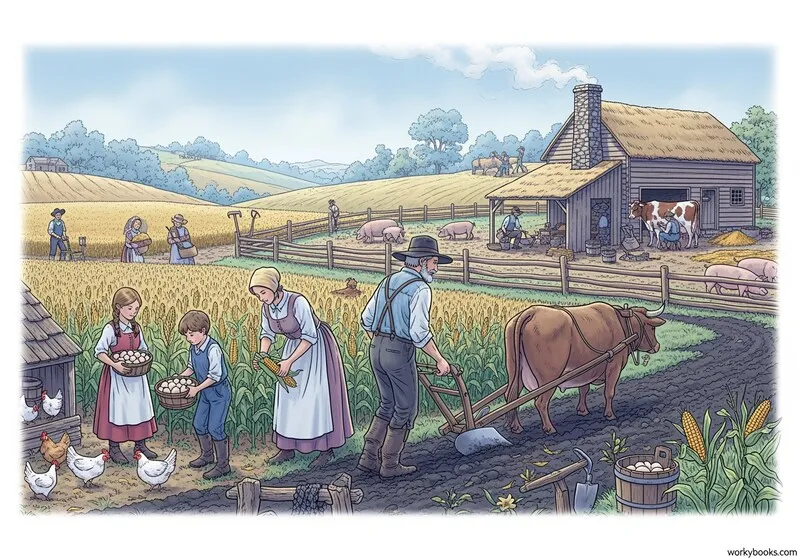
An illustration of a colonial farm with a family working together.
Colonial farm life: hard work, cooperation, and self-sufficiency.

Life on a colonial farm was filled with hard work and teamwork. Every family member had a job to do each day. Farms were far from towns, so families needed to be self-sufficient. This meant they grew their own food, made their own clothes, and built their own tools.

The workday started at sunrise. Fathers and older sons often worked in the fields. They planted corn, wheat, and vegetables. They also cared for animals like cows, pigs, and chickens. Mothers and daughters helped too. They cooked meals over a fire, made butter and cheese, and sewed clothing for everyone.

Children had important jobs. Boys fetched water from the well, gathered firewood, and helped with planting. Girls helped their mothers in the kitchen, fed the chickens, and made candles. These chores were not just for practice. Families relied on everyone to work together to survive.

Most farms had only simple tools. Farmers built wooden plows and used hand tools for planting and harvesting. This made each task take longer. Sometimes, neighbors helped each other during busy times like harvest, showing the value of community and friendship.

Life was not easy, and there was little free time. After a long day, families gathered for supper. They told stories, sang songs, or read the Bible by candlelight. Even though work was hard, families found ways to enjoy time together.

Many families faced challenges like bad weather or sickness. If crops failed, families had to find new ways to get food. Children learned important skills from their parents. These skills helped them grow into strong, responsible adults.

Because families needed to do so many things themselves, they became skilled at many tasks. They learned to solve problems, fix broken tools, and help neighbors. Their hard work and teamwork helped build strong communities in early America.

Interesting Fact: Colonial children often started their chores as young as five years old, and their help was needed every day!

Comprehension quiz (8 questions)

1. What did colonial farms need to be?

Self-sufficient
Rich
Near cities
Very large

2. When did the workday start?

At sunrise
At noon
After supper
At midnight

3. Who helped with chores on the farm?

The whole family
Only fathers
Only children
Only mothers

4. Why did families need to do chores?

To survive
For fun
To be rich
To play games

5. How did neighbors help each other?

During harvest
During winter
Building houses
Never

6. What did children do after supper?

Told stories
Went to work
Left the house
Traveled to town

7. Colonial children started chores at age 10. True or False?

True
False

8. What does 'self-sufficient' mean?

Providing for yourself
Living in a city
Owning many animals
Having no friends
Who it's for

Perfect for the way you teach

Teachers
  • Build comprehension skills
  • Auto-graded quiz
  • Differentiated reading
Parents
  • Read together at home
  • Improve fluency
  • Quiet reading time
Homeschoolers
  • Reading curriculum support
  • Independent practice
  • Track Lexile growth
Reviews & Ratings

No reviews yet. Be the first to share your experience!

More reading you might love

20 more
Passage
Great Awakening Colonial America - reading educational content

Great Awakening Colonial America

Reading Passage

$1.50
Passage
Quakers in Colonial America - reading educational content

Quakers in Colonial America

Reading Passage · D2.HIS.2.3-5

$1.50
Passage
Indentured Servants in Colonial America  - reading educational content

Indentured Servants in Colonial America

Reading Passage · D2.HIS.2.3-5

$1.50
Passage
Cities in Colonial America - reading educational content

Cities in Colonial America

Reading Passage · HSS 5.4.6

$1.50
Passage
Why Europeans Immigrated to Colonial America - reading educational content

Why Europeans Immigrated to Colonial America

Reading Passage · D2.HIS.2.3-5

$1.50
Passage
Colonial Social Classes - reading educational content

Colonial Social Classes

Reading Passage · D2.HIS.2.3-5

$1.50
Passage
Colonial Slave Resistance - reading educational content

Colonial Slave Resistance

Reading Passage · D2.HIS.2.3-5

$1.50
Passage
Benjamin Franklin in Colonial America - reading educational content

Benjamin Franklin in Colonial America

Reading Passage · HSS 5.5

$1.50
Passage
How the Middle Colonies Were Governed - reading educational content

How the Middle Colonies Were Governed

Reading Passage · D2.HIS.2.3-5

$1.50
Passage
Life in the Southern Colonies - reading educational content

Life in the Southern Colonies

Reading Passage · D2.HIS.4.3-5

$1.50
Passage
Colonial Printing Press - reading educational content

Colonial Printing Press

Reading Passage · HSS 5.5

$1.50
Passage
Frontier Life in Colonial America - reading educational content

Frontier Life in Colonial America

Reading Passage · HSS 5.4.6

$1.50
Passage
Colonial Jobs: Blacksmiths, Bakers, and Craftsmen - reading educational content

Colonial Jobs: Blacksmiths, Bakers, and Craftsmen

Reading Passage · D2.HIS.2.3-5

$1.50
Passage
Colonial Apprenticeship System  - reading educational content

Colonial Apprenticeship System

Reading Passage · HSS 5.4.6

$1.50
Passage
Native American Allies in Colonial Wars - reading educational content

Native American Allies in Colonial Wars

Reading Passage · D2.HIS.2.3-5

$1.50
Passage
Colonial Clothing and Homemade Goods - reading educational content

Colonial Clothing and Homemade Goods

Reading Passage · D2.HIS.2.3-5

$1.50
Passage
Colonial Labor Shortage - reading educational content

Colonial Labor Shortage

Reading Passage · CA HSS 8.1.2

$1.50
Passage
Colonial Women's Lives - reading educational content

Colonial Women's Lives

Reading Passage · D2.HIS.2.3-5

$1.50
Passage
African Diaspora in the Americas - reading educational content

African Diaspora in the Americas

Reading Passage · HSS 8.7

$1.50
Passage
Colonial Games and Entertainment - reading educational content

Colonial Games and Entertainment

Reading Passage · D2.HIS.1.3-5

$1.50
Copyright © 2026 Workybooks. Made with ♥ in California.