Reading PassagePremium

Nomadic Peoples and Empires

Interactive passage with audio narration, comprehension questions, and printable PDF.

No ratings yet
Grades 5–8ReadingElaSocial-studiesHistoryEnglish · SpanishInteractive · Printable
Just this resource
$1.50
One-time purchase
Best value
Unlock everything
$49.99$29.99/yr
40% off until Aug 1 — 10,000+ resources
Renews at $49.99/year.
Unlock above to use these actions

What's included

Reading passage
Audio narration
Comprehension quiz
Writing activity
Glossary & flashcards
Differentiated version
Spanish translation

Nomadic Peoples and Empires preview and details

About this printable Nomadic Peoples and Empires reading passage (Grades 5-8)

This engaging history passage explores the impact of nomadic peoples on the decline of ancient empires around 300 CE, focusing on the Huns, Germanic tribes, and the Silk Road’s role in cultural diffusion. Students will learn how nomadic migrations, military tactics, and economic changes contributed to the transformation and fall of great civilizations such as the Roman Empire and Han China. The passage includes primary source evidence, cause-and-effect analysis, and discussion of daily life and social hierarchy, aligning with CA HSS 6.6 and Common Core CCSS RH.6-8.1. Activities include a glossary, comprehension quiz, writing prompts, graphic organizers, and a timeline. Read aloud audio and Spanish translation are provided to support all learners. This resource helps students analyze history like historians and meets key history-social science and language arts standards.
Written by Workybooks TeamPublished by Workybooks
Preview

Sample passage and quiz from Nomadic Peoples and Empires

Reading passage and comprehension quiz preview

Nomadic Peoples and Empires
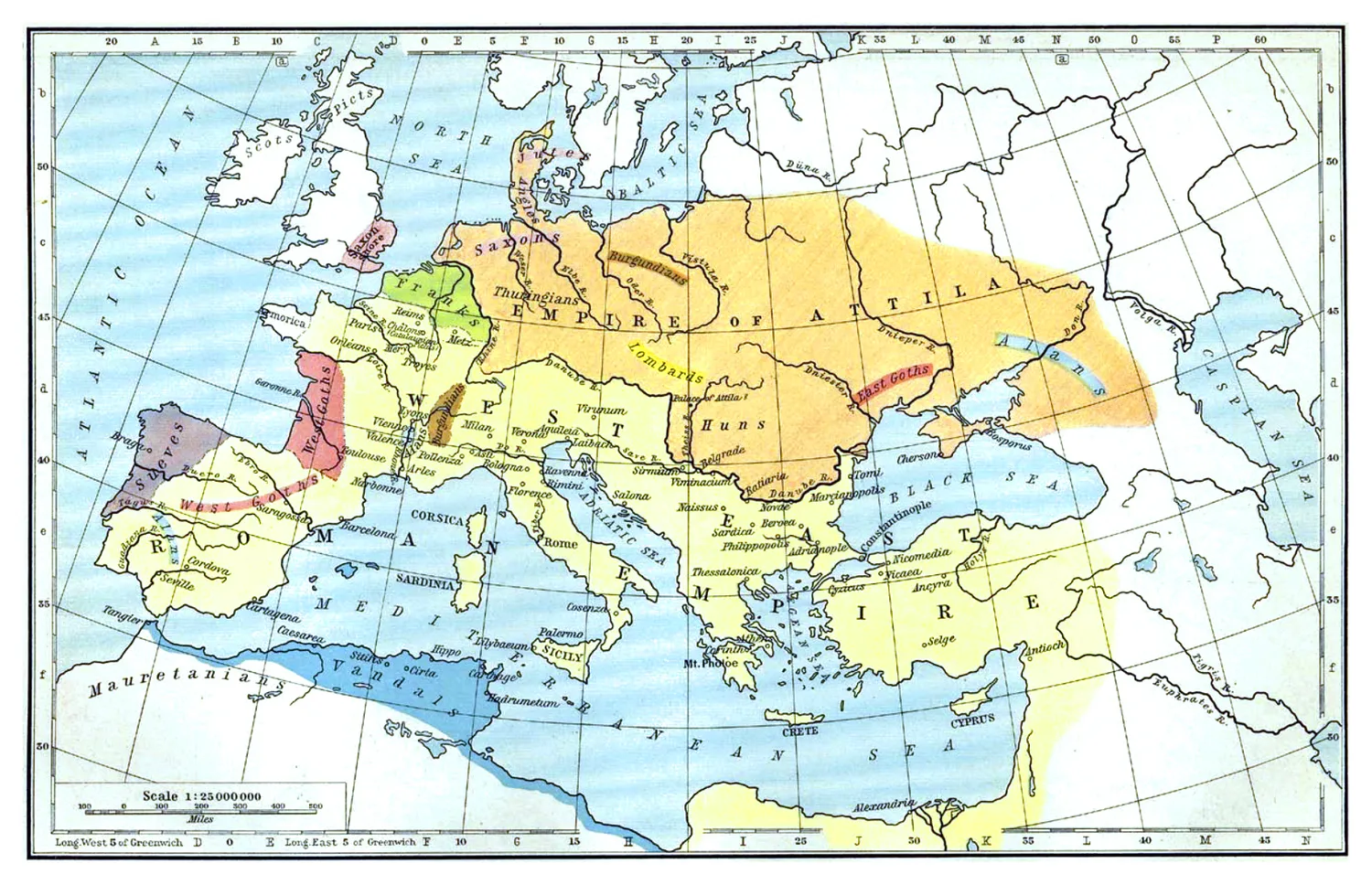
C. 450 Roman and Hun Empires

"C. 450 Roman and Hun Empires" by William Robert Shepherd / Wikimedia Commons (Public domain).

During the centuries around 300 CE, nomadic peoples like the Huns and Germanic tribes played a major role in the decline of powerful ancient empires. These groups, who moved from place to place instead of living in one settlement, disrupted established civilizations and changed the course of world history.

One example of this impact is seen in the Roman Empire. By the late 300s CE, the Roman Empire was vast but vulnerable. Archaeological evidence, including ancient fortifications and written records by Roman historians like Ammianus Marcellinus, shows that external pressures increased as migratory peoples approached Roman borders. The Huns, skilled horse-riders from Central Asia, invaded Eastern Europe in the late 4th century. Their mobility and advanced military tactics, such as mounted archery, forced other groups like the Visigoths and Vandals to move into Roman territory. In 410 CE, the Visigoths famously sacked Rome, a dramatic symbol of imperial decline.

The movement of nomads was often a response to environmental changes, such as drought on the Eurasian Steppe, as well as the search for new resources. The Silk Road, which connected China, the Middle East, and Europe, became both a trade route and a path for migration. Nomadic peoples, such as the Xiongnu and later the Huns, controlled sections of this route and influenced trade. Chinese records from the Han dynasty describe diplomatic missions sent to negotiate with the Xiongnu, showing how important these interactions were.

The impacts of nomadic invasions were far-reaching. Empires struggled to defend long frontiers and manage diverse populations. The decentralization of power, seen in both Rome and Han China, made it harder to respond to rapid threats. As empires weakened, new societies formed from the blending of nomadic and settled cultures. For example, archaeological finds show how Germanic leaders adopted Roman laws and customs after settling in former Roman lands.

Understanding the decline of ancient empires requires recognizing both the strength of nomadic societies and the weaknesses of established states. These migrations shaped the future of Europe and Asia, leading to the rise of new kingdoms and the end of ancient world orders.

This topic connects to the broader theme of hbarbarianow movement, geography, and cultural exchange have shaped human societies throughout history.

Interesting Fact: The word "" was used by Romans to describe outsiders, but many so-called "barbarians" had complex societies and rich traditions of their own.

Comprehension quiz (8 questions)

1. Who were the Huns?

Nomadic horse-riders from Central Asia
Settled farmers in Rome
Egyptian traders
Greek philosophers

2. What city did the Visigoths sack in 410 CE?

Rome
Athens
Constantinople
Alexandria

3. Which road was important for trade and migration?

Silk Road
Royal Road
Appian Way
Amber Road

4. Why did nomads move into new lands?

Seeking resources and escaping drought
Defending their cities
Building pyramids
Studying philosophy

5. How did nomadic invasions affect empires?

Weakened and changed them
Made them stronger
Had no effect
Improved their farming

6. What is decentralization?

Less power for central government
Building new cities
Trading silk
Worshipping new gods

7. The Huns controlled parts of the Silk Road. True or false?

True
False

8. Which word means 'mixing cultures'?

Blending
Fortification
Migration
Military
Who it's for

Perfect for the way you teach

Teachers
  • Build comprehension skills
  • Auto-graded quiz
  • Differentiated reading
Parents
  • Read together at home
  • Improve fluency
  • Quiet reading time
Homeschoolers
  • Reading curriculum support
  • Independent practice
  • Track Lexile growth
Topics

Reviews & Ratings

No reviews yet. Be the first to share your experience!

More reading you might love

20 more
Passage
Ancient Civilizations and the Environment - reading educational content

Ancient Civilizations and the Environment

Reading Passage

$1.50
Passage
Legacy of Ancient Civilizations - reading educational content

Legacy of Ancient Civilizations

Reading Passage · CA HSS 6.2

$1.50
Worksheet
Writing Prompts Ancient Civilizations - worksheet educational content

Writing Prompts Ancient Civilizations

Worksheet · W.5.2.A-2

$1.50
Passage
Family Life in Ancient Civilizations - reading educational content

Family Life in Ancient Civilizations

Reading Passage · CA HSS 6.2

$1.50
Passage
Ancient Trade Routes - reading educational content

Ancient Trade Routes

Reading Passage · CA HSS 6.2

$1.50
Passage
Ancient Mathematics - reading educational content

Ancient Mathematics

Reading Passage · CA HSS 6.2

$1.50
Passage
Monarchy in the Ancient World - reading educational content

Monarchy in the Ancient World

Reading Passage · CA HSS 6.2.3

$1.50
Passage
Ancient Science and Medicine - reading educational content

Ancient Science and Medicine

Reading Passage · CA HSS 6.2

$1.50
Passage
Ancient Writing Systems - reading educational content

Ancient Writing Systems

Reading Passage · CA HSS 6.2

$1.50
Passage
Ancient Architectural Marvels - reading educational content

Ancient Architectural Marvels

Reading Passage · CA HSS 6.2

$1.50
Passage
Geography of Ancient Israel - reading educational content

Geography of Ancient Israel

Reading Passage

$1.50
Passage
Ancient Coins and Barter - reading educational content

Ancient Coins and Barter

Reading Passage · CA HSS 6.2

$1.50
Passage
Comparing Ancient Religions and Beliefs - reading educational content

Comparing Ancient Religions and Beliefs

Reading Passage · CA HSS 6.2

$1.50
Passage
Ancient Taxes and Tribute - reading educational content

Ancient Taxes and Tribute

Reading Passage · CA HSS 6.2

$1.50
Passage
Ancient World Literature - reading educational content

Ancient World Literature

Reading Passage · CA HSS 6.1

$1.50
Passage
River Valley Civilizations - reading educational content

River Valley Civilizations

Reading Passage · HSS 6.2.1

$1.50
Passage
Ancient Engineering Marvels - reading educational content

Ancient Engineering Marvels

Reading Passage · CA HSS 6.2.7

$1.50
Passage
Ancient Jobs and Trades - reading educational content

Ancient Jobs and Trades

Reading Passage · CA HSS 6.2.2

$1.50
Passage
Theocracy in the Ancient World - reading educational content

Theocracy in the Ancient World

Reading Passage · CA HSS 6.2.4

$1.50
Passage
Ancient Forms of Government - reading educational content

Ancient Forms of Government

Reading Passage · CA HSS 6.1

$1.50
Copyright © 2026 Workybooks. Made with ♥ in California.