Property Ownership Determined Voting Rights — Reading Comprehension
Rate this
Premium Resource
Present
Present in classroom. No work saved
Assign
Classroom with student accounts, Track progress
Quick Play
No student accounts, assign with a link
Grades
6
7
8
PRINT+DIGITAL RESOURCE
This learning resource is available in interactive and printable formats. The interactive worksheet can be played online and assigned to students. The Printable PDF version can be downloaded and printed for completion by hand.
This U.S. history reading passage explores how property ownership influenced voting rights and political participation in the early United States. Aligned with CA HSS 8.2.3 and RI.6.3, the passage examines causes, consequences, and perspectives surrounding land-based suffrage laws in the new nation. Students analyze the complexities of who was included or excluded from voting and how social class, law, and regional differences shaped democracy. The passage models historical reasoning, incorporates a primary source, and meets informational text standards. Included are a glossary, Spanish translation, differentiated version, read aloud audio, and interactive activities such as a quiz, writing prompts, and graphic organizers. This resource supports critical thinking about the foundations of American democracy and is ideal for classroom or independent study.
CONTENT PREVIEW
Expand content preview
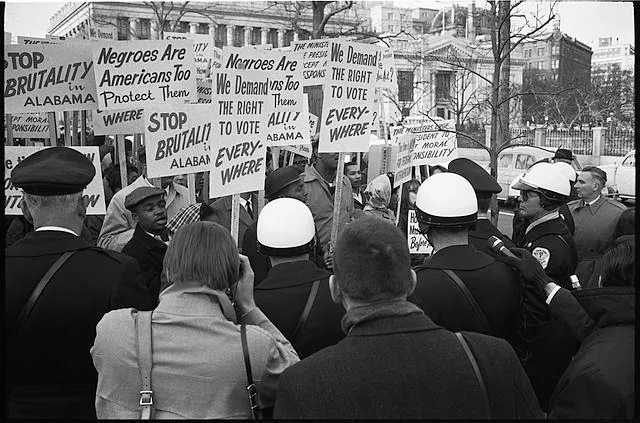
"[African American demonstrators outside the White House, with signs "We demand the right to vote, everywhere" and signs protesting police brutality against civil rights demonstrators in Selma, Alabama]" by Leffler, Warren K. / Library of Congress.
In the early years of the United States, the right to vote was closely tied to property ownership. Most states used property qualifications as a requirement for voting. This meant that only men who owned a certain amount of land or property could participate in elections. The idea behind this rule was that property owners were believed to have a greater stake in society and therefore, would make more responsible decisions. However, this system excluded many people, including poor men, people without land, free Black Americans, and all women.
The connection between property and voting rights created a narrow franchise, which is another word for the right to vote. State constitutions in the late 1700s and early 1800s often stated specific property or tax-paying requirements. For example, in Massachusetts, only men who owned at least fifty pounds' worth of property could vote. In Virginia, voting was limited to men who owned land. These rules reflected a belief in republicanism: the idea that a country should be governed by citizens who were independent and responsible, often defined by their economic status.
As American society changed, arguments against property requirements became more common. Critics said that linking political power to wealth was unfair and undemocratic. They believed that all white men, regardless of wealth, should have a voice in government. The push to expand the electorate—the group of people allowed to vote—grew stronger after the American Revolution. Some states, such as New Jersey, briefly allowed women and free Black men to vote, but most quickly reversed these changes.
By the 1820s and 1830s, a major shift began. States like New York and Pennsylvania eliminated property requirements for white men. This process is known as the expansion of suffrage. The number of eligible voters increased dramatically, leading to what historians call "Jacksonian democracy," named after President Andrew Jackson. Political leaders realized that more people wanted a say in government, and parties began to compete for these new voters. However, even as property limits were removed for white men, restrictions for women, Native Americans, and most Black Americans remained firmly in place.
The slow removal of property qualifications marked a turning point in American democracy. Voting rights were no longer just for the wealthy elite. Over time, the idea that voting should be a right for all citizens, not just property owners, became more widely accepted. This shift set the stage for later movements, such as abolition and women's suffrage, which continued to challenge the boundaries of who was included in American political life.
Interesting Fact: In some early elections, people voted out loud, not by secret ballot. This practice sometimes made it easier for powerful landowners to influence how others voted.
Who could vote in most early states?
Property-owning menAll menAll adultsOnly women
What is a 'franchise'?
Right to voteOwning a businessBecoming presidentA land grant
Which state let women and free Black men vote briefly?
New JerseyVirginiaMassachusettsNew York
Why were property qualifications used?
Belief in responsible votersTo encourage farmingTo support big citiesTo help merchants
What does 'expansion' of suffrage mean?
More people can voteLess votingFewer electionsMore taxes
How did Jacksonian democracy change voting?
Increased votersFewer votersNo votingWomen could vote
Early voting was always by secret ballot. True or false?
TrueFalse
What is 'republicanism'?
Citizens run the governmentOnly kings ruleNo voting allowedOne-party rule
Perfect For:
👩🏫 Teachers
• Reading comprehension practice
• Auto-graded assessments
• Literacy skill development
👨👩👧👦 Parents
• Reading practice at home
• Comprehension improvement
• Educational reading time
🏠 Homeschoolers
• Reading curriculum support
• Independent reading practice
• Progress monitoring
Reading Features:
📖
Reading Passage
Engaging fiction or nonfiction text
❓
Comprehension Quiz
Auto-graded questions
📊
Instant Feedback
Immediate results and scoring
📄
Printable Version
Download for offline reading
🔊
Read Aloud
Voice-over with word highlighting
Reviews & Ratings
No reviews yet. Be the first to share your experience!
Related Content
New Nation America
This history reading passage, 'New Nation America,' covers how the United States struggled to become a united country af...
HSS 5.6.1RI.4.2
The Cherokee Nation: History and Culture
This reading passage explores the rich history and culture of the Cherokee Nation, one of the largest Native American tr...
D2.HIS.2.3-5D2.HIS.14.3-5RI.4.3RI.4.4RI.4.10
New Orleans: An Important Port
This engaging U.S. history reading passage explores the crucial role of New Orleans and the Louisiana Purchase in shapin...
D2.HIS.3.3-5D2.HIS.14.3-5RI.4.3RI.4.4
American Indians and U.S. Citizenship
This reading passage explores the complex history of American Indians and U.S. citizenship, focusing on the period after...
Battle of New Orleans 1815
This passage explores the pivotal Battle of New Orleans in 1815, focusing on Andrew Jackson’s leadership and the complex...
D2.HIS.2.3-5D2.HIS.3.3-5RI.4.3RI.4.4
Hamilton vs Jefferson
This engaging U.S. history reading passage explores the contrasting visions of Alexander Hamilton and Thomas Jefferson, ...
National Bank Debate
This engaging U.S. history passage explores the National Bank Debate and the constitutional disagreement between Alexand...
D2.HIS.2.3-5D2.HIS.3.3-5RI.4.3RI.4.4
Leaders Call for a New Constitution
This reading passage explores the pivotal moment in U.S. history when American leaders recognized the weaknesses of the ...
Lewis and Clark Expedition
This comprehensive U.S. History reading passage explores the Lewis and Clark Expedition (1804-1806), a pivotal journey l...
HSS 8.4.18.8.2RI.6-8.1RI.6-8.3
The Iroquois Influence on the Constitution
This comprehensive U.S. history reading passage investigates the possible influence of the Iroquois Confederacy’s Great ...
James Madison Early Life
This passage explores the formative years of James Madison—his upbringing in Virginia, his education, and his early expe...
The Louisiana Purchase Deal of 1803
This engaging U.S. history reading passage explores the Louisiana Purchase of 1803, when the United States doubled in si...
D2.HIS.1.3-5D2.HIS.3.3-5RI.4.3RI.4.4
Star-Spangled Banner Origins
This passage explores the complex history of the Star-Spangled Banner, focusing on its origins during the War of 1812, t...
D2.HIS.2.3-5D2.HIS.3.3-5RI.4.3RI.4.4
Enslaved People Had No Citizenship Rights
This passage explores the realities faced by approximately four million enslaved people in the United States during the ...
Thomas Jefferson Biography
This engaging history reading passage provides a detailed look at Thomas Jefferson, one of America's most influential fo...
HSS 5.6.2RI.4.2
New Immigrants and New Jobs
This engaging reading passage explores the experiences of new immigrants and the rise of new jobs during the Progressive...
D2.HIS.2.3-5D2.HIS.3.3-5RI.4.3RI.4.4
George Washington First President
This passage explores how George Washington became the first President of the United States in 1789 and the crucial prec...
The First Political Parties Form
This engaging passage explores the formation of America's first political parties, highlighting the Federalists and Demo...
D2.HIS.1-4.3-5RI.4.3RI.4.4
James Monroe and the Monroe Doctrine
This engaging U.S. history reading passage introduces students to President James Monroe and the Monroe Doctrine, a key ...
D2.HIS.1-4.3-5RI.4.1RI.4.2RI.4.3
The Star-Spangled Banner and War
This reading passage explores the inspiring story of 'The Star-Spangled Banner' and its origins during the War of 1812. ...