Sustainability and Individual Action — Reading Comprehension
Rate this
Premium Resource
Present
Present in classroom. No work saved
Assign
Classroom with student accounts, Track progress
Quick Play
No student accounts, assign with a link
Grades
5
6
7
8
Standards
MS-ESS3-4
PRINT+DIGITAL RESOURCE
This learning resource is available in interactive and printable formats. The interactive worksheet can be played online and assigned to students. The Printable PDF version can be downloaded and printed for completion by hand.
This reading passage for grades 6-8 introduces the concept of sustainability, defined as meeting current needs without compromising the ability of future generations to meet theirs. Students will explore sustainable development and the balance between economic growth, environmental protection, and social well-being. The passage explains the idea of an ecological footprint and provides quantitative examples of resource use per person. It describes practical steps for individuals to reduce their impact—such as reducing, reusing, recycling, conserving energy, and making responsible food choices. The text also emphasizes the importance of collective action, including community involvement and citizen science, and highlights careers in sustainability. Designed to align with NGSS standard MS-ESS3-4, this passage encourages students to see themselves as empowered agents of change. Glossary, quiz, writing prompts, and graphic organizers are included. All materials are audio integrated for accessibility.
CONTENT PREVIEW
Expand content preview
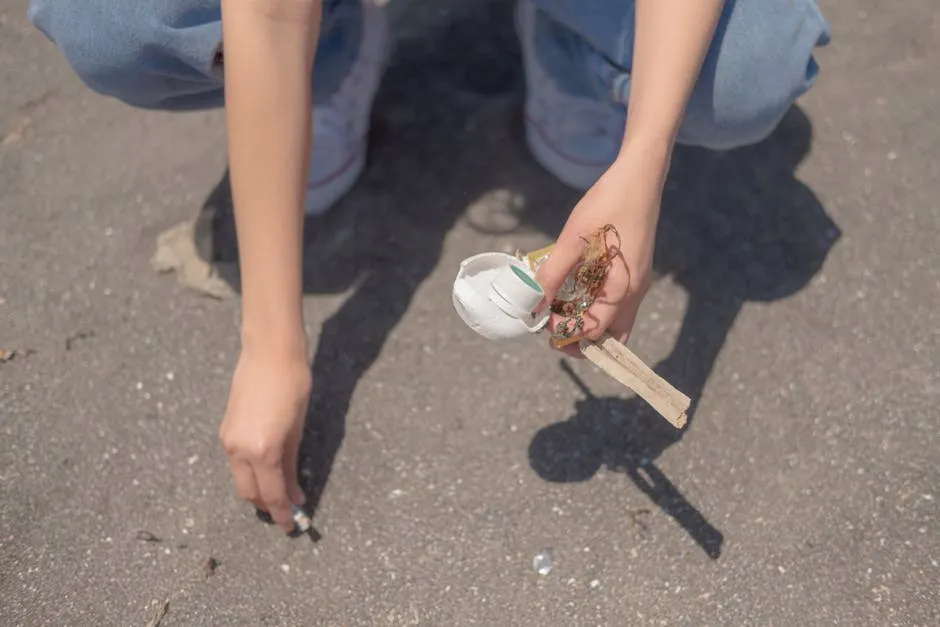
Person picking up trash on a sandy beach, promoting environmental care. Image by Los Muertos Crew / Pexels.
Sustainability is the scientific principle of meeting the needs of people today without reducing the ability of future generations to meet their own needs. This concept is crucial as the world’s population grows and the demand for natural resources increases. Many scientists are asking: how can we balance human development with the health of our planet? To answer this, researchers use data and scientific models to study the connections between resource use, the environment, and society.
Understanding Sustainability and Ecological Footprints One key idea in sustainability is sustainable development, which aims to balance economic growth, social well-being, and environmental health. Scientists use the term ecological footprint to measure how much land, water, and other resources a person or community uses. For example, the average ecological footprint in the United States is about 8 global hectares per person, while the world average is closer to 2.8. If everyone lived like Americans, we would need almost five planets’ worth of resources! This shows why it’s important to find ways to use resources more efficiently.
Reducing Our Impact: Individual and Collective Action Individuals can lower their ecological footprints by following the reduce, reuse, recycle principle. This means using less, finding new uses for items, and recycling materials. Energy conservation—such as turning off lights, using public transportation, or choosing renewable energy sources—also makes a big difference. Making sustainable food choices, like eating more plants and less meat, can reduce water and land use. When individuals act together through community cleanups, citizen science, or environmental advocacy, their impact grows even larger. For example, communities that set up recycling programs can reduce landfill waste by up to 30%.
Hope, Empowerment, and Careers in Sustainability Solving environmental challenges requires both scientific knowledge and social cooperation. There are many careers in sustainability, including environmental scientists, green engineers, and conservation officers. These professionals use evidence from research and fieldwork to create solutions that benefit people and the planet. Students can get involved through school projects, volunteering, or science-based clubs. By understanding cause-and-effect relationships, young people can help lead change and inspire others.
Sustainability is not just a scientific goal; it’s a shared responsibility. When people work together and make informed choices, they help ensure a healthy, fair, and thriving world for the future.
Interesting Fact: If every household in the United States replaced just one light bulb with an energy-saving LED, it would prevent greenhouse gas emissions equal to taking 800,000 cars off the road each year!
What is the main idea of sustainability as described in the passage?
Meeting current needs without harming the ability of future generations to meet theirs.Using as many resources as possible for economic growth.Focusing only on the needs of plants and animals.Developing new technology for entertainment only.
What does the term 'ecological footprint' measure?
The number of animals in a habitat.How much land and resources a person or community uses.The depth of oceans.The speed of population growth.
According to the passage, what can communities achieve by setting up recycling programs?
Increase landfill waste by 30%.Reduce landfill waste by up to 30%.Stop all pollution immediately.Grow more plants automatically.
Which of the following is NOT a way to reduce your ecological footprint according to the passage?
Eating more plants and less meat.Turning off lights to save energy.Using renewable energy sources.Using more single-use plastics.
What is an example of collective action mentioned in the passage?
Community cleanups.Watching TV.Shopping online.Ignoring waste.
In context, what does 'reduce, reuse, recycle' mean?
Buying new things every week.Throwing away everything you use.Using less, reusing items, and recycling materials.Saving only money.
What is a career in sustainability as described in the passage?
Why do scientists use models and data to study sustainability?
To guess randomly about the future.To understand the connections between resource use, environment, and society.To teach only in universities.To create more pollution.
True or False: If everyone lived like Americans, we would need almost five Earths’ worth of resources.
TrueFalse
True or False: Energy conservation has no effect on greenhouse gas emissions.
TrueFalse
Perfect For:
👩🏫 Teachers
• Reading comprehension practice
• Auto-graded assessments
• Literacy skill development
👨👩👧👦 Parents
• Reading practice at home
• Comprehension improvement
• Educational reading time
🏠 Homeschoolers
• Reading curriculum support
• Independent reading practice
• Progress monitoring
Reading Features:
📖
Reading Passage
Engaging fiction or nonfiction text
❓
Comprehension Quiz
Auto-graded questions
📊
Instant Feedback
Immediate results and scoring
📄
Printable Version
Download for offline reading
🔊
Read Aloud
Voice-over with word highlighting
Reviews & Ratings
No reviews yet. Be the first to share your experience!
Related Content
Natural Disaster: Tornadoes
Tornadoes are dangerous spinning columns of air. Knowing the signs and having safety plans can help protect you from the...
RI.3.1RI.4.4RI.4.2RI.5.2
Conservation Strategies
This comprehensive passage introduces students in grades 6-8 to the major strategies used in conservation biology, such ...
MS-LS2-5MS-ESS3-4
Environmental Problems and Solutions
This passage for grades 6-8 introduces major environmental problems such as habitat loss, pollution, climate change, inv...
MS-LS2-4MS-ESS3-3MS-ESS3-4
Restoration Ecology
This passage introduces middle school students to the vital field of restoration ecology, aligning with NGSS standards M...
MS-LS2-4MS-ESS3-4
Climate Change: Solutions and Mitigation
This passage explores scientific solutions and mitigation strategies for climate change, designed for middle school scie...
MS-ESS3-4MS-ESS3-5
Renewable vs. Nonrenewable Energy
This engaging passage, aligned with NGSS standards MS-PS3-4, MS-ESS3-3, and MS-ESS3-4, helps middle school students diff...
MS-PS3-4MS-ESS3-3MS-ESS3-4
Fossil Fuels: Coal
This middle school science reading passage explores the science behind coal, a major fossil fuel. Students will learn ho...
MS-PS3-4MS-ESS3-3MS-ESS3-4
Solar Energy
This engaging passage for grades 6-8 explores the science of solar energy, focusing on how sunlight is converted into el...
MS-PS3-4MS-ESS3-3MS-ESS3-4
Wind Energy
This comprehensive middle school science passage explores the scientific principles behind wind energy and how wind turb...
MS-PS3-4MS-ESS3-3MS-ESS3-4
Hydroelectric Energy
This comprehensive passage introduces middle school students to the science behind hydroelectric energy, directly aligni...
MS-PS3-4MS-ESS3-3MS-ESS3-4
Soil Conservation
This passage for grades 6-8 explains soil conservation, aligning with NGSS standard MS-ESS3-4. Students will learn about...
MS-ESS3-4
Minerals and Rocks as Resources
This middle school science passage, aligned to NGSS standards MS-ESS3-1 and MS-ESS3-4, explores the critical role that m...
MS-ESS3-1MS-ESS3-4
Galápagos Islands
This engaging science passage explores the Galápagos Islands, a volcanic archipelago located off the coast of Ecuador in...
MS-LS2-1MS-LS4-4MS-ESS3-4
Geothermal Energy
This comprehensive science passage introduces middle school students to the mechanisms and applications of geothermal en...
MS-PS3-4MS-ESS3-3MS-ESS3-4
Biomass and Biofuels
This NGSS-aligned passage introduces grades 6-8 students to the science of biomass and biofuels, explaining how organic ...
MS-PS3-4MS-ESS3-3MS-ESS3-4
Nuclear Energy as a Resource
This NGSS-aligned informational science passage, designed for grades 6-8, explores nuclear energy as a resource in the c...
MS-PS3-4MS-ESS3-3MS-ESS3-4
Water as a Resource
This middle school science passage examines water as a critical resource, focusing on how it is used, managed, and conse...
MS-ESS3-1MS-ESS3-4
Florida Everglades
This comprehensive passage introduces middle school students to the Florida Everglades, a distinctive wetland ecosystem ...
MS-LS2-1MS-LS2-4MS-ESS3-3MS-ESS3-4
Nuclear Safety and Waste
This middle school science passage explores the critical topic of nuclear safety and waste management, aligned with NGSS...