This learning resource is available in interactive and printable formats. The interactive worksheet can be played online and assigned to students. The Printable PDF version can be downloaded and printed for completion by hand.
This passage for grades 6-8 explains soil conservation, aligning with NGSS standard MS-ESS3-4. Students will learn about the mechanisms and importance of protecting soil, including the dangers of erosion, loss of topsoil, and decreasing soil fertility. The text covers causes such as deforestation, overgrazing, and poor farming practices, with a focus on scientific solutions like contour plowing, terracing, windbreaks, and crop rotation. Students explore systems thinking, cause and effect, and real-world applications, such as food security and ecosystem health. The passage is supported by a glossary, quiz, writing activities, graphic organizers, and full Spanish translations, and is audio integrated to support diverse learners. This resource helps develop scientific literacy and environmental responsibility.
CONTENT PREVIEW
Expand content preview
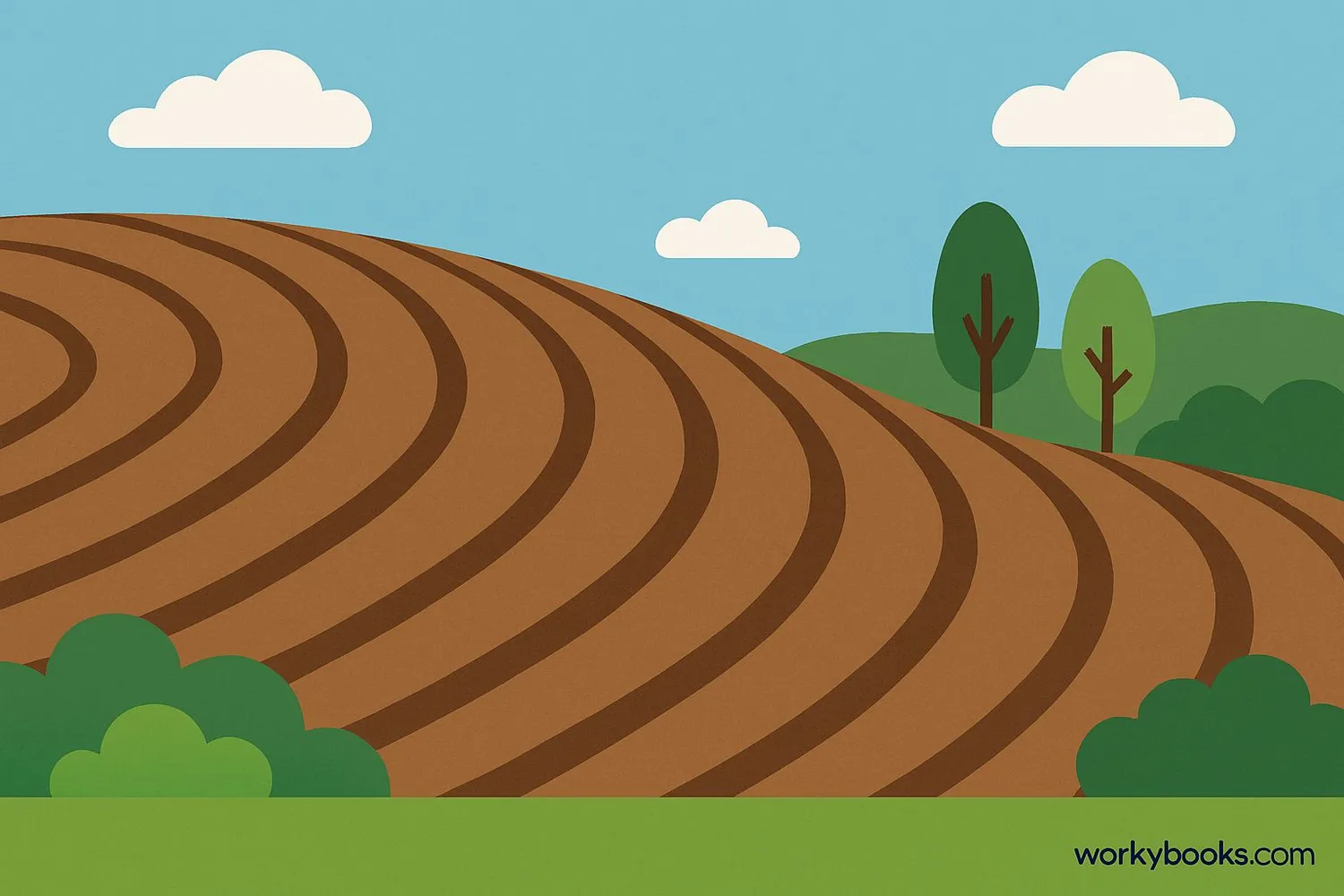
Illustration showing contour plowing on a hillside
Soil is the thin layer of material covering Earth's land surface, and it is vital for growing food, supporting plants, and maintaining healthy ecosystems. Each year, millions of tons of soil are lost due to erosion, where wind or water removes topsoil faster than it can be replaced. The loss of topsoil threatens food production and causes damage to rivers and lakes. Understanding the causes and solutions to soil degradation is essential for protecting our environment and ensuring food security for future generations.
Mechanisms of Soil Degradation
Soil forms slowly, taking hundreds to thousands of years to develop just a few centimeters of fertile topsoil. However, soil can be lost in a single storm if it is not protected. Major causes of soil degradation include deforestation, overgrazing by livestock, poor agricultural practices, construction activities, and the effects of climate change. When trees and plants are removed, soil becomes exposed to rain and wind, increasing erosion rates. For example, after forests are cleared, erosion can remove up to 50 tons of soil per hectare per year, compared to less than 1 ton in healthy forests. Eroded soil often ends up in waterways, where it causes sedimentation that harms aquatic life and reduces water quality.
Conservation Practices and Their Impact
Scientists and farmers have developed soil conservation practices to reduce erosion and maintain soil fertility. Contour plowing involves plowing fields along lines of equal elevation to slow water runoff. Terracing changes steep hillsides into a series of level steps, which greatly reduces soil loss. Strip cropping alternates rows of different crops to break up wind and water flow. Windbreaks, such as rows of trees, protect fields from wind erosion. Planting cover crops between main crops helps hold soil in place and adds nutrients. No-till farming reduces soil disturbance, while crop rotation keeps soil healthy by varying plant types. In the U.S., using these methods together has reduced soil erosion rates by over 40% in the last 40 years.
Why Soil Conservation Matters
Soil conservation is critical not just for farmers, but for everyone. Healthy soil provides more than food—it filters water, stores carbon, and supports biodiversity. When soil degrades, ecosystems lose their balance, and food production becomes less reliable. By understanding and applying soil conservation techniques, we help protect Earth's resources and ensure future generations have enough food and clean water. These practices demonstrate how scientific knowledge, when combined with responsible action, can solve real-world environmental problems.
Interesting Fact: It can take nature more than 500 years to form just one inch of topsoil, but that inch can be eroded away in only a single heavy rainstorm if the soil is not protected.
What is the main reason soil conservation is important?
To protect soil for food production and ecosystem healthTo make soil look cleanerTo build more housesTo increase the amount of rain
Which process removes soil faster than it can be replaced?
PhotosynthesisErosionCondensationTranspiration
What does contour plowing do?
Plows along the land's elevation lines to slow water runoffPlows in straight up-and-down linesPlants trees in rowsRemoves all crops from a field
What is one effect of deforestation mentioned in the passage?
Increases soil erosion ratesCreates more topsoil quicklyMakes rivers cleanerImproves air quality
What does the word 'topsoil' mean as used in the passage?
The lowest layer of the groundThe uppermost, fertile layer of soilA type of rockThe water found in soil
In the passage, what does 'windbreaks' refer to?
Rows of trees that protect soil from windBarriers to stop rainMachines for plowingTypes of crops
Why does soil erosion threaten food production?
Because it removes the fertile layer needed for cropsBecause it adds more nutrients to riversBecause it makes soil wetterBecause it grows new plants automatically
How have conservation practices affected soil erosion rates in the U.S.?
Reduced erosion by over 40% in 40 yearsIncreased erosion by 50%Had no effectStopped all erosion completely
True or False: Soil can be lost in a single storm if not protected.
TrueFalse
True or False: Planting cover crops helps prevent soil erosion.
TrueFalse
Perfect For:
👩🏫 Teachers
• Reading comprehension practice
• Auto-graded assessments
• Literacy skill development
👨👩👧👦 Parents
• Reading practice at home
• Comprehension improvement
• Educational reading time
🏠 Homeschoolers
• Reading curriculum support
• Independent reading practice
• Progress monitoring
Reading Features:
📖
Reading Passage
Engaging fiction or nonfiction text
❓
Comprehension Quiz
Auto-graded questions
📊
Instant Feedback
Immediate results and scoring
📄
Printable Version
Download for offline reading
🔊
Read Aloud
Voice-over with word highlighting
Reviews & Ratings
No reviews yet. Be the first to share your experience!
Related Content
Natural Disaster: Tornadoes
Tornadoes are dangerous spinning columns of air. Knowing the signs and having safety plans can help protect you from the...
RI.3.1RI.4.4RI.4.2RI.5.2
Conservation Strategies
This comprehensive passage introduces students in grades 6-8 to the major strategies used in conservation biology, such ...
MS-LS2-5MS-ESS3-4
Environmental Problems and Solutions
This passage for grades 6-8 introduces major environmental problems such as habitat loss, pollution, climate change, inv...
MS-LS2-4MS-ESS3-3MS-ESS3-4
Sustainability and Individual Action
This reading passage for grades 6-8 introduces the concept of sustainability, defined as meeting current needs without c...
MS-ESS3-4
Restoration Ecology
This passage introduces middle school students to the vital field of restoration ecology, aligning with NGSS standards M...
MS-LS2-4MS-ESS3-4
Climate Change: Solutions and Mitigation
This passage explores scientific solutions and mitigation strategies for climate change, designed for middle school scie...
MS-ESS3-4MS-ESS3-5
Renewable vs. Nonrenewable Energy
This engaging passage, aligned with NGSS standards MS-PS3-4, MS-ESS3-3, and MS-ESS3-4, helps middle school students diff...
MS-PS3-4MS-ESS3-3MS-ESS3-4
Fossil Fuels: Coal
This middle school science reading passage explores the science behind coal, a major fossil fuel. Students will learn ho...
MS-PS3-4MS-ESS3-3MS-ESS3-4
Solar Energy
This engaging passage for grades 6-8 explores the science of solar energy, focusing on how sunlight is converted into el...
MS-PS3-4MS-ESS3-3MS-ESS3-4
Wind Energy
This comprehensive middle school science passage explores the scientific principles behind wind energy and how wind turb...
MS-PS3-4MS-ESS3-3MS-ESS3-4
Hydroelectric Energy
This comprehensive passage introduces middle school students to the science behind hydroelectric energy, directly aligni...
MS-PS3-4MS-ESS3-3MS-ESS3-4
Minerals and Rocks as Resources
This middle school science passage, aligned to NGSS standards MS-ESS3-1 and MS-ESS3-4, explores the critical role that m...
MS-ESS3-1MS-ESS3-4
Galápagos Islands
This engaging science passage explores the Galápagos Islands, a volcanic archipelago located off the coast of Ecuador in...
MS-LS2-1MS-LS4-4MS-ESS3-4
Geothermal Energy
This comprehensive science passage introduces middle school students to the mechanisms and applications of geothermal en...
MS-PS3-4MS-ESS3-3MS-ESS3-4
Biomass and Biofuels
This NGSS-aligned passage introduces grades 6-8 students to the science of biomass and biofuels, explaining how organic ...
MS-PS3-4MS-ESS3-3MS-ESS3-4
Nuclear Energy as a Resource
This NGSS-aligned informational science passage, designed for grades 6-8, explores nuclear energy as a resource in the c...
MS-PS3-4MS-ESS3-3MS-ESS3-4
Water as a Resource
This middle school science passage examines water as a critical resource, focusing on how it is used, managed, and conse...
MS-ESS3-1MS-ESS3-4
Florida Everglades
This comprehensive passage introduces middle school students to the Florida Everglades, a distinctive wetland ecosystem ...
MS-LS2-1MS-LS2-4MS-ESS3-3MS-ESS3-4
Nuclear Safety and Waste
This middle school science passage explores the critical topic of nuclear safety and waste management, aligned with NGSS...