Reading Passage

Virgin of Guadalupe

Interactive passage with audio narration, comprehension questions, and printable PDF.

No ratings yet
Grades 5–8ReadingElaSocial-studiesHistoryEnglish · SpanishInteractive · Printable

What's included

Reading passage
Audio narration
Comprehension quiz
Writing activity
Glossary & flashcards
Differentiated version
Spanish translation

Virgin of Guadalupe preview and details

About this printable Virgin of Guadalupe reading passage (Grades 5-8)

This passage explores the historical and cultural significance of the Virgin of Guadalupe during the rise of European colonialism in the Americas. Students will analyze how Spanish colonialism and indigenous traditions blended through the story of the Virgin of Guadalupe, focusing on primary sources and archaeological evidence. The text highlights cause-and-effect relationships, change over time, social hierarchy, and the human impact of religious syncretism in Colonial America. Activities include a reading passage, glossary, comprehension questions, writing prompts, graphic organizers, and a timeline. A Spanish translation and read aloud audio are also provided. The resource aligns with CA HSS 5.2 and CCSS RI.6-8 standards, promoting historical thinking and literacy skills.
Written by Workybooks TeamPublished by Workybooks
Preview

Sample passage and quiz from Virgin of Guadalupe

Reading passage and comprehension quiz preview

The Virgin of Guadalupe: Blending Traditions
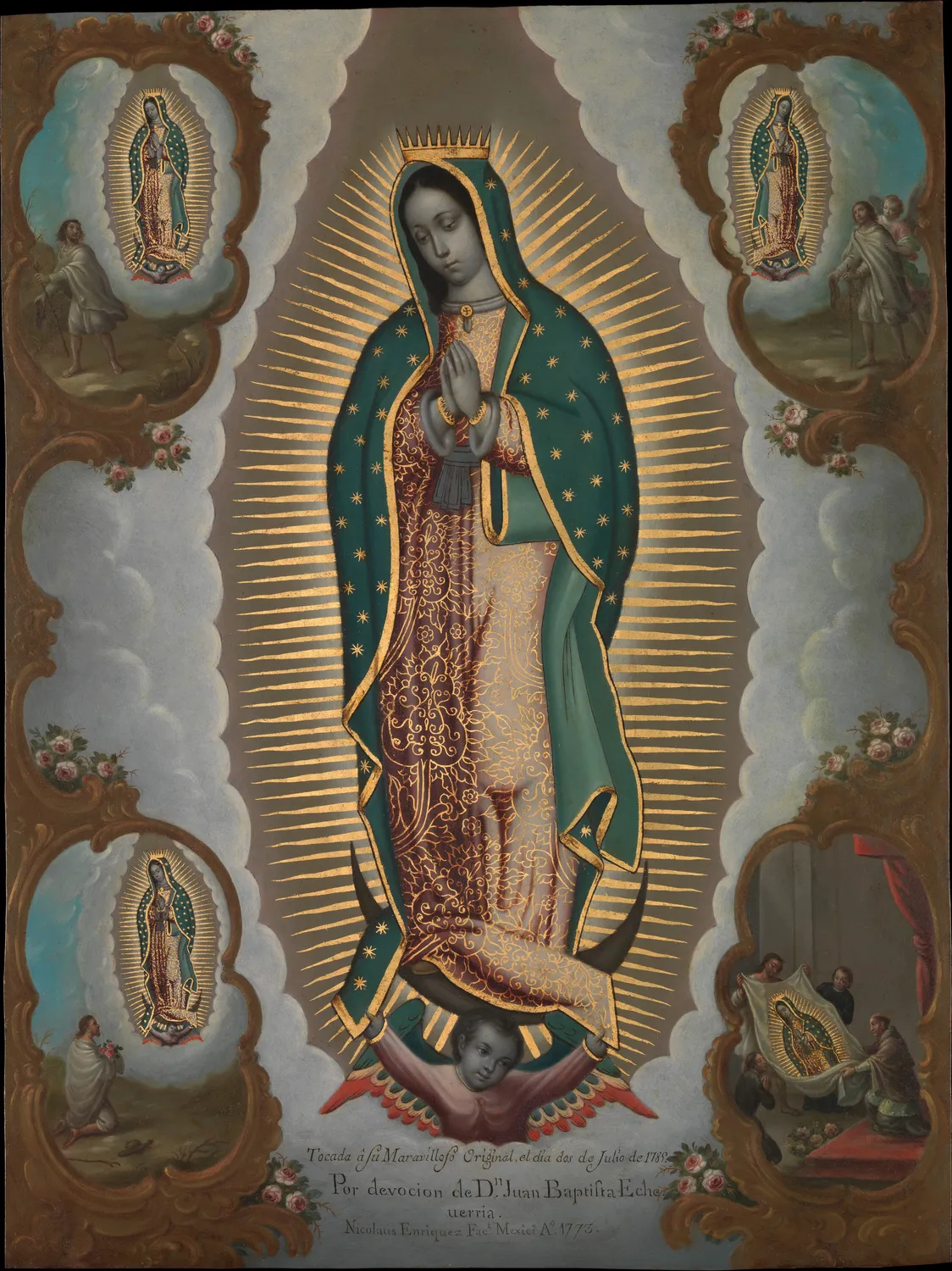
The Virgin of Guadalupe with the Four Apparitions MET DP356939

"The Virgin of Guadalupe with the Four Apparitions MET DP356939" by Nicolás Enríquez
Source: Wikimedia Commons (CC0).

The appearance of the Virgin of Guadalupe in 1531 became a powerful symbol of cultural blending in Colonial America. This event, which took place near present-day Mexico City, represents how Spanish and indigenous traditions merged during the early years of European colonization in the Americas.

According to Catholic sources, a man named Juan Diego, who was an indigenous Nahua, reported seeing a vision of the Virgin Mary on the hill of Tepeyac. The Virgin spoke to him in his native Nahuatl language and asked for a church to be built on the site. Juan Diego told the Spanish bishop, Juan de Zumárraga, who demanded proof. The Virgin instructed Juan Diego to gather roses in his cloak, or tilma. When he presented the roses to the bishop, an image of the Virgin miraculously appeared on the tilma. This event, recorded in documents like the Nican Mopohua, became central to Mexican Catholic identity.

The story of the Virgin of Guadalupe is an example of syncretism, where religious beliefs from different cultures blend into new traditions. Spanish colonizers brought Catholicism to the Americas, but indigenous peoples had their own beliefs and sacred sites, including the hill of Tepeyac, which was previously dedicated to the Aztec goddess Tonantzin. The Virgin’s appearance at this location helped both groups accept and adapt to new religious ideas. Archaeological evidence, such as pre-Hispanic remains near Tepeyac and early colonial churches built over indigenous temples, supports this blending of traditions.

The Virgin of Guadalupe became an important symbol for both Spaniards and indigenous peoples. For the Spanish, she represented the spread of Catholic faith. For indigenous communities, she offered a familiar figure who understood their language and culture. Over time, devotion to the Virgin of Guadalupe spread across New Spain and into what is now the southwestern United States. She played a role in uniting people of different backgrounds and social hierarchies, providing hope and identity in a changing society. Primary sources, such as the Codex Escalada and colonial paintings, show her growing influence.

The blending of traditions in the story of the Virgin of Guadalupe shows how colonialism affected daily life, religion, and cultural identity in the Americas. This fusion of beliefs continues to shape Mexican and American culture today, reminding us that history is often a mix of different perspectives and experiences.

The story of the Virgin of Guadalupe connects to broader themes in world history, such as cultural exchange, adaptation, and the impact of colonization.

Interesting Fact: The Basilica of Our Lady of Guadalupe in Mexico City is one of the most visited religious sites in the world, attracting millions of pilgrims each year.

Comprehension quiz (8 questions)

1. Where did Juan Diego see the Virgin?

Tepeyac hill
Tenochtitlan
Spain
Puebla

2. What year did the Virgin appear?

1531
1492
1620
1776

3. Who asked for proof from Juan Diego?

Bishop Zumárraga
Aztec priests
Spanish king
Juan Diego's family

4. What is syncretism?

Mixing different cultures
Building new cities
Fighting a battle
Making laws

5. Why is Tepeyac hill important?

Sacred to Aztecs and Catholics
It is a volcano
It is in Spain
It has gold mines

6. How did the Virgin speak to Juan Diego?

In Nahuatl
In Spanish
In English
With pictures

7. The Virgin of Guadalupe is a symbol of syncretism. True or false?

True
False

8. What does 'indigenous' mean?

Original inhabitants
Spanish settlers
Priests
Colonies
Who it's for

Perfect for the way you teach

Teachers
  • Build comprehension skills
  • Auto-graded quiz
  • Differentiated reading
Parents
  • Read together at home
  • Improve fluency
  • Quiet reading time
Homeschoolers
  • Reading curriculum support
  • Independent practice
  • Track Lexile growth
Topics

Reviews & Ratings

No reviews yet. Be the first to share your experience!

More reading you might love

20 more
Passage
Great Awakening Colonial America - reading educational content

Great Awakening Colonial America

Reading Passage

$1.50
Passage
Quakers in Colonial America - reading educational content

Quakers in Colonial America

Reading Passage · D2.HIS.2.3-5

$1.50
Passage
Indentured Servants in Colonial America  - reading educational content

Indentured Servants in Colonial America

Reading Passage · D2.HIS.2.3-5

$1.50
Passage
Cities in Colonial America - reading educational content

Cities in Colonial America

Reading Passage · HSS 5.4.6

$1.50
Passage
Why Europeans Immigrated to Colonial America - reading educational content

Why Europeans Immigrated to Colonial America

Reading Passage · D2.HIS.2.3-5

$1.50
Passage
Colonial Social Classes - reading educational content

Colonial Social Classes

Reading Passage · D2.HIS.2.3-5

$1.50
Passage
Colonial Slave Resistance - reading educational content

Colonial Slave Resistance

Reading Passage · D2.HIS.2.3-5

$1.50
Passage
Benjamin Franklin in Colonial America - reading educational content

Benjamin Franklin in Colonial America

Reading Passage · HSS 5.5

$1.50
Passage
How the Middle Colonies Were Governed - reading educational content

How the Middle Colonies Were Governed

Reading Passage · D2.HIS.2.3-5

$1.50
Passage
Life in the Southern Colonies - reading educational content

Life in the Southern Colonies

Reading Passage · D2.HIS.4.3-5

$1.50
Passage
Colonial Printing Press - reading educational content

Colonial Printing Press

Reading Passage · HSS 5.5

$1.50
Passage
Frontier Life in Colonial America - reading educational content

Frontier Life in Colonial America

Reading Passage · HSS 5.4.6

$1.50
Passage
Colonial Jobs: Blacksmiths, Bakers, and Craftsmen - reading educational content

Colonial Jobs: Blacksmiths, Bakers, and Craftsmen

Reading Passage · D2.HIS.2.3-5

$1.50
Passage
Colonial Apprenticeship System  - reading educational content

Colonial Apprenticeship System

Reading Passage · HSS 5.4.6

$1.50
Passage
Native American Allies in Colonial Wars - reading educational content

Native American Allies in Colonial Wars

Reading Passage · D2.HIS.2.3-5

$1.50
Passage
Colonial Clothing and Homemade Goods - reading educational content

Colonial Clothing and Homemade Goods

Reading Passage · D2.HIS.2.3-5

$1.50
Passage
Colonial Labor Shortage - reading educational content

Colonial Labor Shortage

Reading Passage · CA HSS 8.1.2

$1.50
Passage
Colonial Women's Lives - reading educational content

Colonial Women's Lives

Reading Passage · D2.HIS.2.3-5

$1.50
Passage
African Diaspora in the Americas - reading educational content

African Diaspora in the Americas

Reading Passage · HSS 8.7

$1.50
Passage
Colonial Games and Entertainment - reading educational content

Colonial Games and Entertainment

Reading Passage · D2.HIS.1.3-5

$1.50
Copyright © 2026 Workybooks. Made with ♥ in California.