Sound Through Different Materials
Interactive passage with audio narration, comprehension questions, and printable PDF.
By completing this purchase you agree to our Terms of Use and Privacy Policy. Your subscription renews automatically until you cancel. You can cancel anytime from your account settings. All sales are final and non-refundable. Digital content is available for download in your account immediately upon purchase.
What's included
Sound Through Different Materials preview and details
About this printable Sound Through Different Materials science reading passage, NGSS-aligned (Grades 5-8)
Sample passage and quiz from Sound Through Different Materials
Reading passage and comprehension quiz preview
Sound Through Different Materials
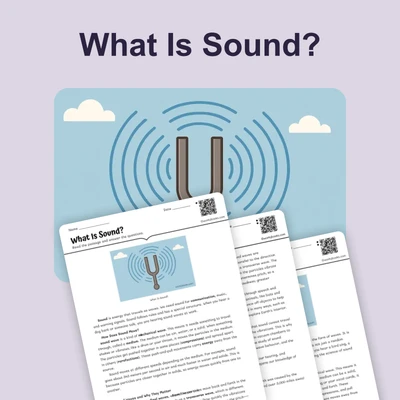
Sound is a form of energy that moves in waves through different materials, such as air, water, and solids. The speed and clarity of sound depend on the properties of the material it travels through. For example, a person on one side of a wall may not hear someone on the other side as clearly as if there were no wall. This happens because the wall changes how the sound waves move. Understanding how sound travels helps explain many real-world phenomena, from why underwater noises sound different to why train tracks can carry vibrations long distances.
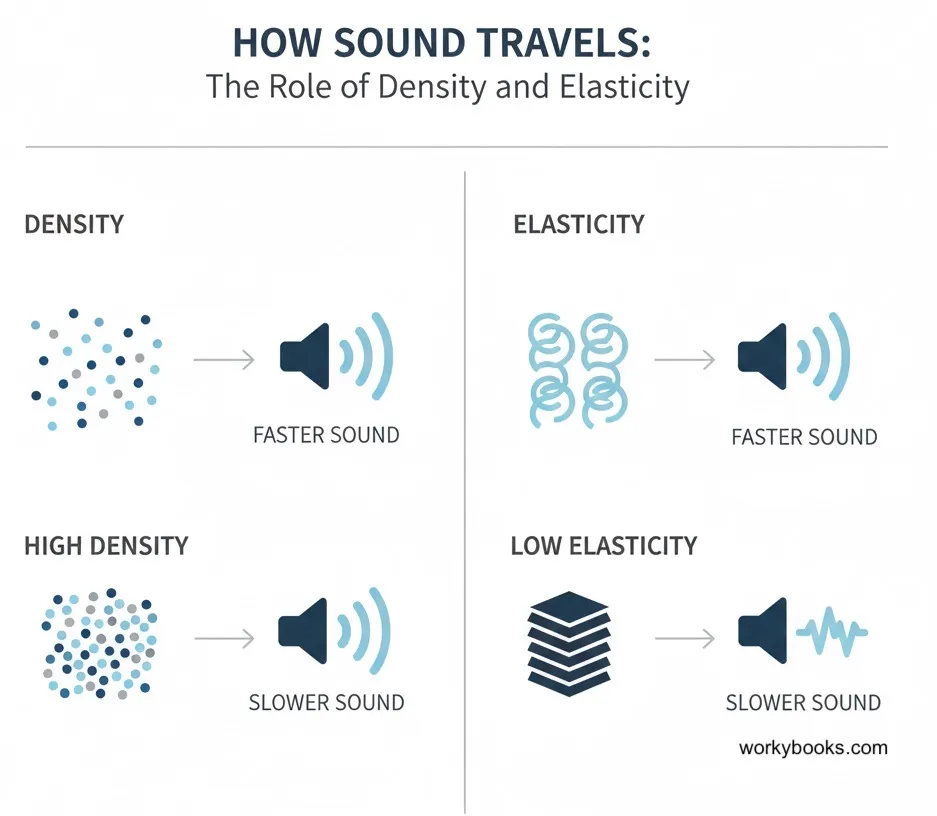
How Sound Travels: The Role of Density and Elasticity
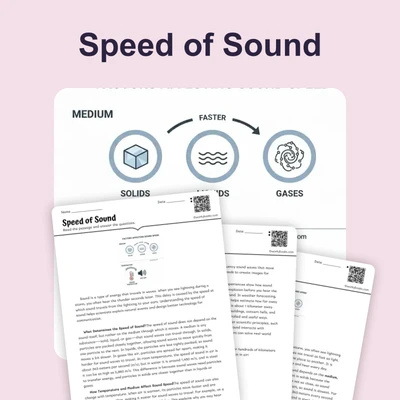
Sound waves are vibrations that move through a medium by causing its particles to bump into each other. Two key factors affect how well sound moves: particle density and elasticity. Materials with higher particle density, like steel, have particles packed closely together, allowing sound waves to transfer energy quickly from one particle to the next. Elasticity is the ability of a material to return to its original shape after being disturbed. Highly elastic materials, such as steel or glass, also transmit sound efficiently. In contrast, air has a much lower particle density and less elasticity, so sound moves more slowly and can lose energy quickly. This is why sound travels about 343 meters per second in air, but much faster in water (about 1,480 m/s) and even faster in steel (about 5,960 m/s).
Examples and Applications: Hearing Through Walls, Water, and More
The effect of material properties on sound transmission is easy to observe. When you put your ear against a wooden table or a steel rail, you hear sounds more clearly and sooner than through air. This is because wood and steel have higher particle density and elasticity than air. Underwater, people notice that voices sound distorted, but sound itself travels further and is heard more quickly. Similarly, train tracks made of steel can carry the vibration of an oncoming train for kilometers. This is why, before modern technology, people sometimes placed their ear on the rails to detect approaching trains. Glass is also an efficient sound transmitter, which is why tapping on a glass window can be heard easily on the other side.
Broader Implications: Technology, Safety, and Nature
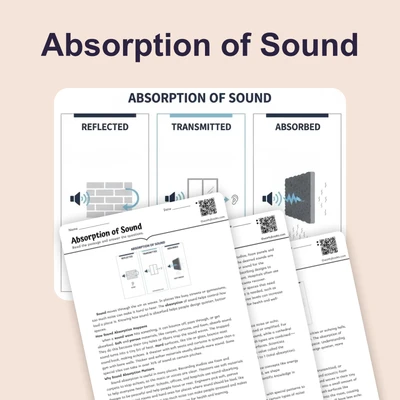
Understanding how sound travels through materials has led to important technological advances. Engineers use this knowledge to design soundproof rooms by choosing materials that absorb or reflect sound waves. Marine biologists rely on sound transmission in water to study whales and dolphins, whose calls travel great distances underwater. Even in nature, animals have evolved to use different materials to help transmit or block sound. For example, burrowing animals may use the ground to detect predators or communicate. The principles of sound transmission also connect to broader scientific ideas about waves, energy transfer, and the structure of matter.
Learning how sound travels through different materials helps us understand everything from musical instruments to earthquake warning systems. It shows how the invisible properties of matter shape the world we experience every day.
Interesting Fact: Sound travels over 17 times faster in steel than in air, which is why you can sometimes hear a distant train coming through the rails long before you hear it in the open air.
Comprehension quiz (10 questions)
1. What two main properties of a material affect how sound travels through it?
2. Why does sound travel faster in steel than in air?
3. According to the passage, what is the approximate speed of sound in air?
4. Which material transmits sound most efficiently based on the passage?
5. What does the word 'medium' mean in the context of this passage?
6. In the passage, what does 'elasticity' refer to?
7. Why do people sometimes put their ear to train tracks?
8. How does understanding sound transmission help engineers?
9. True or False: Sound travels slower in water than in air.
10. True or False: The structure of matter does not affect how sound travels.
Perfect for the way you teach
- Build comprehension skills
- Auto-graded quiz
- Differentiated reading
- Read together at home
- Improve fluency
- Quiet reading time
- Reading curriculum support
- Independent practice
- Track Lexile growth