Absorption of Sound
Interactive passage with audio narration, comprehension questions, and printable PDF.
By completing this purchase you agree to our Terms of Use and Privacy Policy. Your subscription renews automatically until you cancel. You can cancel anytime from your account settings. All sales are final and non-refundable. Digital content is available for download in your account immediately upon purchase.
What's included
Absorption of Sound preview and details
About this printable Absorption of Sound science reading passage, NGSS-aligned (Grades 5-8)
Sample passage and quiz from Absorption of Sound
Reading passage and comprehension quiz preview
Absorption of Sound
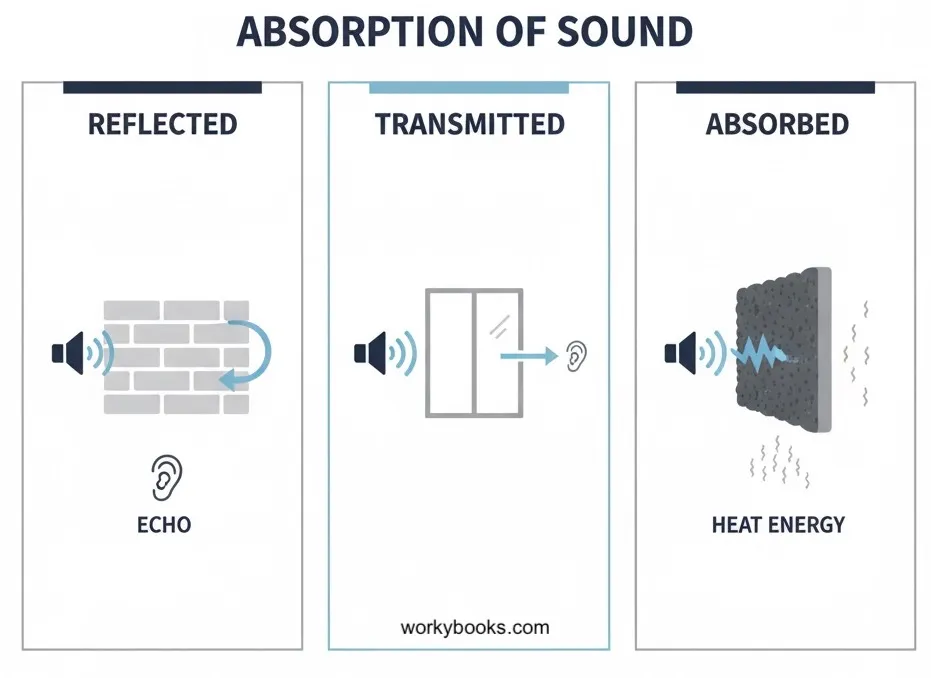
Sound travels through the air as waves of energy. In busy cities or echoing halls, controlling sound is important for comfort and communication. The absorption of sound by materials determines how much noise remains in a space. Understanding how materials absorb sound helps scientists and engineers design quieter, more effective environments.
How Absorption of Sound Works
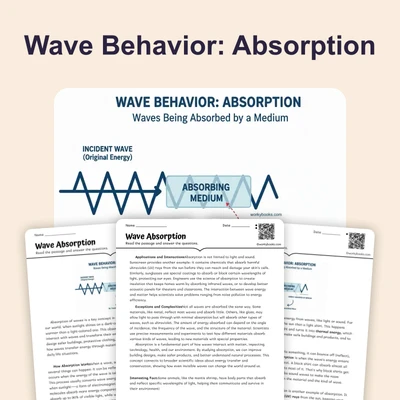
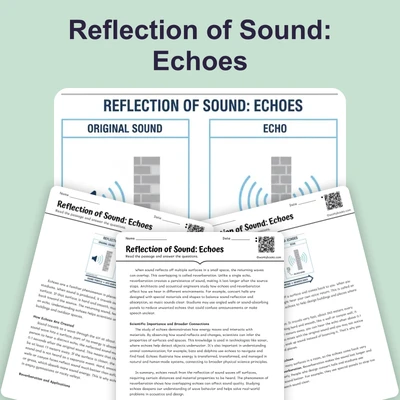
When a sound wave meets a surface, it can be reflected, transmitted, or absorbed. Soft, porous materials, such as carpets, curtains, and acoustic foam panels, absorb sound energy. They do this by trapping the sound waves in their tiny holes or fibers. The energy from the sound wave is converted into a small amount of heat as it moves through the material. In contrast, hard, smooth surfaces like concrete, glass, or tile reflect most of the sound waves back into the room, causing echoes. For example, a theater with many soft seats and curtains will have less echo than an empty gymnasium with bare walls and floors. The ability of a material to absorb sound depends on its thickness, density, and structure. Some acoustic tiles can absorb over 70% of incoming sound energy at certain frequencies.
Applications and Importance
Sound absorption has many practical uses. In recording studios, foam panels and carpets are used to prevent unwanted echoes, so that only the desired sounds are recorded. In theaters, absorptive materials help create clear sound for the audience by reducing reverberation. Architects use sound-absorbing designs to make classrooms, offices, and homes quieter and more pleasant. Hospitals often use acoustic ceiling tiles to lower noise levels, which can help patients recover. Comparing materials, engineers select soft, porous options for spaces that need quiet, and hard, reflective ones where loudness or resonance is needed, such as concert halls. Research shows that environments with high noise levels can increase stress and reduce learning, making sound absorption crucial for health and well-being.
Comparing Absorptive and Reflective Materials
Absorptive materials are chosen when the goal is to reduce noise or echo. Reflective materials are used when sound needs to be projected or amplified. For example, a library uses carpet and soft furniture to absorb sound, while a cathedral uses stone walls to enhance echoes for music. Sometimes, both types are combined—such as in a classroom with acoustic panels and some hard surfaces. Scientists measure how much sound is absorbed or reflected by using a value called the absorption coefficient, which ranges from 0 (total reflection) to 1 (total absorption).
Understanding sound absorption connects to larger science concepts like energy transfer and the properties of materials. By controlling sound, we shape environments to meet our needs, illustrating the power of scientific knowledge in everyday life.
Interesting Fact: Some sound-absorbing foams are designed with special patterns to absorb specific frequencies, making them highly effective for certain types of noise!
Comprehension quiz (10 questions)
1. What happens to sound energy when it is absorbed by a material?
2. Which of the following is an example of a soft, porous material used for absorbing sound?
3. What does the absorption coefficient measure?
4. Why do recording studios use foam panels on their walls?
5. Based on the passage, which environment would likely have the most echo?
6. Which term best describes a material that bounces sound waves back into a room?
7. According to the passage, what is one effect of high noise levels in environments like schools?
8. If a library wants to keep noise low, what should it use more of?
9. True or False: Acoustic tiles are designed to increase the amount of echo in a room.
10. True or False: The main purpose of sound absorption is to make spaces quieter and reduce unwanted noise.
Perfect for the way you teach
- Build comprehension skills
- Auto-graded quiz
- Differentiated reading
- Read together at home
- Improve fluency
- Quiet reading time
- Reading curriculum support
- Independent practice
- Track Lexile growth