Reflection of Sound: Echoes — Reading Comprehension
Rate this
Premium Resource
Present
Present in classroom. No work saved
Assign
Classroom with student accounts, Track progress
Quick Play
No student accounts, assign with a link
Grades
5
6
7
8
Standards
MS-PS4-2
PRINT+DIGITAL RESOURCE
This learning resource is available in interactive and printable formats. The interactive worksheet can be played online and assigned to students. The Printable PDF version can be downloaded and printed for completion by hand.
This comprehensive middle school science passage explores the phenomenon of echoes, focusing on the reflection of sound and the mechanisms that cause echoes to occur. Aligned to NGSS standard MS-PS4-2, students learn how sound waves reflect off surfaces, the specific conditions required for an echo to be heard, and the difference between echoes and reverberation. The passage uses real-world examples such as canyons, empty rooms, and stadiums to illustrate these concepts. Applications in architecture and acoustics are discussed, showing how understanding echoes helps design better spaces for communication and music. The resource includes a glossary, differentiated and Spanish versions, as well as audio integration for accessibility. Additional activities such as quizzes, writing prompts, and graphic organizers help deepen understanding and encourage scientific thinking. This resource is perfect for engaging students in the study of sound, waves, and energy transfer.
CONTENT PREVIEW
Expand content preview
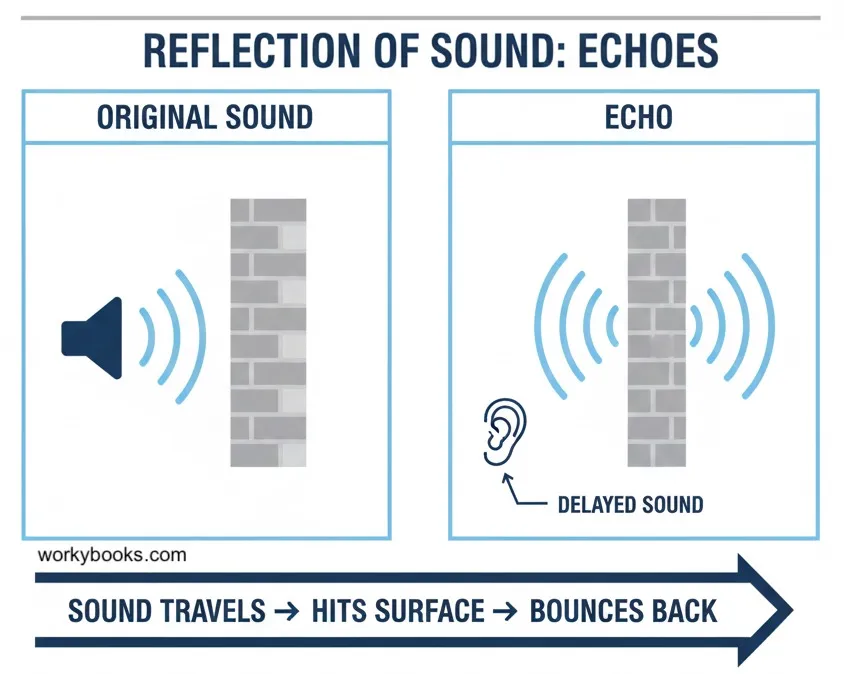
Echoes are a familiar phenomenon in places like canyons, empty rooms, and large stadiums. When sound is produced, it travels outward in waves until it encounters a surface. If that surface is hard and smooth, much of the sound energy is reflected back toward the source. The returning sound, heard after a short delay, is known as an echo. Understanding echoes helps scientists and engineers control sound in buildings and outdoor spaces.
How Echoes Are Created
Sound travels as a wave through the air at about 343 meters per second. When a sound wave hits a surface, part of its energy is absorbed and part is reflected. For a person to hear a distinct echo, the reflected sound must return to their ears at least 0.1 seconds after the original sound. This means that the reflecting surface needs to be at least 17 meters away. If the surface is closer, the echo blends with the original sound and is not heard as a separate event. Hard, smooth surfaces like concrete walls or canyon faces reflect sound much better than soft, uneven ones like curtains or grass, which absorb more sound energy. This is why echoes are often experienced in empty gymnasiums or rocky valleys.
Reverberation and Applications
When sound reflects off multiple surfaces in a small space, the returning waves can overlap. This overlapping is called reverberation. Unlike a single echo, reverberation creates a persistence of sound, making it last longer after the source stops. Architects and acoustical engineers study how echoes and reverberation affect how we hear in different environments. For example, concert halls are designed with special materials and shapes to balance sound reflection and absorption, so music sounds clear. Stadiums may use angled walls or sound-absorbing panels to reduce unwanted echoes that could confuse announcements or make speech unclear.
Scientific Importance and Broader Connections
The study of echoes demonstrates how energy moves and interacts with materials. By observing how sound reflects and changes, scientists can infer the properties of surfaces and spaces. This knowledge is used in technologies like sonar, where echoes help detect objects underwater. It’s also important in understanding animal communication; for example, bats and dolphins use echoes to navigate and find food. Echoes illustrate how energy is transferred, transformed, and managed in natural and human-made systems, connecting to broader physical science principles.
In summary, echoes result from the reflection of sound waves off surfaces, requiring certain distances and material properties to be heard. The phenomenon of reverberation shows how overlapping echoes can affect sound quality. Studying echoes deepens our understanding of wave behavior and helps solve real-world problems in acoustics and design.
Interesting Fact: Some caves have such strong echoes that a single word can bounce back and forth for several seconds before fading away!
What is an echo?
A sound heard again after bouncing off a surfaceA sound that travels in a straight line foreverA sound that is absorbed by soft materialsA type of animal communication
Which kind of surface reflects sound best?
Hard and smoothSoft and roughWet and stickyTransparent and thin
How far away does a surface need to be for a person to hear a distinct echo?
At least 17 metersAt least 1 meterAt least 50 centimetersAny distance
What happens to sound that hits a soft, uneven surface?
It is absorbedIt is reflected stronglyIt travels fasterIt creates a louder echo
What is the main difference between an echo and reverberation?
Echo is a single reflected sound, reverberation is overlapping echoesEcho is only heard outdoors, reverberation is only indoorsEcho makes sounds softer, reverberation makes them louderEcho is created by animals, reverberation by machines
What is the purpose of using special materials in concert halls?
To control echoes and sound qualityTo make the room look beautifulTo block all soundTo keep the air cool
Which technology uses echoes to detect objects underwater?
SonarRadarLaserMicroscope
Animals like bats and dolphins use echoes to:
Navigate and find foodMake musicBuild sheltersSee colors
True or False: Echoes can only happen in open outdoor spaces.
TrueFalse
True or False: Reverberation is caused by sound reflecting off multiple surfaces.
TrueFalse
Perfect For:
👩🏫 Teachers
• Reading comprehension practice
• Auto-graded assessments
• Literacy skill development
👨👩👧👦 Parents
• Reading practice at home
• Comprehension improvement
• Educational reading time
🏠 Homeschoolers
• Reading curriculum support
• Independent reading practice
• Progress monitoring
Reading Features:
📖
Reading Passage
Engaging fiction or nonfiction text
❓
Comprehension Quiz
Auto-graded questions
📊
Instant Feedback
Immediate results and scoring
📄
Printable Version
Download for offline reading
🔊
Read Aloud
Voice-over with word highlighting
Reviews & Ratings
No reviews yet. Be the first to share your experience!
Related Content
Remote Sensing
This middle school science passage introduces students to the concept of remote sensing—the collection of information ab...
MS-ESS3-3MS-PS4-2MS-ETS1-1MS-ETS1-3
The Electromagnetic Spectrum
This comprehensive science reading passage introduces middle school students (grades 6-8) to the electromagnetic spectru...
MS-PS4-1MS-PS4-2
Visible Light and Color
This comprehensive science passage for grades 6-8 explores visible light as the part of the electromagnetic spectrum tha...
MS-PS4-2
Light Waves
This middle school science passage introduces students in grades 6-8 to the concept of light as an electromagnetic wave,...
MS-PS4-2
Wave Absorption
This engaging science passage for grades 6-8 explores the mechanism of wave absorption, where waves transfer energy to m...
MS-PS4-2
Wave Behavior: Transmission
This informational science reading passage for grades 6-8 explores the concept of wave behavior, focusing on transmissio...
MS-PS4-2
Wave Refraction
This comprehensive science passage introduces middle school students to the concept of refraction, a key phenomenon in w...
MS-PS4-2
Wave Reflection
This middle school science passage explores the behavior of waves during reflection, focusing on how and why waves bounc...
MS-PS4-2
Reflection and Mirrors
This engaging passage explores the science behind reflection and mirrors, designed for students in grades 6-8. Aligned w...
MS-PS4-2
Lasers
This passage explores the science of lasers for middle school students, aligning with NGSS standard MS-PS4-2. Students l...
MS-PS4-2
How We See
This informational science passage for grades 6-8 explores the mechanisms behind human vision, focusing on how light ent...
MS-PS4-2
Optical Instruments
This passage introduces middle school students to the fascinating world of optical instruments. Aligned to NGSS standard...
MS-PS4-2
What Is Sound?
This passage explores the science of sound for middle school students, aligned with NGSS standards MS-PS4-1 and MS-PS4-2...
MS-PS4-1MS-PS4-2
Speed of Sound
This comprehensive passage for grades 6-8 explores the science behind the speed of sound and how it varies depending on ...
MS-PS4-1MS-PS4-2
Absorption of Sound
This comprehensive passage, aligned to NGSS MS-PS4-2, explores the science behind the absorption of sound. Students in g...
MS-PS4-2
Sound Through Different Materials
This comprehensive middle school science passage, aligned to NGSS standard MS-PS4-2, explores the fascinating topic of h...
MS-PS4-2
How We Hear
This engaging middle school science passage explores the fascinating process of how we hear, tracing sound’s journey fro...
MS-PS4-2
Sonar and Echolocation
This engaging middle school science passage explores the science behind sonar and echolocation, aligned to NGSS standard...
MS-PS4-2
Noise Pollution
This comprehensive, NGSS-aligned middle school science passage explores the concept of noise pollution as harmful or unw...