This learning resource is available in interactive and printable formats. The interactive worksheet can be played online and assigned to students. The Printable PDF version can be downloaded and printed for completion by hand.
This engaging middle school science passage explores the fascinating process of how we hear, tracing sound’s journey from the outer ear to the brain. Aligned with NGSS standard MS-PS4-2, students will learn about the function of each part of the ear, how vibrations are transformed into electrical signals, and how the brain interprets these signals as sound. The passage discusses mechanisms for determining sound direction and highlights the importance of ear protection and hearing health. Key scientific vocabulary is embedded throughout, and students are encouraged to think critically about cause and effect within the auditory system. The resource includes a glossary, multiple-choice quiz, writing activities, and graphic organizers, and is audio integrated for diverse learning needs. This passage supports the development of scientific thinking, systems understanding, and real-world application.
CONTENT PREVIEW
Expand content preview
How We Hear
Sound is a form of energy that moves in waves through the air. When a bell rings, molecules in the air vibrate, creating sound waves that travel to our ears. Hearing is essential for communication, detecting danger, and enjoying music. The process of hearing involves a complex system that changes vibrations into signals our brain can understand. This passage explores how the ear works to make hearing possible and how we determine where sounds come from.
The Path of Sound Through the Ear
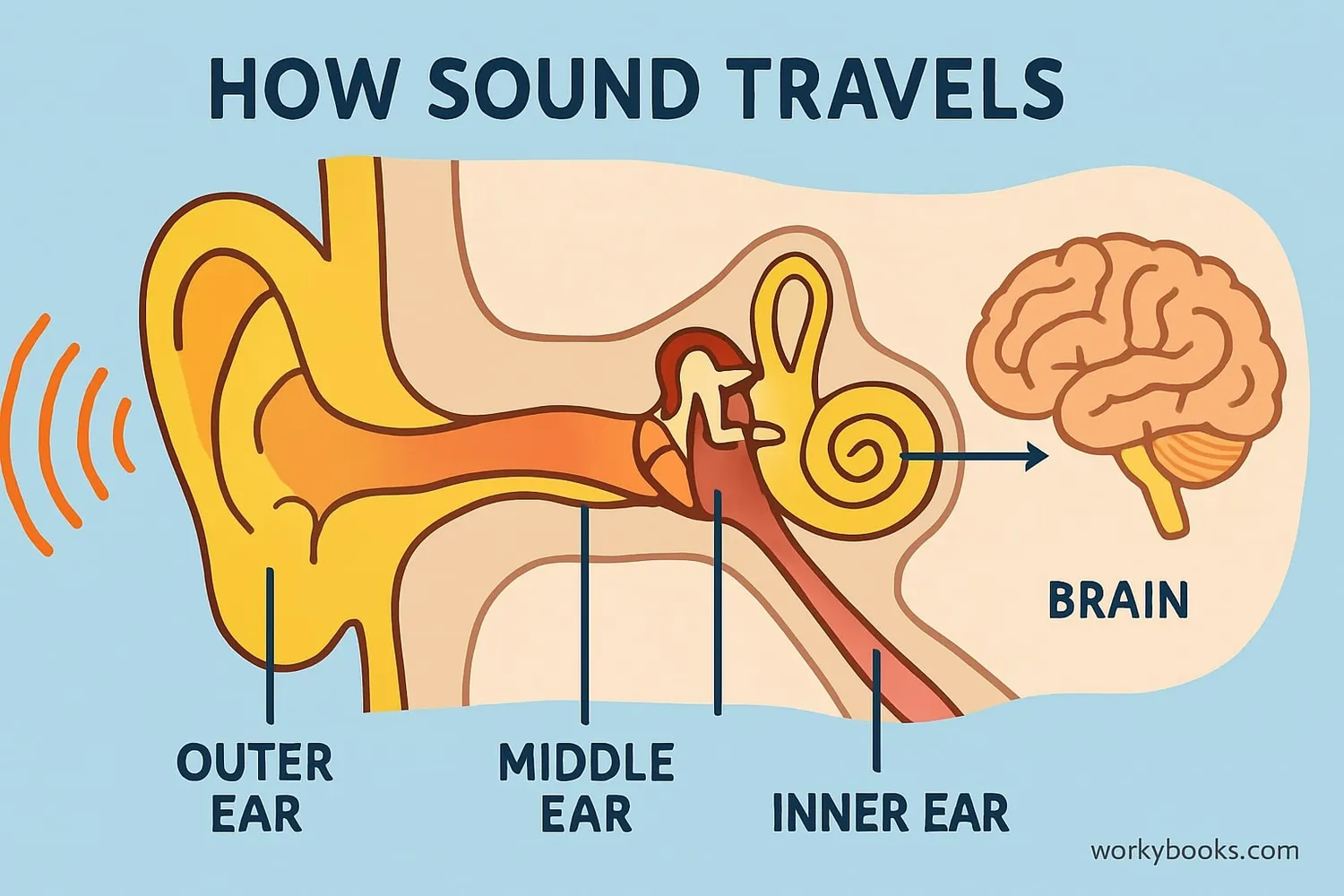
Every part of the ear has a special job in turning sound waves into something our brain recognizes as sound. First, the outer ear collects sound waves from the environment. These waves travel down the ear canal and strike the eardrum, causing it to vibrate. The vibrations are then passed to three tiny bones in the middle ear: the malleus, incus, and stapes. These bones amplify, or increase, the strength of the vibrations by about 20 times. The vibrations move into the cochlea, a spiral-shaped organ filled with fluid and thousands of tiny hair cells. These cells convert the vibrations into electrical signals. The auditory nerve carries these signals to the brain, where they are interpreted as sound.
Determining Sound Direction and Hearing Health
The human ear can detect sounds from 20 to 20,000 hertz (Hz), which measures how many times a sound wave vibrates each second. Our ability to tell where a sound comes from depends on the shape of our ears and the time it takes for sound to reach each ear. If a sound arrives at the left ear before it reaches the right, the brain knows the sound is coming from the left. The slight difference in time, sometimes less than one-thousandth of a second, is enough for the brain to locate the direction. Protecting hearing is important because loud noises can damage the hair cells in the cochlea. Once these cells are destroyed, they do not grow back, leading to permanent hearing loss. Using ear protection in noisy environments helps maintain good hearing health.
Applications and Broader Importance
Understanding how we hear has led to important technologies such as hearing aids and cochlear implants, which help people with hearing loss. Scientists use their knowledge of the ear to design better audio equipment and sound systems. In medicine, doctors can diagnose hearing problems by testing each part of the ear. The study of hearing is also connected to physics, biology, and engineering, showing how science disciplines interact to solve real-world problems.
In conclusion, the ear is a remarkable system that transforms invisible sound waves into meaningful information. The ability to determine sound direction and the importance of protecting hearing connect to larger scientific ideas about energy transfer, health, and the relationship between structure and function.
Interesting Fact: The smallest bone in your body, the stapes, is found in the ear and is only about 0.1 inches (2.5 mm) long!
What is the main function of the cochlea in the ear?
To turn vibrations into electrical signalsTo collect sound waves from the environmentTo make the eardrum vibrateTo carry signals to the brain
Which part of the ear amplifies sound vibrations?
The outer earThe middle ear bonesThe cochleaThe auditory nerve
What is the range of sound frequencies (in hertz) that humans can hear?
2 to 200 Hz20 to 2,000 Hz20 to 20,000 Hz200 to 200,000 Hz
What happens if the hair cells in the cochlea are destroyed?
They grow back after a few daysPermanent hearing loss occursThe eardrum stops vibratingSound waves can no longer enter the ear
What does 'amplify' mean as used in the passage?
To decrease the strength of somethingTo change something into a signalTo increase the strength of somethingTo block something completely
What is the 'auditory nerve' responsible for?
Carrying electrical signals to the brainCollecting sound waves from the airMaking the eardrum vibrateAmplifying sound vibrations
How do we know which direction a sound is coming from?
By the strength of the sound onlyBy which ear hears it first and the ear shapeBy the color of the sound wavesBy how fast the eardrum vibrates
Why is ear protection important in noisy environments?
To make sounds louderTo prevent damage to hair cells in the cochleaTo help the eardrum vibrate betterTo collect more sound waves
The middle ear bones increase the strength of vibrations by about 20 times. (True/False)
TrueFalse
The cochlea is filled with fluid and tiny hair cells. (True/False)
TrueFalse
Perfect For:
👩🏫 Teachers
• Reading comprehension practice
• Auto-graded assessments
• Literacy skill development
👨👩👧👦 Parents
• Reading practice at home
• Comprehension improvement
• Educational reading time
🏠 Homeschoolers
• Reading curriculum support
• Independent reading practice
• Progress monitoring
Reading Features:
📖
Reading Passage
Engaging fiction or nonfiction text
❓
Comprehension Quiz
Auto-graded questions
📊
Instant Feedback
Immediate results and scoring
📄
Printable Version
Download for offline reading
🔊
Read Aloud
Voice-over with word highlighting
Reviews & Ratings
No reviews yet. Be the first to share your experience!
Related Content
Remote Sensing
This middle school science passage introduces students to the concept of remote sensing—the collection of information ab...
MS-ESS3-3MS-PS4-2MS-ETS1-1MS-ETS1-3
The Electromagnetic Spectrum
This comprehensive science reading passage introduces middle school students (grades 6-8) to the electromagnetic spectru...
MS-PS4-1MS-PS4-2
Visible Light and Color
This comprehensive science passage for grades 6-8 explores visible light as the part of the electromagnetic spectrum tha...
MS-PS4-2
Light Waves
This middle school science passage introduces students in grades 6-8 to the concept of light as an electromagnetic wave,...
MS-PS4-2
Wave Absorption
This engaging science passage for grades 6-8 explores the mechanism of wave absorption, where waves transfer energy to m...
MS-PS4-2
Wave Behavior: Transmission
This informational science reading passage for grades 6-8 explores the concept of wave behavior, focusing on transmissio...
MS-PS4-2
Wave Refraction
This comprehensive science passage introduces middle school students to the concept of refraction, a key phenomenon in w...
MS-PS4-2
Wave Reflection
This middle school science passage explores the behavior of waves during reflection, focusing on how and why waves bounc...
MS-PS4-2
Reflection and Mirrors
This engaging passage explores the science behind reflection and mirrors, designed for students in grades 6-8. Aligned w...
MS-PS4-2
Lasers
This passage explores the science of lasers for middle school students, aligning with NGSS standard MS-PS4-2. Students l...
MS-PS4-2
How We See
This informational science passage for grades 6-8 explores the mechanisms behind human vision, focusing on how light ent...
MS-PS4-2
Optical Instruments
This passage introduces middle school students to the fascinating world of optical instruments. Aligned to NGSS standard...
MS-PS4-2
What Is Sound?
This passage explores the science of sound for middle school students, aligned with NGSS standards MS-PS4-1 and MS-PS4-2...
MS-PS4-1MS-PS4-2
Speed of Sound
This comprehensive passage for grades 6-8 explores the science behind the speed of sound and how it varies depending on ...
MS-PS4-1MS-PS4-2
Absorption of Sound
This comprehensive passage, aligned to NGSS MS-PS4-2, explores the science behind the absorption of sound. Students in g...
MS-PS4-2
Sound Through Different Materials
This comprehensive middle school science passage, aligned to NGSS standard MS-PS4-2, explores the fascinating topic of h...
MS-PS4-2
Reflection of Sound: Echoes
This comprehensive middle school science passage explores the phenomenon of echoes, focusing on the reflection of sound ...
MS-PS4-2
Sonar and Echolocation
This engaging middle school science passage explores the science behind sonar and echolocation, aligned to NGSS standard...
MS-PS4-2
Noise Pollution
This comprehensive, NGSS-aligned middle school science passage explores the concept of noise pollution as harmful or unw...