This learning resource is available in interactive and printable formats. The interactive worksheet can be played online and assigned to students. The Printable PDF version can be downloaded and printed for completion by hand.
This passage explores the science of lasers for middle school students, aligning with NGSS standard MS-PS4-2. Students learn how lasers produce focused, coherent, and single-wavelength light, and how these properties make lasers different from ordinary light sources. The passage describes the underlying mechanisms of lasers, provides real-world examples such as surgery, fiber optic communication, manufacturing, barcode scanners, and entertainment, and emphasizes safety considerations. Vocabulary is reinforced through a glossary, and comprehension is assessed with a quiz and writing prompts. Graphic organizers support comparison and cause-effect thinking. The passage and activities are suitable for grades 6-8, feature audio integration for accessible learning, and support students in understanding both scientific concepts and practical applications of laser technology.
CONTENT PREVIEW
Expand content preview
A laser produces a highly focused, powerful beam of light.
Laser technology is a fundamental part of modern science and technology. A laser produces a highly focused, powerful beam of light that is very different from the light we see from everyday sources like light bulbs or the Sun. The name 'laser' stands for 'Light Amplification by Stimulated Emission of Radiation.' Unlike regular light, which spreads out and contains many different wavelengths, a laser creates light that is focused, coherent, and consists of a single wavelength. This unique property makes lasers essential in many fields, from medicine to communication.
How Lasers Work: The Science Behind the Beam
Lasers work by a process called stimulated emission. In a laser device, a material such as a special crystal, gas, or semiconductor is used as the gain medium. When energy is added to this medium, its atoms or molecules become excited. When these excited atoms return to a lower energy state, they release photons, which are tiny packets of light. These photons stimulate other excited atoms to release even more photons of the same wavelength and direction. All these photons move together in a synchronized, or coherent, way. The result is a narrow, intense beam of light with a single, pure color. In contrast, ordinary light sources emit photons in many directions and with many wavelengths, resulting in scattered and less powerful light.
Applications and Impacts: Lasers in the Real World
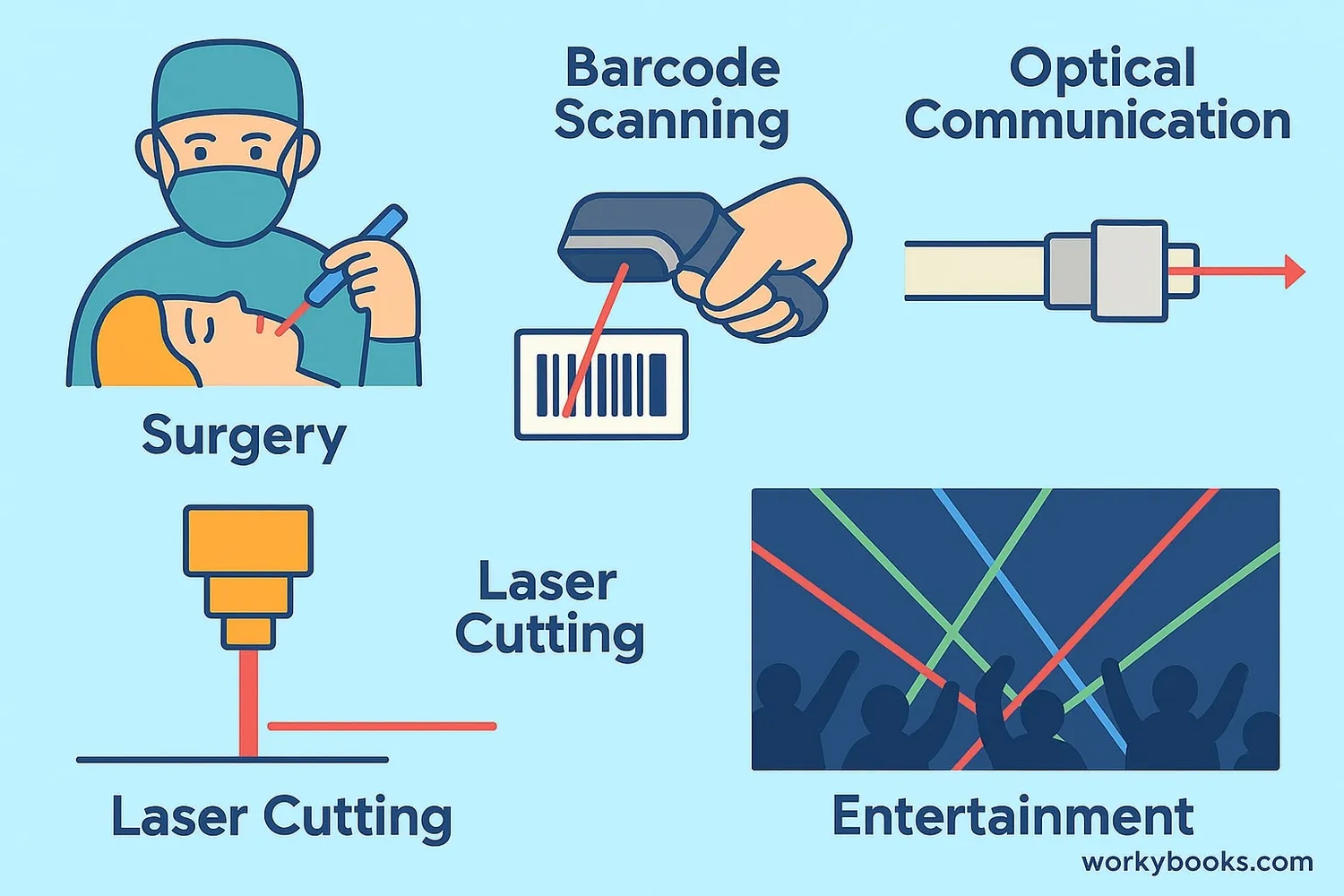
Lasers are used in a wide range of applications because of their unique properties. In medicine, lasers can cut tissue precisely during eye surgery or remove tumors without damaging nearby healthy cells. In fiber optic communication, lasers send pulses of light through thin glass fibers, allowing data to travel at nearly the speed of light over long distances. In manufacturing, high-powered lasers can cut or weld metals with incredible precision. Everyday technology such as barcode scanners in grocery stores and DVD players also rely on lasers. In entertainment, lasers create spectacular light shows by producing vivid, colorful beams that can be controlled accurately.
Safety and Broader Implications
Because lasers are so powerful and focused, they must be used carefully. Exposure to a strong laser beam can damage the eyes or skin. Safety measures, such as wearing protective goggles and following strict guidelines, are essential when working with powerful lasers. The development and use of lasers demonstrate how understanding the behavior of light at the atomic level can lead to innovations that transform society. Lasers are crucial in scientific research, advanced manufacturing, and global communications, highlighting the importance of physics in technology and daily life.
Interesting Fact: The first working laser was built in 1960, and today, millions of lasers are used worldwide in everything from medical devices to space exploration.
What does the word 'laser' stand for?
Light Amplification by Stimulated Emission of RadiationLong-range Amplified Sound Emission ReceiverLow Amplification by Sound Emission of RadiationLight and Sound Emission Radiator
How is laser light different from regular light?
Laser light is focused, coherent, and single-wavelength.Laser light spreads out in many directions like regular light.Laser light has many colors mixed together.Laser light changes color quickly.
What is the main function of the gain medium in a laser?
To excite atoms so they can release photons.To protect the laser from overheating.To reflect light back into the room.To absorb all incoming light.
Which of these is NOT mentioned as a use of lasers?
Growing plantsEye surgeryBarcode scannersFiber optic communication
What does 'coherent' mean when describing laser light?
All light waves move together in the same direction and phase.Light is made of different colors.Light spreads out in all directions.Light is very dim and weak.
What does the term 'wavelength' refer to in the passage?
The distance between two peaks of a wave, which determines color.The time it takes for light to travel.The speed at which light moves.The amount of energy a photon has.
Why are lasers used in fiber optic communication?
They send data quickly through glass fibers using light.They produce sound waves for communication.They are less expensive than wires.They create colorful signals.
What is a safety concern when working with powerful lasers?
They can damage eyes or skin if not handled properly.They always explode when overheated.They cause instant electric shocks.They are too faint to see.
Lasers can be used for surgery and manufacturing. (True/False)
TrueFalse
Regular light is more focused and powerful than laser light. (True/False)
TrueFalse
Perfect For:
👩🏫 Teachers
• Reading comprehension practice
• Auto-graded assessments
• Literacy skill development
👨👩👧👦 Parents
• Reading practice at home
• Comprehension improvement
• Educational reading time
🏠 Homeschoolers
• Reading curriculum support
• Independent reading practice
• Progress monitoring
Reading Features:
📖
Reading Passage
Engaging fiction or nonfiction text
❓
Comprehension Quiz
Auto-graded questions
📊
Instant Feedback
Immediate results and scoring
📄
Printable Version
Download for offline reading
🔊
Read Aloud
Voice-over with word highlighting
Reviews & Ratings
No reviews yet. Be the first to share your experience!
Related Content
Remote Sensing
This middle school science passage introduces students to the concept of remote sensing—the collection of information ab...
MS-ESS3-3MS-PS4-2MS-ETS1-1MS-ETS1-3
The Electromagnetic Spectrum
This comprehensive science reading passage introduces middle school students (grades 6-8) to the electromagnetic spectru...
MS-PS4-1MS-PS4-2
Visible Light and Color
This comprehensive science passage for grades 6-8 explores visible light as the part of the electromagnetic spectrum tha...
MS-PS4-2
Light Waves
This middle school science passage introduces students in grades 6-8 to the concept of light as an electromagnetic wave,...
MS-PS4-2
Wave Absorption
This engaging science passage for grades 6-8 explores the mechanism of wave absorption, where waves transfer energy to m...
MS-PS4-2
Wave Behavior: Transmission
This informational science reading passage for grades 6-8 explores the concept of wave behavior, focusing on transmissio...
MS-PS4-2
Wave Refraction
This comprehensive science passage introduces middle school students to the concept of refraction, a key phenomenon in w...
MS-PS4-2
Wave Reflection
This middle school science passage explores the behavior of waves during reflection, focusing on how and why waves bounc...
MS-PS4-2
Reflection and Mirrors
This engaging passage explores the science behind reflection and mirrors, designed for students in grades 6-8. Aligned w...
MS-PS4-2
How We See
This informational science passage for grades 6-8 explores the mechanisms behind human vision, focusing on how light ent...
MS-PS4-2
Optical Instruments
This passage introduces middle school students to the fascinating world of optical instruments. Aligned to NGSS standard...
MS-PS4-2
What Is Sound?
This passage explores the science of sound for middle school students, aligned with NGSS standards MS-PS4-1 and MS-PS4-2...
MS-PS4-1MS-PS4-2
Speed of Sound
This comprehensive passage for grades 6-8 explores the science behind the speed of sound and how it varies depending on ...
MS-PS4-1MS-PS4-2
Absorption of Sound
This comprehensive passage, aligned to NGSS MS-PS4-2, explores the science behind the absorption of sound. Students in g...
MS-PS4-2
Sound Through Different Materials
This comprehensive middle school science passage, aligned to NGSS standard MS-PS4-2, explores the fascinating topic of h...
MS-PS4-2
Reflection of Sound: Echoes
This comprehensive middle school science passage explores the phenomenon of echoes, focusing on the reflection of sound ...
MS-PS4-2
How We Hear
This engaging middle school science passage explores the fascinating process of how we hear, tracing sound’s journey fro...
MS-PS4-2
Sonar and Echolocation
This engaging middle school science passage explores the science behind sonar and echolocation, aligned to NGSS standard...
MS-PS4-2
Noise Pollution
This comprehensive, NGSS-aligned middle school science passage explores the concept of noise pollution as harmful or unw...