This learning resource is available in interactive and printable formats. The interactive worksheet can be played online and assigned to students. The Printable PDF version can be downloaded and printed for completion by hand.
This engaging passage explores the science behind reflection and mirrors, designed for students in grades 6-8. Aligned with NGSS standard MS-PS4-2, it covers the mechanisms of the law of reflection, explains how light interacts with surfaces to produce regular and diffuse reflection, and describes how plane mirrors create virtual, upright, same-size images. The passage integrates academic vocabulary and real-world applications, helping students understand how we see objects and how these principles are used in daily life and technology. Included are a glossary, multiple-choice quiz, writing prompts, graphic organizers, and both English and Spanish versions, as well as a simplified version for differentiated instruction. Audio integration supports diverse learning styles. Perfect for middle school science classrooms focused on deepening conceptual understanding of light and optics.
CONTENT PREVIEW
Expand content preview
Reflection is a fundamental concept in physics, connecting to broader ideas about energy transfer and wave behavior. Source: Wikimedia Commons (Public domain).
Reflection is the process that allows us to see most things around us. When a beam of light strikes a surface, some or all of it bounces off. This redirection of light is what makes objects visible to our eyes. Mirrors, in particular, are special surfaces that can reflect almost all the light that hits them, creating clear images. Understanding how reflection works is essential for explaining many everyday phenomena and technologies.
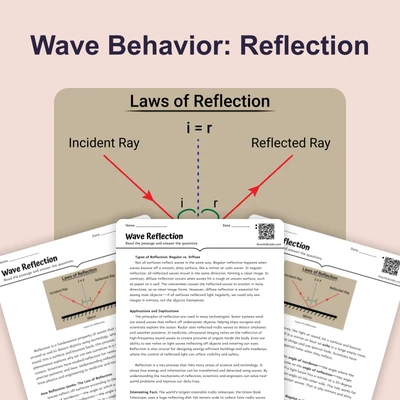
The Law of Reflection At the core of reflection is the law of reflection. This scientific principle states that when light hits a smooth surface, the angle of incidence (the angle between the incoming light and a line perpendicular to the surface, called the normal) is always equal to the angle of reflection (the angle between the outgoing light and the normal). For example, if a light ray strikes a mirror at 30 degrees from the normal, it will reflect off at 30 degrees on the other side. This rule applies to all smooth, shiny surfaces and is why mirrors show such accurate images.
Regular vs. Diffuse Reflection Not all surfaces reflect light in the same way. Regular reflection happens on smooth, flat surfaces like mirrors. Here, all the light rays bounce off in the same direction, producing a clear image. In contrast, diffuse reflection occurs on rough or uneven surfaces, such as paper or walls. The tiny bumps and dips scatter incoming light in many directions, so no image forms, but the object is still visible. About 90% of the objects we see are visible because of diffuse reflection. For example, you can see a wooden table even though it is not shiny because light bounces off it in all directions and some of that light enters your eyes.
How We See Objects and Plane Mirrors We see objects when reflected light enters our eyes. Our brain interprets the direction from which the light arrives to determine where the object is located. With a plane mirror, the reflected rays appear to come from behind the mirror, creating a virtual image. This image is upright and the same size as the original object, but it cannot be projected onto a screen. Plane mirrors are used in everyday life, from bathroom mirrors to periscopes and certain scientific instruments. The precise reflection from these mirrors is crucial for devices like telescopes and lasers, where controlling the direction of light is essential.
Reflection is a fundamental concept in physics, connecting to broader ideas about energy transfer and wave behavior. Understanding how light interacts with matter helps explain not only vision, but also technologies such as cameras, fiber optics, and even solar panels. As scientists continue to study light and reflection, new applications and discoveries will keep shaping our world.
Interesting Fact: Some animals, like cats and cows, have a special layer behind their retinas that reflects light, helping them see better in the dark!
What is the main reason we can see most objects around us?
Because of light reflecting off their surfacesBecause they are all shiny like mirrorsBecause they make their own lightBecause our eyes create light
What does the law of reflection state?
The angle of incidence equals the angle of reflectionAll light is absorbed by mirrorsLight can only travel in straight linesOnly shiny surfaces reflect light
What type of surface causes diffuse reflection?
A rough surface like paperA flat mirrorA polished metal plateA glass window
Which of the following best describes a virtual image?
It appears to come from behind the mirror and cannot be projected onto a screenIt can be captured on a piece of paperIt is always upside downIt is smaller than the real object
What is the function of the 'normal' in the law of reflection?
It is an imaginary line perpendicular to the surfaceIt is the light ray that bounces off the surfaceIt is the brightest part of the mirrorIt is a line drawn on the back of the mirror
What percentage of objects we see are visible due to diffuse reflection?
About 90%About 10%About 50%About 5%
What is the main difference between regular and diffuse reflection?
Regular reflection produces clear images; diffuse reflection does notDiffuse reflection only happens with mirrorsRegular reflection scatters light; diffuse reflection does notDiffuse reflection only happens at night
If a ray of light strikes a mirror at 45 degrees from the normal, at what angle will it reflect?
45 degrees0 degrees90 degrees15 degrees
True or False: A plane mirror creates a real image that can be projected on a screen.
FalseTrue
True or False: Light must always reflect off a surface at a 90 degree angle.
FalseTrue
Perfect For:
👩🏫 Teachers
• Reading comprehension practice
• Auto-graded assessments
• Literacy skill development
👨👩👧👦 Parents
• Reading practice at home
• Comprehension improvement
• Educational reading time
🏠 Homeschoolers
• Reading curriculum support
• Independent reading practice
• Progress monitoring
Reading Features:
📖
Reading Passage
Engaging fiction or nonfiction text
❓
Comprehension Quiz
Auto-graded questions
📊
Instant Feedback
Immediate results and scoring
📄
Printable Version
Download for offline reading
🔊
Read Aloud
Voice-over with word highlighting
Reviews & Ratings
No reviews yet. Be the first to share your experience!
Related Content
Remote Sensing
This middle school science passage introduces students to the concept of remote sensing—the collection of information ab...
MS-ESS3-3MS-PS4-2MS-ETS1-1MS-ETS1-3
The Electromagnetic Spectrum
This comprehensive science reading passage introduces middle school students (grades 6-8) to the electromagnetic spectru...
MS-PS4-1MS-PS4-2
Visible Light and Color
This comprehensive science passage for grades 6-8 explores visible light as the part of the electromagnetic spectrum tha...
MS-PS4-2
Light Waves
This middle school science passage introduces students in grades 6-8 to the concept of light as an electromagnetic wave,...
MS-PS4-2
Wave Absorption
This engaging science passage for grades 6-8 explores the mechanism of wave absorption, where waves transfer energy to m...
MS-PS4-2
Wave Behavior: Transmission
This informational science reading passage for grades 6-8 explores the concept of wave behavior, focusing on transmissio...
MS-PS4-2
Wave Refraction
This comprehensive science passage introduces middle school students to the concept of refraction, a key phenomenon in w...
MS-PS4-2
Wave Reflection
This middle school science passage explores the behavior of waves during reflection, focusing on how and why waves bounc...
MS-PS4-2
Lasers
This passage explores the science of lasers for middle school students, aligning with NGSS standard MS-PS4-2. Students l...
MS-PS4-2
How We See
This informational science passage for grades 6-8 explores the mechanisms behind human vision, focusing on how light ent...
MS-PS4-2
Optical Instruments
This passage introduces middle school students to the fascinating world of optical instruments. Aligned to NGSS standard...
MS-PS4-2
What Is Sound?
This passage explores the science of sound for middle school students, aligned with NGSS standards MS-PS4-1 and MS-PS4-2...
MS-PS4-1MS-PS4-2
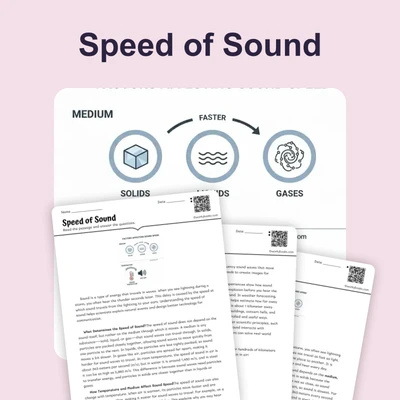
Speed of Sound
This comprehensive passage for grades 6-8 explores the science behind the speed of sound and how it varies depending on ...
MS-PS4-1MS-PS4-2
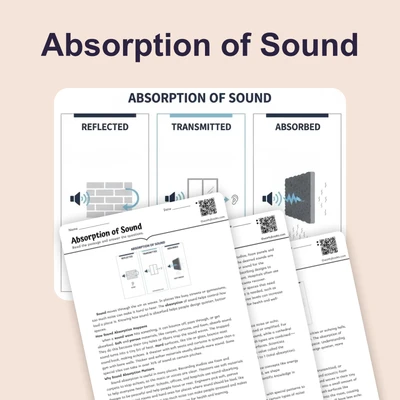
Absorption of Sound
This comprehensive passage, aligned to NGSS MS-PS4-2, explores the science behind the absorption of sound. Students in g...
MS-PS4-2
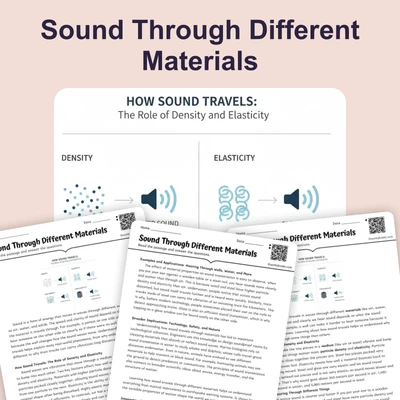
Sound Through Different Materials
This comprehensive middle school science passage, aligned to NGSS standard MS-PS4-2, explores the fascinating topic of h...
MS-PS4-2
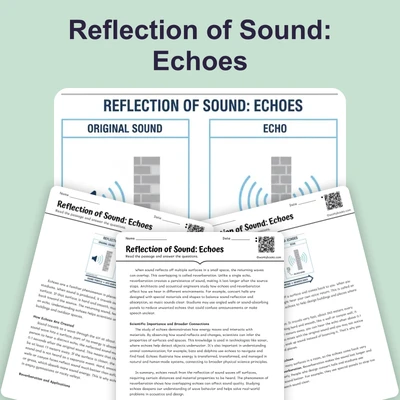
Reflection of Sound: Echoes
This comprehensive middle school science passage explores the phenomenon of echoes, focusing on the reflection of sound ...
MS-PS4-2
How We Hear
This engaging middle school science passage explores the fascinating process of how we hear, tracing sound’s journey fro...
MS-PS4-2
Sonar and Echolocation
This engaging middle school science passage explores the science behind sonar and echolocation, aligned to NGSS standard...
MS-PS4-2
Noise Pollution
This comprehensive, NGSS-aligned middle school science passage explores the concept of noise pollution as harmful or unw...