This learning resource is available in interactive and printable formats. The interactive worksheet can be played online and assigned to students. The Printable PDF version can be downloaded and printed for completion by hand.
This informational science passage for grades 6-8 explores the mechanisms behind human vision, focusing on how light enters the eye, is focused by the lens, and detected by specialized cells in the retina. Students will learn about the roles of rods and cones, the function of the optic nerve, and how the brain creates the images we see. The text also explains common vision problems, such as nearsightedness, farsightedness, and color blindness, and discusses how corrective lenses work. Aligned to NGSS standard MS-PS4-2, this passage helps students understand systems and interactions in biological structures. Activities include a glossary, differentiated reading, quiz, writing prompts, and graphic organizers to support comprehension. Audio integration is available for students who benefit from listening support. This resource is ideal for classroom use or independent study on the science of vision.
CONTENT PREVIEW
Expand content preview
How We See
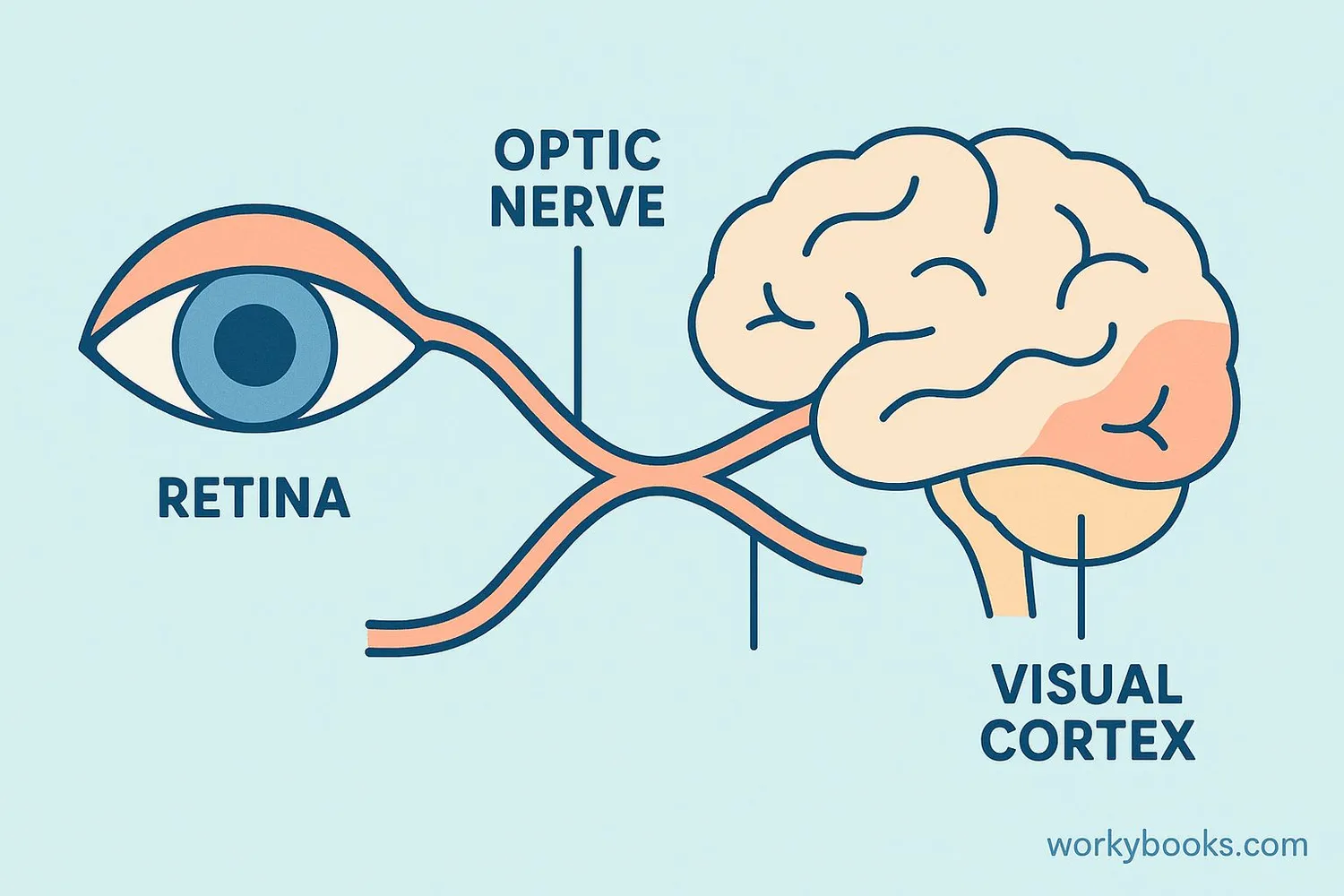
Vision is one of the key senses that allows humans to interpret the world around them. The process of seeing begins with light entering the eye. This light is first bent and directed by the cornea, the clear outer layer at the front of the eye. After passing through the pupil, the opening that controls how much light enters, the light is further focused by the lens. The lens changes shape to focus light precisely onto the retina at the back of the eye.
How the Eye Turns Light into Sight
The retina contains two main types of specialized cells: rods and cones. Rods are sensitive to dim light and help us see in black and white, while cones detect color and work best in bright light. There are about 120 million rods and 6 million cones in a typical human retina. When light hits these cells, it triggers chemical reactions that create electrical signals. These signals travel along the optic nerve to the brain, where visual information is processed and interpreted as images.
Different Ways Vision Can Vary
Not everyone sees the world in the same way. Some people are nearsighted (myopic), which means they can see objects up close but have trouble seeing things far away. This usually happens because the eye is too long or the cornea is too curved, causing light to focus in front of the retina. Others are farsighted (hyperopic), so distant objects are clear, but nearby ones are blurry. In this case, light focuses behind the retina. Color blindness is another common condition, caused by missing or malfunctioning cones. People with color blindness may have trouble distinguishing between certain colors, like red and green.
Correcting Vision and Understanding Sight
Scientists have developed technologies to correct many vision problems. Corrective lenses such as glasses or contact lenses bend light so it focuses properly on the retina, allowing people to see clearly. Understanding how the eye works also helps doctors diagnose diseases and develop treatments. The study of vision is a great example of systems working together: the eye, the nervous system, and the brain all interact to make sight possible. This knowledge is used in designing cameras, improving lighting in public spaces, and even advancing computer vision in robotics.
Vision research continues to answer questions about how we perceive the world and how to help people with vision loss. The science of sight connects to broader principles in biology, physics, and technology, demonstrating the importance of systems and interactions in science.
Interesting Fact: Some birds and insects can see ultraviolet light, a part of the spectrum invisible to humans, giving them a very different view of the world!
Which part of the eye first bends and directs light?
CorneaPupilLensRetina
What do cones in the retina help us see?
Only black and whiteDim lightColors in bright lightFar away objects
What is the function of the optic nerve?
To focus light onto the corneaTo carry visual signals to the brainTo control the amount of light entering the eyeTo produce tears
What does 'nearsighted' mean as used in the passage?
Seeing distant objects clearlySeeing colors clearlySeeing close objects clearly but distant objects blurryHaving trouble seeing in dim light
What is the main job of the lens in the eye?
To detect colorTo focus light onto the retinaTo carry signals to the brainTo control the size of the pupil
Which sentence best explains why people with farsightedness have trouble seeing up close?
Their eye is too short or their cornea is too flat.Their rods do not work well.Their pupil is too large.Their lens cannot focus light.
If someone is color blind, what is likely not working properly in their eyes?
RodsConesCorneaLens
Glasses help people see clearly by:
Making the pupil largerBending light to focus it correctly on the retinaSending signals to the brainChanging the shape of the retina
True or False: The retina is found at the front of the eye.
TrueFalse
True or False: Some animals can see ultraviolet light, which humans cannot see.
TrueFalse
Perfect For:
👩🏫 Teachers
• Reading comprehension practice
• Auto-graded assessments
• Literacy skill development
👨👩👧👦 Parents
• Reading practice at home
• Comprehension improvement
• Educational reading time
🏠 Homeschoolers
• Reading curriculum support
• Independent reading practice
• Progress monitoring
Reading Features:
📖
Reading Passage
Engaging fiction or nonfiction text
❓
Comprehension Quiz
Auto-graded questions
📊
Instant Feedback
Immediate results and scoring
📄
Printable Version
Download for offline reading
🔊
Read Aloud
Voice-over with word highlighting
Reviews & Ratings
No reviews yet. Be the first to share your experience!
Related Content
Remote Sensing
This middle school science passage introduces students to the concept of remote sensing—the collection of information ab...
MS-ESS3-3MS-PS4-2MS-ETS1-1MS-ETS1-3
The Electromagnetic Spectrum
This comprehensive science reading passage introduces middle school students (grades 6-8) to the electromagnetic spectru...
MS-PS4-1MS-PS4-2
Visible Light and Color
This comprehensive science passage for grades 6-8 explores visible light as the part of the electromagnetic spectrum tha...
MS-PS4-2
Light Waves
This middle school science passage introduces students in grades 6-8 to the concept of light as an electromagnetic wave,...
MS-PS4-2
Wave Absorption
This engaging science passage for grades 6-8 explores the mechanism of wave absorption, where waves transfer energy to m...
MS-PS4-2
Wave Behavior: Transmission
This informational science reading passage for grades 6-8 explores the concept of wave behavior, focusing on transmissio...
MS-PS4-2
Wave Refraction
This comprehensive science passage introduces middle school students to the concept of refraction, a key phenomenon in w...
MS-PS4-2
Wave Reflection
This middle school science passage explores the behavior of waves during reflection, focusing on how and why waves bounc...
MS-PS4-2
Reflection and Mirrors
This engaging passage explores the science behind reflection and mirrors, designed for students in grades 6-8. Aligned w...
MS-PS4-2
Lasers
This passage explores the science of lasers for middle school students, aligning with NGSS standard MS-PS4-2. Students l...
MS-PS4-2
Optical Instruments
This passage introduces middle school students to the fascinating world of optical instruments. Aligned to NGSS standard...
MS-PS4-2
What Is Sound?
This passage explores the science of sound for middle school students, aligned with NGSS standards MS-PS4-1 and MS-PS4-2...
MS-PS4-1MS-PS4-2
Speed of Sound
This comprehensive passage for grades 6-8 explores the science behind the speed of sound and how it varies depending on ...
MS-PS4-1MS-PS4-2
Absorption of Sound
This comprehensive passage, aligned to NGSS MS-PS4-2, explores the science behind the absorption of sound. Students in g...
MS-PS4-2
Sound Through Different Materials
This comprehensive middle school science passage, aligned to NGSS standard MS-PS4-2, explores the fascinating topic of h...
MS-PS4-2
Reflection of Sound: Echoes
This comprehensive middle school science passage explores the phenomenon of echoes, focusing on the reflection of sound ...
MS-PS4-2
How We Hear
This engaging middle school science passage explores the fascinating process of how we hear, tracing sound’s journey fro...
MS-PS4-2
Sonar and Echolocation
This engaging middle school science passage explores the science behind sonar and echolocation, aligned to NGSS standard...
MS-PS4-2
Noise Pollution
This comprehensive, NGSS-aligned middle school science passage explores the concept of noise pollution as harmful or unw...