Optical Instruments
Interactive passage with audio narration, comprehension questions, and printable PDF.
By completing this purchase you agree to our Terms of Use and Privacy Policy. Your subscription renews automatically until you cancel. You can cancel anytime from your account settings. All sales are final and non-refundable. Digital content is available for download in your account immediately upon purchase.
What's included
Optical Instruments preview and details
About this printable Optical Instruments science reading passage, NGSS-aligned (Grades 5-8)
Sample passage and quiz from Optical Instruments
Reading passage and comprehension quiz preview
Optical Instruments
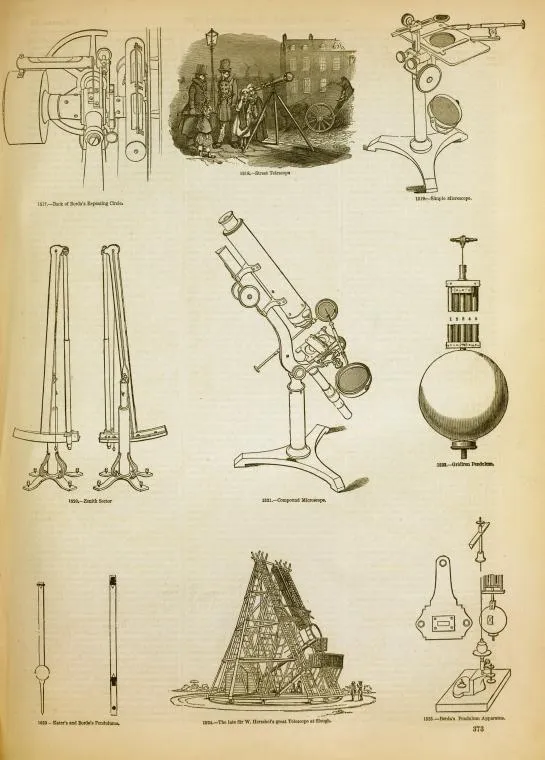
Source: Wikimedia Commons (Public domain).
Optical instruments are essential tools that use lenses and mirrors to change the way we see and study the world. From examining tiny cells to observing distant galaxies, these devices allow us to extend our natural vision far beyond its limits. Understanding how optical instruments work involves learning about the behavior of light and the principles of optics. By manipulating light, these instruments can magnify, focus, or capture images, making them vital in science, medicine, and technology.
How Optical Instruments Work
The main function of optical instruments is to bend, reflect, or focus light to produce clear images. A lens is a curved piece of glass or plastic that bends light rays through a process called refraction. By changing the direction of light, lenses can make objects appear larger (magnification) or smaller. Mirrors use reflection to redirect light. For example, a microscope uses multiple lenses to magnify tiny objects, sometimes more than 1,000 times their actual size. A telescope uses large lenses or mirrors to gather and focus light from faraway stars, making faint objects visible to our eyes. The ability to change the path of light through different combinations of lenses and mirrors is what enables each instrument to perform its unique function.
Types and Applications of Optical Instruments
Different optical instruments are designed for specific purposes. Cameras use a lens to focus light onto a sensor or film, capturing detailed images for photography or scientific analysis. Projectors do the opposite: they shine light through a small image and use lenses to enlarge it onto a screen. Binoculars combine pairs of lenses and mirrors to allow both eyes to see distant objects clearly, which is helpful for bird watching or sports. Each instrument relies on precise arrangements of lenses and mirrors to control how light travels. The quality of the image depends on factors like lens shape, size, and the material used, as well as the alignment of optical parts. For example, a telescope’s ability to see faint stars depends on the diameter of its main lens or mirror, known as its aperture.
Connections to Science and Society
Optical instruments have transformed scientific discovery and daily life. Microscopes made it possible to see bacteria and cells, launching modern biology and medicine. Telescopes revealed the true scale of the universe, leading to major breakthroughs in astronomy. Cameras document important moments, aid in research, and even help diagnose diseases. The development of these tools relies on understanding the physics of light, and improvements in optics continue to push the boundaries of what we can observe. As technology advances, optical instruments become more powerful and accessible, shaping fields from space exploration to health care and environmental science.
In summary, optical instruments are powerful systems that use lenses and mirrors to manipulate light. Their design and function are based on scientific principles of optics, and their impact is seen in many areas of life and research. Studying how these devices work helps us appreciate the role of science in expanding our knowledge and abilities.
Interesting Fact: The Hubble Space Telescope can see objects more than 13 billion light-years away, thanks to its giant mirrors and advanced optics!
Comprehension quiz (10 questions)
1. What is the main purpose of optical instruments?
2. How does a lens affect light?
3. Which instrument is used to view very small objects?
4. What is the role of mirrors in optical instruments?
5. What does the term 'aperture' refer to in a telescope?
6. In the passage, what does 'refraction' mean?
7. Why are improvements in optics important for society?
8. How do projectors differ from cameras?
9. True or False: Binoculars use both lenses and mirrors to help both eyes see distant objects clearly.
10. True or False: The Hubble Space Telescope uses advanced optics to see objects more than 13 billion light-years away.
Perfect for the way you teach
- Build comprehension skills
- Auto-graded quiz
- Differentiated reading
- Read together at home
- Improve fluency
- Quiet reading time
- Reading curriculum support
- Independent practice
- Track Lexile growth