Reading PassagePremium

What Are Climate Models

Interactive passage with audio narration, comprehension questions, and printable PDF.

No ratings yet
Grades 5–8ScienceReadingElaEnglish · SpanishInteractive · Printable
Aligned toMS-ESS3-5
Just this resource
$1.50
One-time purchase
Best value
Unlock everything
$49.99$29.99/yr
40% off until Aug 1 — 10,000+ resources
Renews at $49.99/year.
Unlock above to use these actions

What's included

Reading passage
Audio narration
Comprehension quiz
Writing activity
Glossary & flashcards
Differentiated version
Spanish translation

What Are Climate Models preview and details

About this printable What Are Climate Models science reading passage, NGSS-aligned (Grades 5-8)

This 400-500 word informational science reading passage explores climate models for middle school students in grades 6-8. Aligned with NGSS standard MS-ESS3-5, the passage explains how climate models are computer programs that simulate Earth's climate using physics principles like energy balance and the greenhouse effect. Students learn how models divide Earth into a 3-D grid, calculate energy and water flow, and are tested against historical data. The passage includes real-world applications showing how models help scientists predict future climate under different emission scenarios. Audio-integrated content supports diverse learners. Activities include multiple-choice questions, writing prompts, and graphic organizers that reinforce understanding of climate modeling, scientific testing, and evidence-based predictions. Vocabulary includes simulation, greenhouse gases, grid system, and validation.
Written by Workybooks TeamPublished by Workybooks
Preview

Sample passage and quiz from What Are Climate Models

Reading passage and comprehension quiz preview

What Are Climate Models
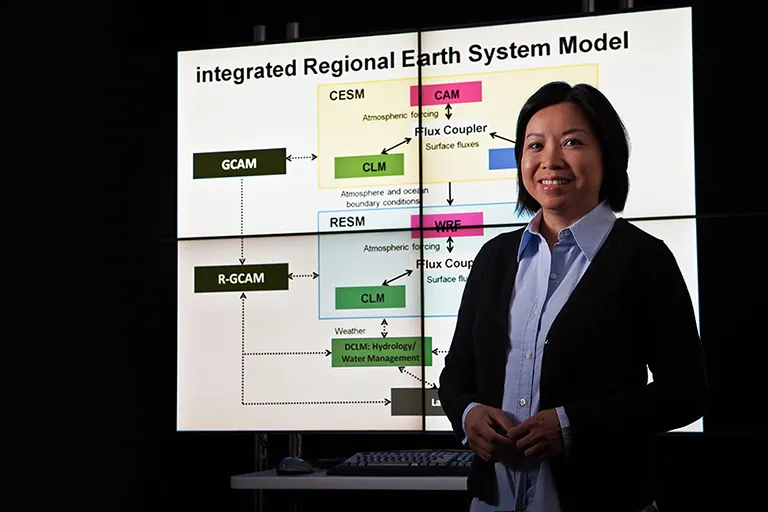
Ruby Leung (8696740216)

Building accurate, intricate computer models that allow scientists and stakeholders to understand the interplay between Earth, water, clouds, and atmosphere is what Dr. Ruby Leung does at Pacific Northwest National Laboratory. She conducts cutting-edge research and refines models that are vital to predicting climate and understanding the impact of energy policies, new technologies, and our changing climate. ENERGY.GOV / Wikimedia Commons 

Climate models are powerful computer programs that help scientists understand and predict how Earth's climate works. These models simulate the complex interactions between the atmosphere, oceans, land, and ice. Scientists build climate models using the same physics principles students learn in school, including energy balance, the greenhouse effect, and how air and water move around the planet.

A climate model divides Earth into a giant three-dimensional grid made of thousands of boxes. Each box represents a section of the atmosphere or ocean. The model calculates how energy, air, and water flow between these boxes. Scientists program equations that describe how solar radiation enters the system, how greenhouse gases trap heat, and how ocean currents transport warmth around the globe. The computer performs millions of calculations to track these changes over time. This process creates a simulation of Earth's climate system.

Climate models serve an important purpose in scientific research. Scientists use them to run experiments they cannot perform on the real planet. What happens if greenhouse gas levels keep rising? What if humans reduce emissions significantly? Models can test these different scenarios. Before scientists trust a model's predictions, they test it against the past. If a model accurately reproduces climate patterns we have already measured, scientists gain confidence in its ability to project future conditions. This testing process is called validation.

The National Center for Atmospheric Research operates some of the world's most advanced climate models. These models successfully predicted warming patterns observed over the past 50 years. Scientists input different levels of future greenhouse gas emissions into the models. The results show that Earth's temperature may rise between 1.5 and 4 degrees Celsius by 2100, depending on the choices humans make today. Models also predict changes in rainfall patterns, sea level rise, and extreme weather events.

Climate models matter because they help society prepare for the future. Governments use model projections to plan for water resources, agriculture, and coastal protection. While no model is perfect, evidence shows that models have become increasingly accurate over time. Scientists continue improving models by adding more detail and using faster computers. Understanding climate models helps us make informed decisions about our planet's future.

Interesting Fact: The first climate model was created in 1896 by Swedish scientist Svante Arrhenius using only pencil and paper. It took him a full year to calculate by hand what modern computers can do in seconds!

Comprehension quiz (10 questions)

1. What is a climate model?

A physical model of Earth made from clay
A computer program that simulates Earth's climate
A weather forecast for tomorrow
A map showing temperature zones

2. How do climate models divide Earth for calculations?

Into continents and oceans
Into climate zones
Into a three-dimensional grid of boxes
Into hemispheres

3. What does the term 'validation' mean in the context of climate models?

Making the model run faster
Testing the model against past climate data to check accuracy
Sharing the model with other scientists
Publishing the model results

4. According to the passage, what physics principles are used in climate models?

Gravity and magnetism
Energy balance, greenhouse effect, and movement of air and water
Nuclear reactions and electricity
Sound waves and light reflection

5. Why do scientists use climate models to run experiments?

Because computers are fun to use
Because they cannot perform these experiments on the real planet
Because models are always 100% accurate
Because experiments are too expensive

6. What range of temperature increase do models predict by 2100?

0.5 to 1 degree Celsius
1.5 to 4 degrees Celsius
5 to 10 degrees Celsius
10 to 15 degrees Celsius

7. How do governments use climate model projections?

To predict daily weather
To plan for water resources, agriculture, and coastal protection
To design new computers
To create tourist attractions

8. What does 'greenhouse gases' refer to in the passage?

Gases found only in greenhouses
Gases that make plants grow
Gases in the atmosphere that trap heat
Gases that are green in color

9. Climate models have become less accurate over time as technology has improved.

True
False

10. The first climate model was created using modern computers.

True
False
Who it's for

Perfect for the way you teach

Teachers
  • Build comprehension skills
  • Auto-graded quiz
  • Differentiated reading
Parents
  • Read together at home
  • Improve fluency
  • Quiet reading time
Homeschoolers
  • Reading curriculum support
  • Independent practice
  • Track Lexile growth
Topics

Reviews & Ratings

No reviews yet. Be the first to share your experience!

More reading you might love

20 more
Passage
Natural Disaster: Hurricanes - reading educational content
Grades 4–5

Natural Disaster: Hurricanes

weather and climate · RI.3.1

Free
Passage
Animal Migration and Climate Change - reading educational content
Grades 5–8

Animal Migration and Climate Change

weather and climate · MS-LS2-4

$1.50
Passage
What Is Global Warming? - reading educational content
Grades 5–8

What Is Global Warming?

weather and climate · MS-ESS3-5

Free
Passage
What Causes Global Warming? - reading educational content
Grades 5–8

What Causes Global Warming?

weather and climate · MS-ESS3-5

$1.50
Passage
How to Stop Global Warming - reading educational content
Grades 5–8

How to Stop Global Warming

weather and climate · MS-ESS3-5

$1.50
Passage
What Is Ocean Acidification - reading educational content
Grades 5–8

What Is Ocean Acidification

weather and climate · MS-ESS3-5

$1.50
Passage
Human Impacts: Climate Change - reading educational content
Grades 5–8

Human Impacts: Climate Change

life science · MS-LS2-4

$1.50
Passage
Climate Change: Vulnerable Ecosystems - reading educational content
Grades 5–8

Climate Change: Vulnerable Ecosystems

life science · MS-ESS3-5

$1.50
Passage
Climate Change: Solutions and Mitigation - reading educational content
Grades 5–8

Climate Change: Solutions and Mitigation

life science · MS-ESS3-4

$1.50
Passage
Scientific Inquiry in Earth Science - reading educational content
Grades 5–8

Scientific Inquiry in Earth Science

earth science · MS-ESS1-4

$1.50
Passage
Great Barrier Reef - reading educational content
Grades 5–8

Great Barrier Reef

weather and climate · MS-LS2-1

$1.50
Passage
Siberian Taiga - reading educational content
Grades 5–8

Siberian Taiga

weather and climate · MS-LS2-1

$1.50
Passage
Melting Glaciers and Ice Sheets - reading educational content
Grades 5–8

Melting Glaciers and Ice Sheets

weather and climate · MS-ESS3-5

$1.50
Passage
Sea Level Rise and Climate Change - reading educational content
Grades 5–8

Sea Level Rise and Climate Change

weather and climate · MS-ESS3-5

$1.50
Passage
Ice Cores  - reading educational content
Grades 5–8

Ice Cores

weather and climate · MS-ESS3-5

$1.50
Passage
How Climate Change Affects Weather - reading educational content
Grades 5–8

How Climate Change Affects Weather

science · MS-ESS3-5

$1.50
Passage
How Climate Change Affects Oceans - reading educational content
Grades 5–8

How Climate Change Affects Oceans

weather and climate · MS-ESS3-5

$1.50
Passage
Carbon Footprint - reading educational content
Grades 5–8

Carbon Footprint

science · MS-ESS3-4

$1.50
Passage
El Niño - reading educational content
Grades 5–8

El Niño

science · MS-ESS2-6

$1.50
Passage
ENSO and Global Climate - reading educational content
Grades 5–8

ENSO and Global Climate

science · MS-ESS2-6

$1.50
Copyright © 2026 Workybooks. Made with ♥ in California.