This learning resource is available in interactive and printable formats. The interactive worksheet can be played online and assigned to students. The Printable PDF version can be downloaded and printed for completion by hand.
This engaging 400-500 word reading passage introduces middle school students (grades 6-8) to constellations and their cultural significance. Aligned with NGSS MS-ESS1-1 and DCI MS-ESS1.A, students explore how constellations are human-made patterns rather than natural groupings of stars. The passage covers recognizable constellations including the Big Dipper (an asterism within Ursa Major), Orion with its distinctive three-star belt, and Scorpius as a summer constellation. Students discover how different cultures—Greek, Polynesian, Lakota, and Chinese—saw entirely different patterns and stories in the same stars. The content emphasizes that sky-watching is a universal human activity and helps students understand how humans organize observations into recognizable patterns. Audio-integrated features support diverse learners. Activities include comprehension questions, writing prompts, and graphic organizers that reinforce understanding of how humans interpret celestial patterns and appreciate multicultural perspectives on astronomy.
Constellations are patterns of stars that humans have grouped together and named. These star patterns are not natural groupings. Stars in a constellation may be millions of miles apart from each other. They only appear close together from our view on Earth. Ancient peoples looked up at the night sky and connected bright stars into pictures. These pictures helped them tell stories, mark seasons, and navigate across land and sea. Today, astronomers recognize 88 official constellations that map the entire sky.
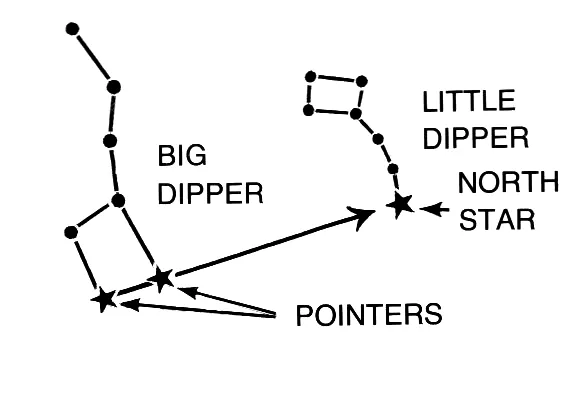
People create constellations by connecting stars that seem to form shapes or patterns. The Big Dipper is one of the most recognizable patterns in the Northern Hemisphere. It looks like a large spoon or ladle with a long handle. However, the Big Dipper is technically an asterism: a smaller pattern within a larger constellation. The Big Dipper is part of Ursa Major, the Great Bear. Orion is another famous constellation that appears in winter. Three bright stars form Orion's belt, making it easy to spot. Scorpius curves across summer skies like a scorpion with a curved tail. These patterns help observers locate other stars and objects in the night sky.
Different cultures around the world looked at the same stars but saw completely different patterns and stories. Ancient Greeks saw a hunter named Orion, but the Lakota people of North America saw a bison's spine in those same stars. Polynesians navigating the Pacific Ocean used star patterns as ocean highways, giving them names tied to voyaging and seasons. Chinese astronomers organized the sky into different sections with unique meanings related to their emperor and government. Aboriginal Australians even saw patterns in the dark spaces between stars, not just the stars themselves. This shows that constellations reflect human imagination and culture rather than any physical connection between stars.
Understanding constellations helps us appreciate how humans observe and organize nature. Scientists still use constellation names to identify regions of the sky when studying distant galaxies or tracking satellites. Constellations connect us to thousands of years of human curiosity about space. They remind us that people everywhere have looked up and wondered about the universe. Learning to recognize constellations gives us a way to navigate the night sky and connect with observers across time and cultures.
Interesting Fact: The stars in the Big Dipper are moving through space at different speeds and in different directions. In about 50,000 years, the Big Dipper will look completely different from how it appears today.
What are constellations?
Natural groupings of stars that are close together in spacePatterns of stars that humans have grouped together and namedOnly the 88 brightest stars in the night skyStars that move together through space
How many official constellations do astronomers recognize today?
A type of meteorA smaller pattern of stars within a larger constellationA planet that looks like a starA star that changes brightness
Which constellation features three bright stars forming a belt?
ScorpiusUrsa MajorThe Big DipperOrion
Why do stars in the same constellation appear close together from Earth even though they may be millions of miles apart?
They are actually moving closer to each otherIt is an optical illusion based on our viewpoint from EarthThey are connected by invisible forcesTelescopes make them appear closer
What did the Lakota people see in the stars that Greeks called Orion?
A hunterA bison's spineA scorpionAn ocean highway
How did Polynesians use star patterns?
To predict earthquakesTo tell time during the dayTo navigate across the Pacific OceanTo measure distances on land
What unique approach did Aboriginal Australians take when observing the night sky?
They only looked at planets, not starsThey saw patterns in the dark spaces between starsThey used telescopes before other culturesThey only observed during summer
True or False: The stars in a constellation are physically close together in space.
TrueFalse
True or False: The Big Dipper will look the same 50,000 years from now as it does today.
TrueFalse
Perfect For:
👩🏫 Teachers
• Reading comprehension practice
• Auto-graded assessments
• Literacy skill development
👨👩👧👦 Parents
• Reading practice at home
• Comprehension improvement
• Educational reading time
🏠 Homeschoolers
• Reading curriculum support
• Independent reading practice
• Progress monitoring
Reading Features:
📖
Reading Passage
Engaging fiction or nonfiction text
❓
Comprehension Quiz
Auto-graded questions
📊
Instant Feedback
Immediate results and scoring
📄
Printable Version
Download for offline reading
🔊
Read Aloud
Voice-over with word highlighting
Reviews & Ratings
No reviews yet. Be the first to share your experience!
Related Content
What is Solar Radiation
This NGSS-aligned science reading passage for middle school students explores the concept of solar radiation. Solar radi...
MS-ESS1-1
How Incoming Solar Radiation Changes with Latitude
This NGSS-aligned science reading passage helps middle school students understand how solar radiation, or insolation, ch...
MS-ESS1-1
Tides and Tidal Forces
This middle school science passage explores the mechanisms of tides and tidal forces, aligning with NGSS standards MS-ES...
MS-ESS1-1MS-ESS1-2
The Night Sky
This comprehensive science reading passage for grades 6-8 aligns with NGSS standard MS-ESS1-1 and explores the systems a...
MS-ESS1-1
Ancient Astronomy
This engaging passage for grades 6-8 explores the history of astronomy through the lens of ancient observations. Student...
MS-ESS1-1
Tools of Modern Astronomy
This passage introduces middle school students to modern astronomy, aligning with NGSS standard MS-ESS1-1. It explains h...
MS-ESS1-1
How Astronomy Became a Science
This passage explores the transformative period known as the Scientific Revolution, with a special focus on the history ...
MS-ESS1-1
Earth's Rotation
This middle school science passage, aligned with NGSS standard MS-ESS1-1, focuses on Earth's rotation—how Earth spins on...
MS-ESS1-1
Earth's Revolution
This middle school science passage explores the science behind Earth's revolution around the Sun, closely aligned with N...
MS-ESS1-1
Why We Have Seasons
This comprehensive middle school science reading passage explains the mechanisms behind Earth's seasons, directly addres...
MS-ESS1-1
Earth's Seasons
This comprehensive reading passage for grades 6-8 explains why Earth has seasons, revealing the scientific mechanisms be...
MS-ESS1-1
Phases of the Moon
This comprehensive middle school science passage explains the phases of the Moon, focusing on the mechanisms behind the ...
MS-ESS1-1
Tides
This comprehensive middle school science reading passage explores the phenomenon of ocean tides, aligned to NGSS standar...
MS-ESS1-1MS-ESS1-2
Eclipses
This comprehensive passage for grades 6-8 explores the science behind eclipses, including solar and lunar eclipses, thei...
MS-ESS1-1
The Moon's Characteristics
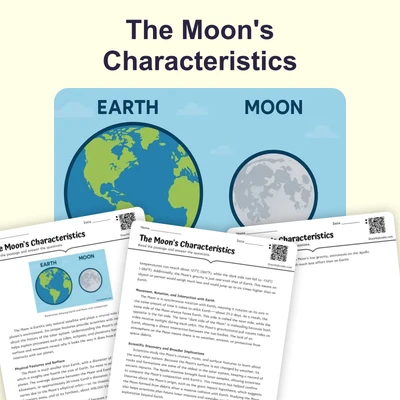
This comprehensive science reading passage for grades 6-8 examines the Moon's physical characteristics, including its si...
MS-ESS1-1MS-ESS1-2
Lunar Eclipses
This passage introduces middle school students to the phenomenon of lunar eclipses, connecting observable events to the ...
MS-ESS1-1
The Sun's Characteristics
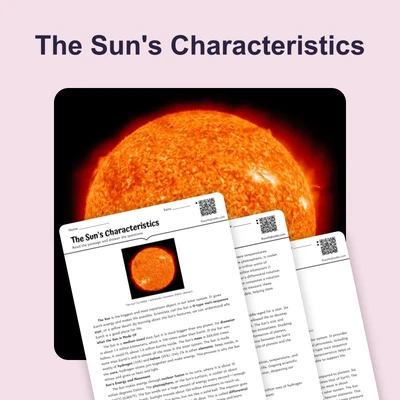
This engaging science passage introduces middle school students to the Sun’s key characteristics, such as its classifica...
MS-ESS1-1MS-ESS1-2
What Is a Galaxy?
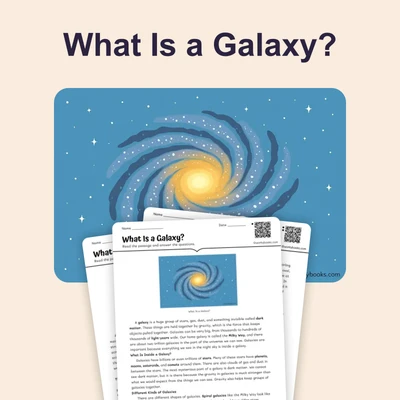
This comprehensive middle school science passage answers the question: What is a galaxy? Aligned to NGSS standard MS-ESS...
MS-ESS1-1
The Milky Way: Our Home Galaxy
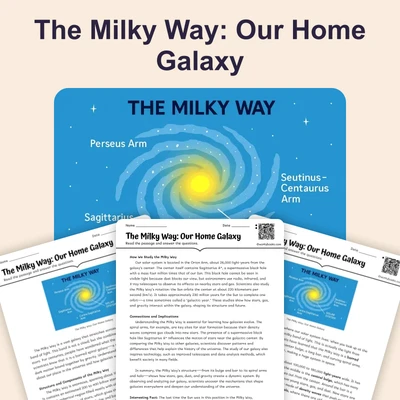
This comprehensive science passage introduces middle school students to the Milky Way, the barred spiral galaxy that is ...
MS-ESS1-1
Types of Galaxies
This comprehensive middle school science passage introduces students to the classification and characteristics of galaxi...