What Are Radio Telescopes
Interactive passage with audio narration, comprehension questions, and printable PDF.
By completing this purchase you agree to our Terms of Use and Privacy Policy. Your subscription renews automatically until you cancel. You can cancel anytime from your account settings. All sales are final and non-refundable. Digital content is available for download in your account immediately upon purchase.
What's included
What Are Radio Telescopes preview and details
About this printable What Are Radio Telescopes science reading passage, NGSS-aligned (Grades 5-8)
Sample passage and quiz from What Are Radio Telescopes
Reading passage and comprehension quiz preview
What Are Radio Telescopes
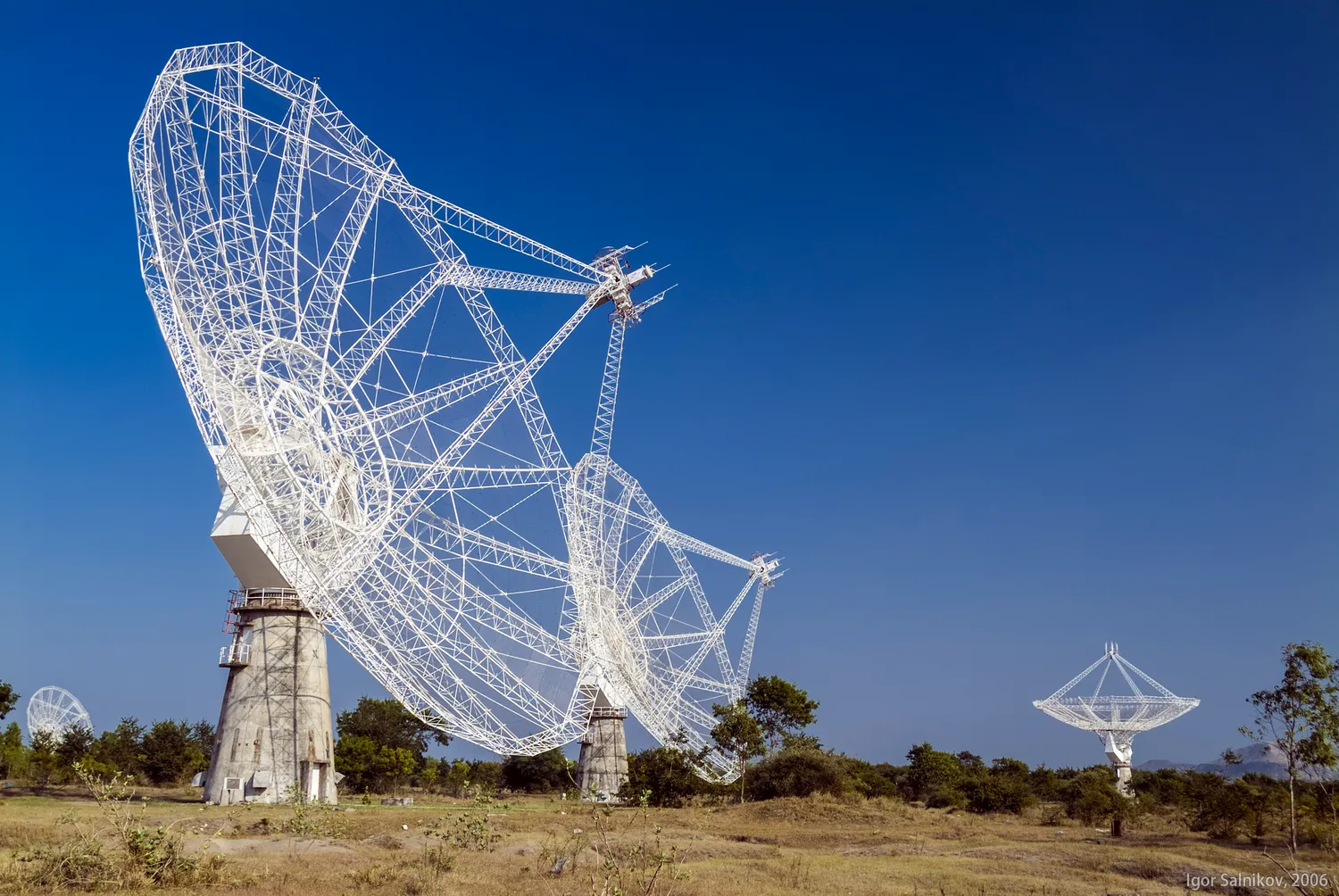
"Giant Microwave Radio Telescope" by Igoressen / Wikimedia Commons
Radio telescopes are specialized instruments that detect radio waves from space rather than visible light. Unlike optical telescopes that use lenses or mirrors to collect light, radio telescopes use large metal dishes to collect radio waves. These waves are a form of electromagnetic radiation with longer wavelengths than visible light. Scientists use radio telescopes to study objects and events in the universe that cannot be seen with traditional telescopes.
A typical radio telescope looks like a giant satellite dish, often measuring 25 to 100 meters across. The curved metal surface reflects incoming radio waves to a receiver at the focal point. The receiver converts these waves into electrical signals that computers can analyze. Multiple radio telescopes can be linked together across continents to form an array. This technique, called interferometry, combines signals from different locations to create more detailed images. The Very Large Array in New Mexico uses 27 radio telescopes working together.
Radio telescopes detect many fascinating cosmic objects. Quasars are extremely bright and distant objects powered by supermassive black holes. Pulsars are rapidly spinning neutron stars that emit regular pulses of radio waves. Scientists also use radio telescopes to study the cosmic microwave background, which is radiation left over from the Big Bang. Evidence shows that this faint radio signal provides important clues about the early universe. Radio telescopes can detect clouds of gas and dust where new stars form.
Radio telescopes offer important advantages over optical telescopes. They can operate day and night because radio waves pass through Earth's atmosphere at all times. Clouds, fog, and light pollution do not block radio waves. This means radio telescopes can collect data continuously in almost any weather condition. Scientists explain that radio astronomy reveals aspects of the universe that remain invisible to other instruments. Radio telescopes help us understand the structure and history of galaxies, including our own Milky Way.
Interesting Fact: The Arecibo radio telescope in Puerto Rico was so large that its 305-meter dish could have held 357 million boxes of cereal before it collapsed in 2020.
Comprehension quiz (10 questions)
1. What type of waves do radio telescopes detect from space?
2. How many radio telescopes work together at the Very Large Array in New Mexico?
3. What does the term 'interferometry' mean in the context of radio telescopes?
4. What is the cosmic microwave background?
5. Why can radio telescopes work day and night?
6. What can scientists learn by studying pulsars?
7. Which advantage do radio telescopes have over optical telescopes?
8. What powers quasars according to the passage?
9. Radio telescopes can only work at night when it is dark.
10. Radio waves have longer wavelengths than visible light.
Perfect for the way you teach
- Build comprehension skills
- Auto-graded quiz
- Differentiated reading
- Read together at home
- Improve fluency
- Quiet reading time
- Reading curriculum support
- Independent practice
- Track Lexile growth