What Causes Day and Night
Interactive passage with audio narration, comprehension questions, and printable PDF.
By completing this purchase you agree to our Terms of Use and Privacy Policy. Your subscription renews automatically until you cancel. You can cancel anytime from your account settings. All sales are final and non-refundable. Digital content is available for download in your account immediately upon purchase.
What's included
What Causes Day and Night preview and details
About this printable What Causes Day and Night science reading passage, NGSS-aligned (Grades 5-8)
Sample passage and quiz from What Causes Day and Night
Reading passage and comprehension quiz preview
What Causes Day and Night
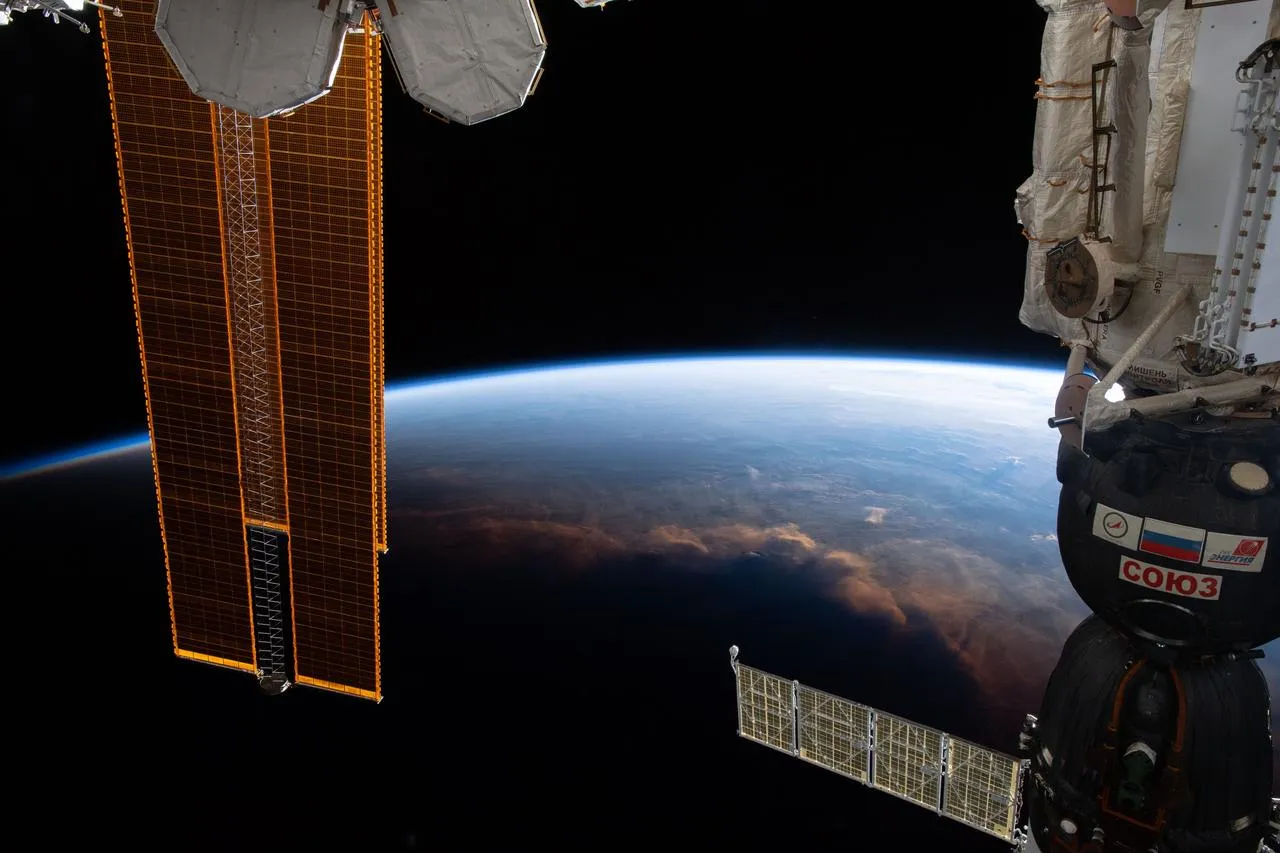
"iss059e025207". image by NASA (Public domain).
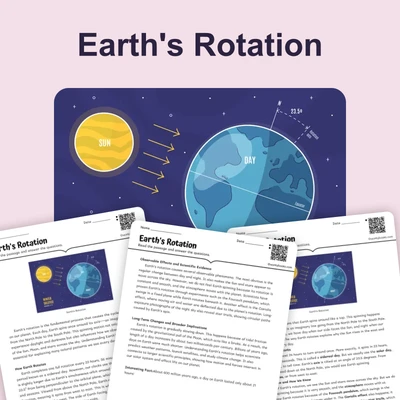
What causes day and night on Earth? The answer lies in Earth's constant rotation on its axis. Our planet spins like a top, completing one full rotation every 24 hours. This spinning motion creates the cycle of day and night that we experience every single day.
Earth rotates around an imaginary line called an axis that runs through the North and South Poles. As Earth spins, different parts of the planet face toward or away from the Sun. The hemisphere facing the Sun receives direct sunlight and experiences daytime. At the same moment, the hemisphere facing away from the Sun is in shadow and experiences nighttime. Scientists explain that this rotation never stops, which means the line between light and dark continuously moves across Earth's surface.
The speed of Earth's rotation determines the length of our day. Earth rotates at approximately 1,000 miles per hour at the equator. This might seem fast, but the rotation is so smooth that we cannot feel it. Evidence shows that Earth's rotation can be observed by tracking the Sun's apparent movement across the sky. The Sun appears to rise in the east, move overhead, and set in the west. However, the Sun is not actually moving around Earth. Instead, Earth's rotation makes it seem like the Sun is moving.
Consider what happens in New York City and Tokyo. When it is noon in New York, the Sun is high in the sky and people are eating lunch. At that exact moment, it is midnight in Tokyo, and the city is dark. Six hours later, the Sun begins to set in New York while dawn approaches in Tokyo. This happens because Earth's rotation brings different locations into and out of sunlight. The terminator is the name scientists use for the moving line that separates day from night on Earth's surface.
Understanding day and night helps us comprehend Earth's place in the solar system. Our planet's rotation affects weather patterns, ocean currents, and the behavior of living things. Many animals use the day-night cycle to know when to hunt, sleep, or migrate. Humans have built entire societies around this 24-hour cycle, creating schedules for work, school, and rest. Earth's rotation is one of the most fundamental motions that shapes life on our planet.
Interesting Fact: Earth's rotation is gradually slowing down by about 1.7 milliseconds per century. This means that dinosaurs experienced slightly shorter days than we do today!
Comprehension quiz (10 questions)
1. How long does it take Earth to complete one full rotation on its axis?
2. What is the axis of Earth?
3. What is the term scientists use for the line that separates day from night on Earth?
4. Why does the Sun appear to move across the sky during the day?
5. When it is noon in New York City, what time is it in Tokyo?
6. What causes one side of Earth to experience daytime?
7. At approximately what speed does Earth rotate at the equator?
8. How does Earth's rotation affect living things?
9. True or False: We can feel Earth spinning because it rotates so fast.
10. True or False: The line between day and night on Earth stays in the same place.
Perfect for the way you teach
- Build comprehension skills
- Auto-graded quiz
- Differentiated reading
- Read together at home
- Improve fluency
- Quiet reading time
- Reading curriculum support
- Independent practice
- Track Lexile growth