What Does the Webb Telescope See
Interactive passage with audio narration, comprehension questions, and printable PDF.
By completing this purchase you agree to our Terms of Use and Privacy Policy. Your subscription renews automatically until you cancel. You can cancel anytime from your account settings. All sales are final and non-refundable. Digital content is available for download in your account immediately upon purchase.
What's included
What Does the Webb Telescope See preview and details
About this printable What Does the Webb Telescope See science reading passage, NGSS-aligned (Grades 5-8)
Sample passage and quiz from What Does the Webb Telescope See
Reading passage and comprehension quiz preview
What Does the Webb Telescope See
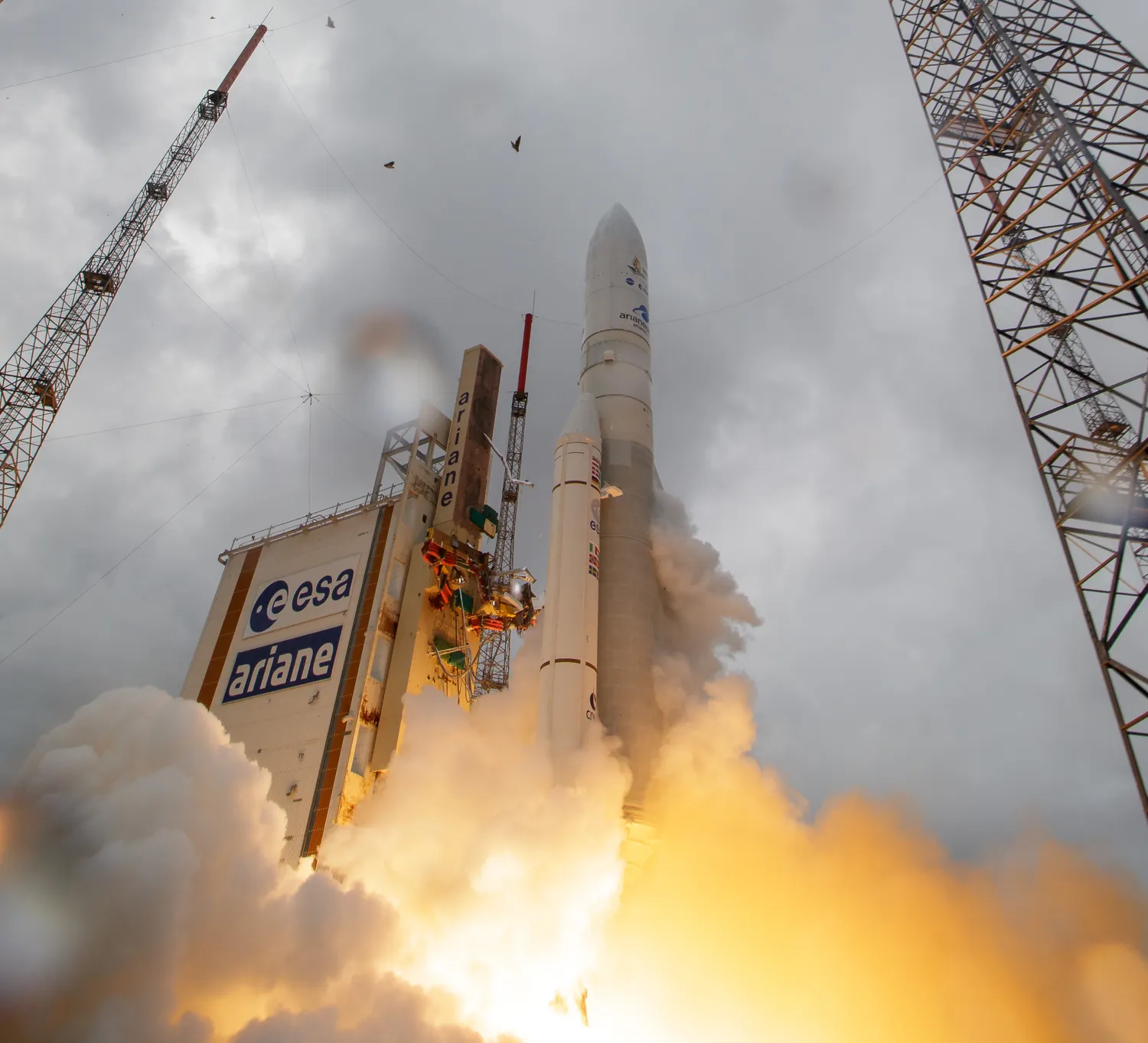
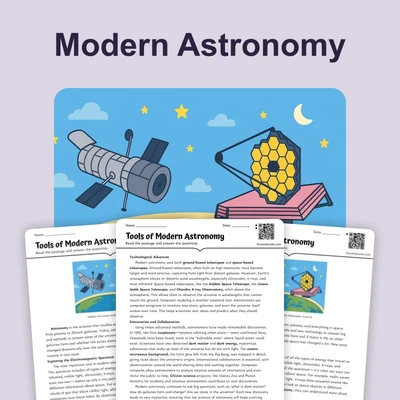
Arianespace's Ariane 5 rocket launches with NASA’s James Webb Space Telescope onboard, Saturday, Dec. 25, 2021, from the ELA-3 Launch Zone of Europe’s Spaceport at the Guiana Space Centre in Kourou, French Guiana. The James Webb Space Telescope (sometimes called JWST or Webb) is a large infrared telescope with a 21.3 foot (6.5 meter) primarymirror. Image by Bill Ingalls / Wikimedia Commons
The James Webb Space Telescope sees the universe in a completely different way than our eyes can. Webb detects infrared light, which is invisible to humans. This special ability allows Webb to peer through clouds of cosmic dust that block visible light. Scientists observe hidden regions of space where stars are born and galaxies formed billions of years ago.
Infrared light has longer wavelengths than visible light on the electromagnetic spectrum. When light from distant objects travels through space, it stretches and shifts toward the infrared range. Webb's instruments can detect this stretched light from the earliest galaxies. The telescope also captures infrared heat signatures from cool objects like planets and dust clouds. Evidence shows that infrared observation reveals structures that remain invisible to telescopes detecting only visible light.
Webb orbits the Sun at a point called L2, located one million miles from Earth. This position keeps Webb far beyond the Moon's orbit. The telescope's massive mirror measures 21 feet across and consists of 18 gold-coated segments. Gold reflects infrared light very efficiently. A giant sunshield the size of a tennis court protects Webb's instruments from heat. The telescope must stay extremely cold to detect faint infrared signals from space.
Scientists use Webb to study exoplanet atmospheres by analyzing infrared light passing through them. In 2022, Webb detected carbon dioxide in the atmosphere of a gas giant planet 700 light-years away. The telescope has also captured images of star-forming regions in nearby nebulae. Webb's observations of ancient galaxies reveal that large galaxies formed earlier than scientists previously thought. These discoveries can change our understanding of cosmic history.
Webb's infrared vision matters because it allows scientists to answer fundamental questions about the universe. The telescope helps researchers understand how stars and planets form from dust and gas. Webb's ability to analyze exoplanet atmospheres may help identify worlds with conditions suitable for life. By observing the most distant galaxies, scientists learn how the universe evolved over billions of years. Webb's discoveries demonstrate how technology expands human knowledge of Earth's place in the cosmos.
Interesting Fact: The James Webb Space Telescope can detect the heat signature of a bumblebee at the distance of the Moon. This incredible sensitivity allows it to observe extremely faint and distant objects in space.
Comprehension quiz (10 questions)
1. What type of light does the James Webb Space Telescope detect?
2. How far from Earth is the Webb telescope located?
3. What does the term 'wavelength' mean in the context of the passage?
4. Why is Webb's mirror coated with gold?
5. Based on the passage, why can Webb see through cosmic dust when other telescopes cannot?
6. What discovery did Webb make about exoplanet atmospheres in 2022?
7. How might Webb's observations change our understanding of the universe?
8. If scientists wanted to study how planets form from dust and gas, which telescope feature would be most useful?
9. The James Webb Space Telescope can only see objects in our solar system.
10. Webb must stay extremely cold to detect faint infrared signals from space.
Perfect for the way you teach
- Build comprehension skills
- Auto-graded quiz
- Differentiated reading
- Read together at home
- Improve fluency
- Quiet reading time
- Reading curriculum support
- Independent practice
- Track Lexile growth