This comprehensive middle school science passage explores the phenomenon of full moons and their place in the lunar cycle. Aligned with NGSS standards MS-ESS1-1 and MS-ESS1.B, students learn how Earth's position between the Sun and Moon creates this distinctive lunar phase. The passage explains the Earth-Sun-Moon system, orbital mechanics, and the cultural significance of full moons throughout human history. Audio-integrated content supports diverse learners with clear explanations of key vocabulary including lunar phase, orbit, illuminate, celestial, alignment, and hemisphere. Students engage with multiple-choice questions, writing activities, and graphic organizers that reinforce understanding of patterns in the solar system. The passage includes real-world examples and helps students develop scientific reasoning skills while exploring how observations of the Moon have shaped human understanding of space. Perfect for grades 6-8 Earth and space science curriculum.
Written by Workybooks TeamPublished by Workybooks
Preview
Sample passage and quiz content
CONTENT PREVIEW
Expand content preview
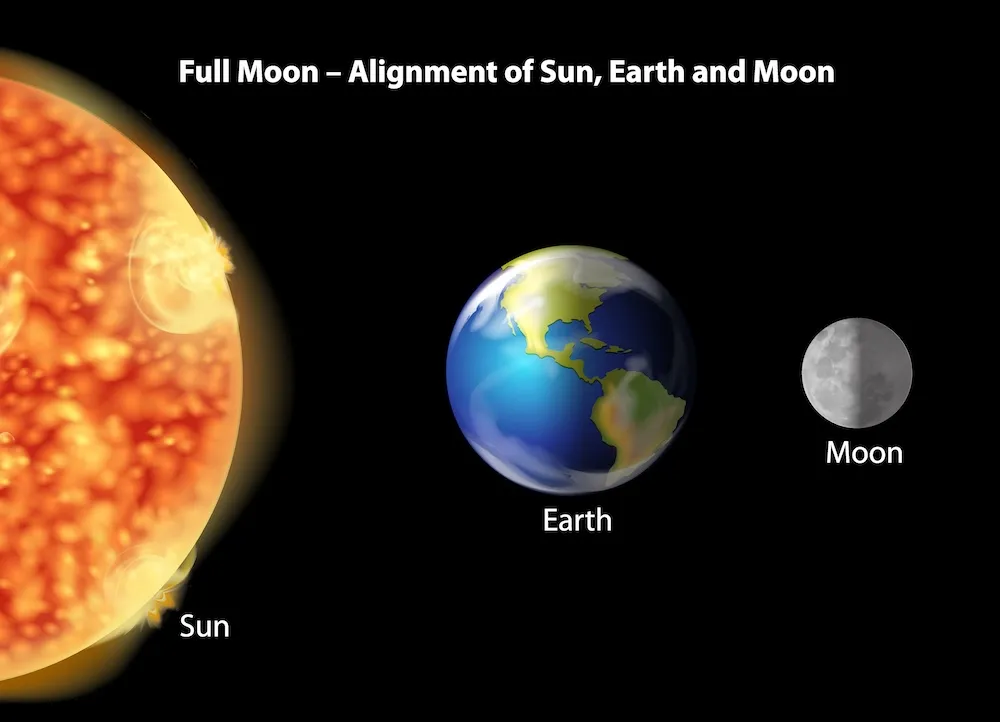
A full moon is a lunar phase that occurs when Earth sits directly between the Sun and the Moon.
A full moon is a lunar phase that occurs when Earth sits directly between the Sun and the Moon. During this alignment, sunlight shines on the entire half of the Moon facing Earth. This positioning allows us to see the Moon's fully lit side as a bright, complete circle in the night sky. Scientists explain that the full moon represents one specific point in the Moon's monthly journey around Earth.
The Moon does not produce its own light. Instead, it reflects sunlight that reaches its surface. As the Moon orbits Earth, different amounts of its sunlit side become visible from our planet. This creates the changing moon phases we observe. Evidence shows that a full moon occurs approximately every 29.5 days, which is the length of one complete lunar cycle. The Moon's orbit around Earth and Earth's orbit around the Sun work together to create this predictable pattern.
Full moons rise in the east around sunset and set in the west near sunrise. This timing happens because Earth, the Moon, and the Sun form a straight line during this phase. The Moon appears on the opposite side of Earth from the Sun. Observers in both the Northern and Southern hemispheres can see the full moon, though it appears at different angles depending on location. The full moon provides enough light to cast shadows and illuminate landscapes at night.
Scientists observe that full moons have influenced human cultures for thousands of years. Many ancient civilizations used lunar phases to track time and create calendars. In January 2019, people across North and South America witnessed a total lunar eclipse during a full moon. This event occurred when Earth's shadow fell directly on the Moon's surface. The Moon appeared reddish-orange because Earth's atmosphere bent some sunlight around our planet. Such observations help scientists understand the geometry of the Earth-Sun-Moon system.
Understanding full moons matters because it connects us to larger patterns in our solar system. The predictable nature of lunar phases demonstrates how celestial objects move in regular, measurable ways. This knowledge helps scientists plan space missions and understand gravitational effects. Full moons also affect ocean tides on Earth because the Moon's gravity pulls on our planet's water. Studying the Moon's phases teaches us about orbital mechanics and helps us appreciate Earth's place in space.
Interesting Fact: The term "supermoon" describes a full moon that occurs when the Moon reaches its closest point to Earth in its orbit. During a supermoon, the Moon can appear up to 14% larger and 30% brighter than when it is at its farthest point.
What causes a full moon to appear in the night sky?
The Moon produces its own lightEarth sits between the Sun and the MoonThe Sun moves behind the MoonEarth's shadow covers the Moon
How often does a full moon occur?
Every 7 daysEvery 14 daysApproximately every 29.5 daysEvery 60 days
What does the word 'illuminate' mean in the passage?
To make dark or shadowyTo light up or make visibleTo move in a circleTo reflect off a surface
Based on the passage, what is a lunar phase?
The time it takes the Moon to orbit EarthThe distance between Earth and the MoonThe different shapes of the Moon's lit portion as seen from EarthThe temperature on the Moon's surface
Why did the Moon appear reddish-orange during the January 2019 lunar eclipse?
The Moon was covered in red dustEarth's atmosphere bent some sunlight around the planetThe Sun changed color during the eclipseThe Moon moved closer to Mars
What can be inferred about the relationship between the Moon and ocean tides?
The Moon has no effect on Earth's oceansOcean tides control the Moon's movementThe Moon's gravity pulls on Earth's water, affecting tidesTides only occur during full moons
If you wanted to observe a full moon rising, what time would be best to look?
Early morningNoonAround sunsetMid-afternoon
How might understanding lunar phases help scientists plan space missions?
It shows unpredictable patterns in spaceIt demonstrates regular, measurable movements of celestial objectsIt proves the Moon is closer during full moonsIt changes the distance to other planets
True or False: The Moon produces its own light like the Sun does.
TrueFalse
True or False: A supermoon occurs when the Moon is at its closest point to Earth during a full moon.
TrueFalse
Who it's for
Perfect for the way you teach
Teachers
Build comprehension skills
Auto-graded quiz
Differentiated reading
Parents
Read together at home
Improve fluency
Quiet reading time
Homeschoolers
Reading curriculum support
Independent practice
Track Lexile growth
Topics
full moonlunar phasesEarth-Sun-Moon systemmoon phasesastronomymiddle school scienceNGSS MS-ESS1-1celestial objects
Reviews & Ratings
No reviews yet. Be the first to share your experience!
More reading you might love
20 more
What is Solar Radiation
This NGSS-aligned science reading passage for middle school students explores the concept of solar radiation. Solar radi...
MS-ESS1-1
How Incoming Solar Radiation Changes with Latitude
This NGSS-aligned science reading passage helps middle school students understand how solar radiation, or insolation, ch...
MS-ESS1-1
Tides and Tidal Forces
This middle school science passage explores the mechanisms of tides and tidal forces, aligning with NGSS standards MS-ES...
MS-ESS1-1MS-ESS1-2
The Night Sky
This comprehensive science reading passage for grades 6-8 aligns with NGSS standard MS-ESS1-1 and explores the systems a...
MS-ESS1-1
Ancient Astronomy
This engaging passage for grades 6-8 explores the history of astronomy through the lens of ancient observations. Student...
MS-ESS1-1
Tools of Modern Astronomy
This passage introduces middle school students to modern astronomy, aligning with NGSS standard MS-ESS1-1. It explains h...
MS-ESS1-1
How Astronomy Became a Science
This passage explores the transformative period known as the Scientific Revolution, with a special focus on the history ...
MS-ESS1-1
Earth's Rotation
This middle school science passage, aligned with NGSS standard MS-ESS1-1, focuses on Earth's rotation—how Earth spins on...
MS-ESS1-1
Earth's Revolution
This middle school science passage explores the science behind Earth's revolution around the Sun, closely aligned with N...
MS-ESS1-1
Why We Have Seasons
This comprehensive middle school science reading passage explains the mechanisms behind Earth's seasons, directly addres...
MS-ESS1-1
Earth's Seasons
This comprehensive reading passage for grades 6-8 explains why Earth has seasons, revealing the scientific mechanisms be...
MS-ESS1-1
Phases of the Moon
This comprehensive middle school science passage explains the phases of the Moon, focusing on the mechanisms behind the ...
MS-ESS1-1
Tides
This comprehensive middle school science reading passage explores the phenomenon of ocean tides, aligned to NGSS standar...
MS-ESS1-1MS-ESS1-2
Eclipses
This comprehensive passage for grades 6-8 explores the science behind eclipses, including solar and lunar eclipses, thei...
MS-ESS1-1
The Moon's Characteristics
This comprehensive science reading passage for grades 6-8 examines the Moon's physical characteristics, including its si...
MS-ESS1-1MS-ESS1-2
Lunar Eclipses
This passage introduces middle school students to the phenomenon of lunar eclipses, connecting observable events to the ...
MS-ESS1-1
The Sun's Characteristics
This engaging science passage introduces middle school students to the Sun’s key characteristics, such as its classifica...
MS-ESS1-1MS-ESS1-2
What Is a Galaxy?
This comprehensive middle school science passage answers the question: What is a galaxy? Aligned to NGSS standard MS-ESS...
MS-ESS1-1
The Milky Way: Our Home Galaxy
This comprehensive science passage introduces middle school students to the Milky Way, the barred spiral galaxy that is ...
MS-ESS1-1
Types of Galaxies
This comprehensive middle school science passage introduces students to the classification and characteristics of galaxi...