What Is a Sidereal Day
Interactive passage with audio narration, comprehension questions, and printable PDF.
By completing this purchase you agree to our Terms of Use and Privacy Policy. Your subscription renews automatically until you cancel. You can cancel anytime from your account settings. All sales are final and non-refundable. Digital content is available for download in your account immediately upon purchase.
What's included
What Is a Sidereal Day preview and details
About this printable What Is a Sidereal Day science reading passage, NGSS-aligned (Grades 5-8)
Sample passage and quiz from What Is a Sidereal Day
Reading passage and comprehension quiz preview
What Is a Sidereal Day
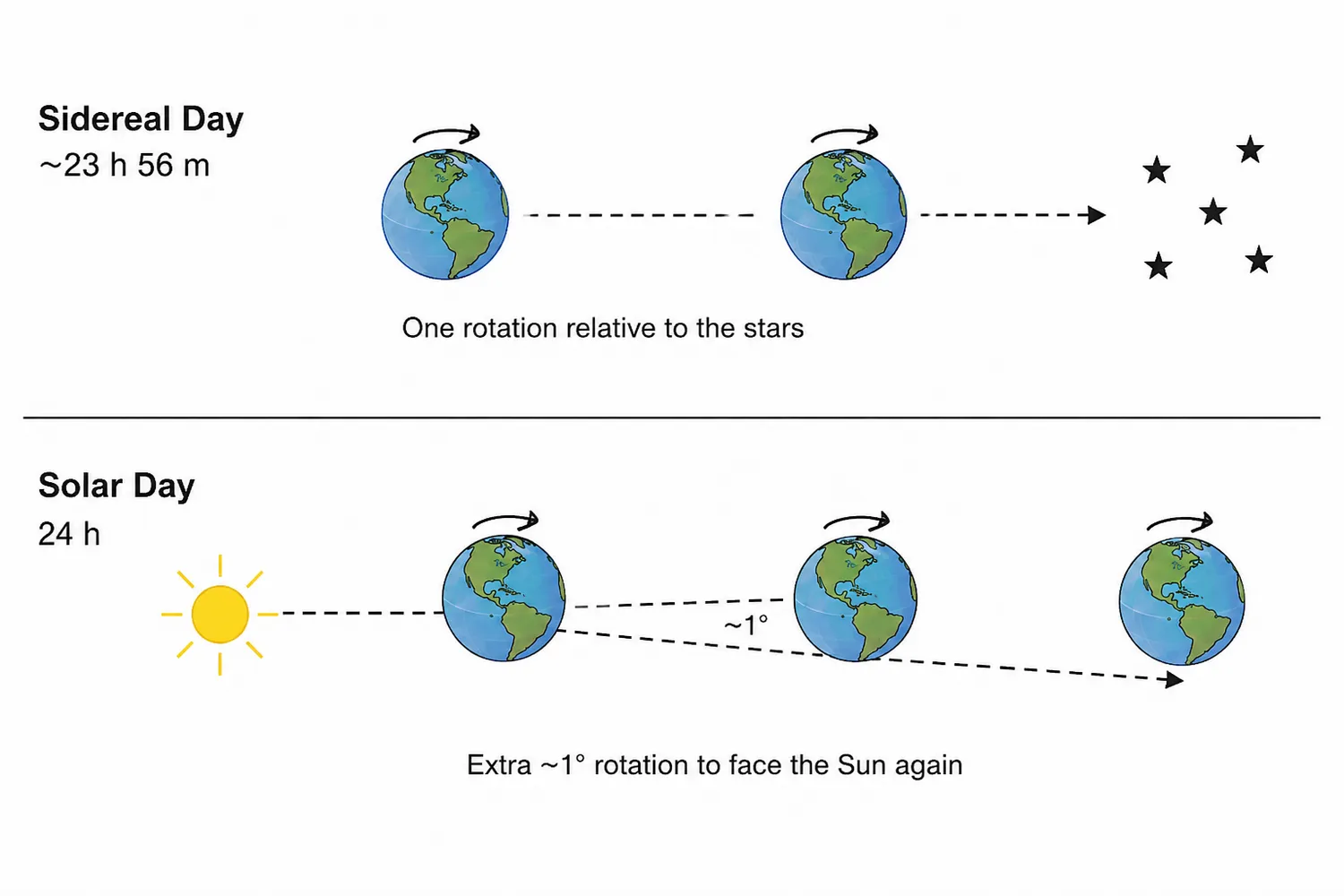
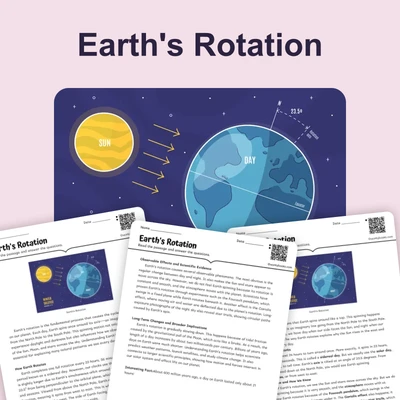
A sidereal day measures Earth's true rotation time. This period lasts about 23 hours and 56 minutes. Scientists measure this rotation against distant stars in space. The stars provide fixed reference points that do not appear to move. When Earth completes one full spin relative to these stars, one sidereal day passes.
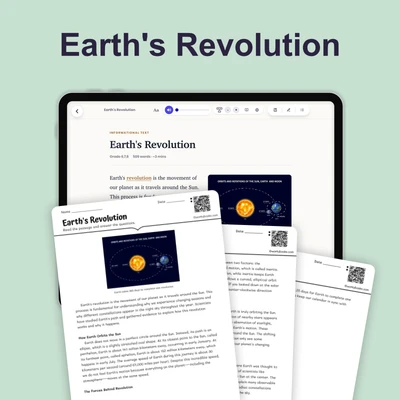
Most people use a 24-hour solar day for daily schedules and clocks. A solar day measures the time between when the Sun appears highest in the sky on two consecutive days. This measurement takes four minutes longer than a sidereal day. The difference occurs because Earth moves along its orbit around the Sun while it rotates. After Earth completes one full rotation relative to the stars, it must spin a bit more to face the Sun again. This extra rotation takes approximately four minutes.
Earth travels about 1.6 million miles along its orbit each day. This orbital motion changes Earth's position relative to the Sun. Evidence shows that Earth must rotate about one extra degree beyond a complete 360-degree turn to point toward the Sun again. Scientists explain that this small additional rotation accumulates over time. The four-minute daily difference adds up to 24 hours over one year. This means Earth actually completes 366.25 sidereal days during one trip around the Sun, but we experience only 365.25 solar days.
Astronomers use sidereal time to track stars and other distant objects in the night sky. Observatories around the world rely on this measurement system. For example, the Arecibo Observatory in Puerto Rico used sidereal time to point its radio telescope at specific stars. The system helped scientists observe the same celestial objects at precise times. This celestial timekeeping method can predict when particular stars will appear in certain positions. Navigation systems and space missions also depend on accurate measurements of Earth's rotation.
Understanding sidereal days helps explain how Earth moves through space. The concept shows that Earth's rotation and orbital motion work together as connected systems. This knowledge matters for satellite operations, astronomy research, and understanding our planet's place in the solar system. Scientists use these measurements to calculate positions of objects in space with great precision.
Interesting Fact: If you could stand on Mars, you would experience a sidereal day of about 24 hours and 37 minutes. This shows that each planet has its own unique rotation period based on its size and formation history.
Comprehension quiz (10 questions)
1. How long does a sidereal day last?
2. What do scientists use as reference points to measure a sidereal day?
3. What does the term 'orbital motion' mean in the passage?
4. According to the passage, what does 'celestial' refer to?
5. Why does a solar day take four minutes longer than a sidereal day?
6. What can scientists predict using sidereal time?
7. How many sidereal days does Earth complete in one year?
8. Which facility mentioned in the passage used sidereal time to point its telescope?
9. True or False: A sidereal day measures Earth's rotation relative to the Sun.
10. True or False: The four-minute daily difference between sidereal and solar days adds up to 24 hours over one year.
Perfect for the way you teach
- Build comprehension skills
- Auto-graded quiz
- Differentiated reading
- Read together at home
- Improve fluency
- Quiet reading time
- Reading curriculum support
- Independent practice
- Track Lexile growth