This 400-500 word informational science reading passage explores the asteroid belt for middle school students in grades 6-8. Students learn about the main asteroid belt located between Mars and Jupiter, understanding why this region contains millions of rocky objects instead of a planet. The passage explains how Jupiter's powerful gravity disrupted the formation of a planet during solar system formation 4.6 billion years ago. Aligned with NGSS standards MS-ESS1-3 and MS-ESS1.B, this passage helps students understand patterns in the solar system and gravitational forces. The content includes audio integration, vocabulary development with 8-10 key science terms, and real-world examples. Students explore scientific evidence and develop critical thinking skills through comprehension questions, writing activities, and graphic organizers. The passage is available in English and Spanish, with differentiated versions for English Language Learners and struggling readers.
Written by Workybooks TeamPublished by Workybooks
Preview
Sample passage and quiz content
CONTENT PREVIEW
Expand content preview
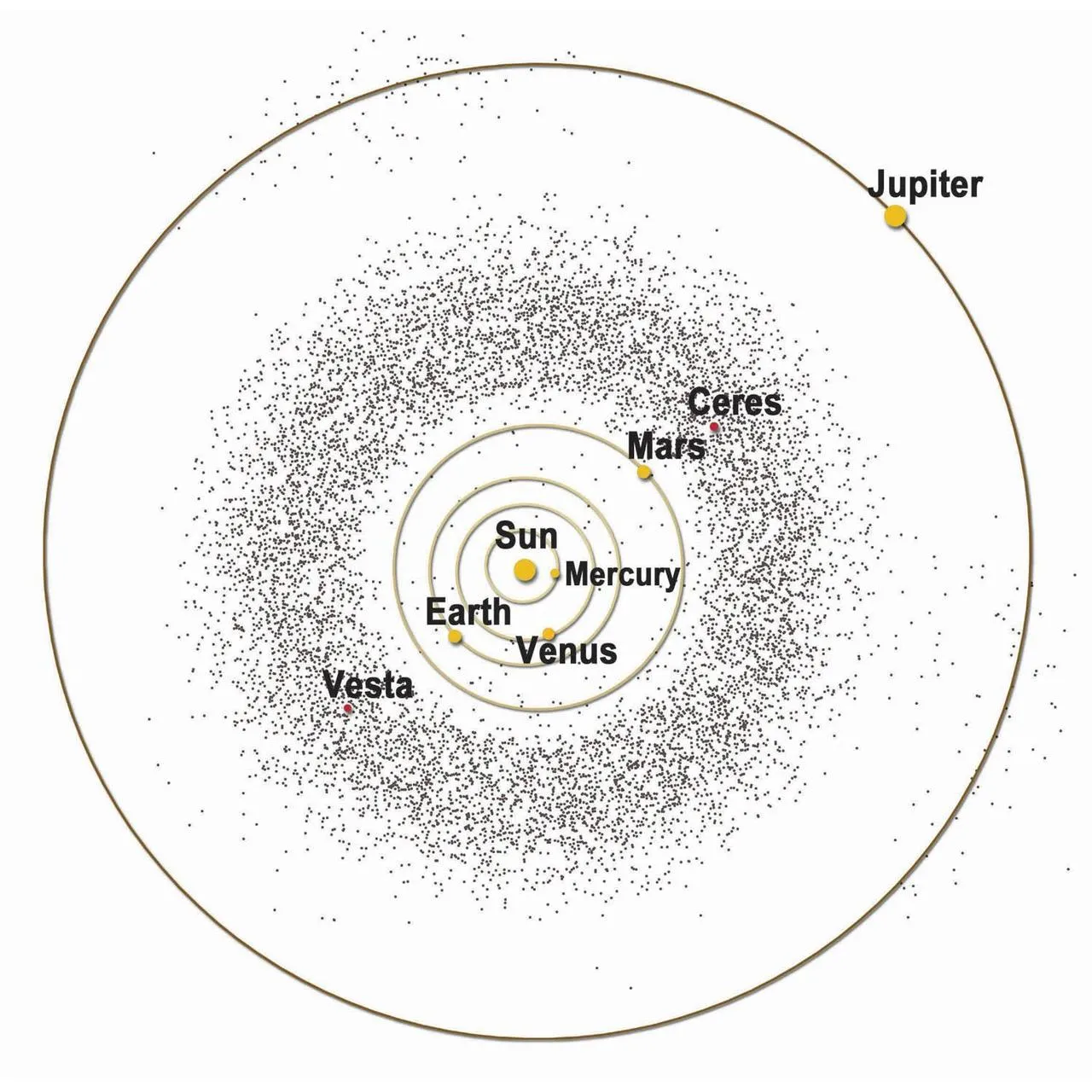
The asteroid belt is a vast region of space between Mars and Jupiter. This zone contains millions of rocky objects called asteroids that orbit the Sun. "Asteroid Belt" / NASA
The asteroid belt is a vast region of space between Mars and Jupiter. This zone contains millions of rocky objects called asteroids that orbit the Sun. Scientists explain that the asteroid belt formed about 4.6 billion years ago during the birth of our solar system. Most asteroids are small, ranging from tiny pebbles to rocks hundreds of kilometers wide. The largest asteroid, Ceres, measures about 940 kilometers across. Evidence shows that these objects are leftover materials from when planets formed.
The asteroid belt exists because of Jupiter's powerful gravity. When the solar system was forming, dust and gas swirled around the young Sun. Small particles collided and stuck together, forming larger objects called planetesimals. In most regions, planetesimals continued combining until they became planets. However, Jupiter's enormous mass created strong gravitational forces in the nearby region. These forces pulled on the planetesimals between Mars and Jupiter. The gravitational tugs caused the objects to speed up and collide violently. Instead of sticking together gently, the planetesimals smashed apart or scattered. This process prevented the material from coalescing into a single planet.
Scientists observe that the asteroid belt is not densely packed like movies sometimes show. The asteroids are spread across a huge volume of space. A spacecraft can travel through the belt without hitting anything. NASA's Dawn mission visited Ceres in 2015, providing detailed images and data. The mission revealed that Ceres may have a subsurface ocean beneath its icy crust. This discovery helps scientists understand how water and organic materials were distributed in the early solar system.
Understanding the asteroid belt matters because it provides clues about planetary formation. The asteroids are like fossils from the solar system's early days. They preserve materials that have changed little over billions of years. Studying asteroids helps scientists learn what conditions were like when Earth formed. Some asteroids contain water and organic compounds that may have been delivered to early Earth. This material could have contributed to the development of life on our planet.
Interesting Fact: If you combined all the asteroids in the belt into one object, it would be smaller than Earth's Moon. The total mass of the asteroid belt is only about 4% of the Moon's mass.
Where is the asteroid belt located in our solar system?
Between Earth and MarsBetween Mars and JupiterBetween Jupiter and SaturnBeyond Neptune
About how long ago did the asteroid belt form?
1 billion years ago2.5 billion years ago4.6 billion years ago10 billion years ago
What is the name of the largest asteroid in the asteroid belt?
VestaPallasCeresEros
What does the term 'coalescing' mean in the context of the passage?
Breaking apart into smaller piecesComing together to form a larger objectOrbiting around the SunMoving away from each other
Why did the material between Mars and Jupiter not form into a planet?
There was not enough material in that regionThe Sun's heat melted all the materialJupiter's gravity caused objects to collide violently instead of sticking togetherMars pulled all the material toward itself
According to the passage, what are planetesimals?
Large planets like JupiterSmall solid objects that formed in the early solar system and grew into planetsPieces of broken asteroidsClouds of gas and dust
What did NASA's Dawn mission discover about Ceres in 2015?
It has active volcanoes on its surfaceIt is made entirely of ironIt may have a subsurface ocean beneath its icy crustIt has rings like Saturn
Why is studying the asteroid belt important for understanding Earth?
Asteroids preserve materials from the early solar system that help scientists learn about Earth's formationAsteroids will eventually crash into EarthThe asteroid belt protects Earth from the Sun's radiationAsteroids are identical to Earth's rocks
The asteroid belt is so densely packed that spacecraft cannot travel through it without hitting asteroids.
TrueFalse
If all the asteroids in the belt were combined into one object, it would be larger than Earth's Moon.
TrueFalse
Who it's for
Perfect for the way you teach
Teachers
Build comprehension skills
Auto-graded quiz
Differentiated reading
Parents
Read together at home
Improve fluency
Quiet reading time
Homeschoolers
Reading curriculum support
Independent practice
Track Lexile growth
Topics
asteroid beltJupiterMarssolar system formationgravityasteroidsplanetesimalssolar nebulaNGSS MS-ESS1-3
Reviews & Ratings
No reviews yet. Be the first to share your experience!
More reading you might love
20 more
Sunspots and Solar Flares
This quiz is designed to test your understanding of the fascinating phenomena of sunspots and solar flares, as described...
RI.4.1RI.4.4RI.5.1ESS1.A
The Hottest Planet in the Solar System
This NGSS-aligned middle school reading passage explains why Venus is the hottest planet in our solar system. Students l...
MS-ESS1-3
Mercury: Closest to the Sun
This comprehensive, standards-aligned passage explores Mercury—the smallest and closest planet to the Sun. Students in g...
MS-ESS1-2MS-ESS1-3
Venus: Earth's Twin?
This comprehensive science passage for grades 6-8 examines Venus—often called Earth's twin—by exploring its similarities...
MS-ESS1-2MS-ESS1-3
Mars: The Red Planet
This middle school science passage explores Mars, the Red Planet, providing students in grades 6-8 with a comprehensive ...
MS-ESS1-2MS-ESS1-3
What Is the Solar System?
This passage provides a comprehensive overview of the solar system for grades 6-8, aligned with NGSS standards MS-ESS1-2...
MS-ESS1-2MS-ESS1-3
Structure of the Solar System
This comprehensive science reading passage introduces middle school students (grades 6-8) to the structure of the solar ...
MS-ESS1-2MS-ESS1-3
Scale of the Solar System
This passage, aligned to NGSS standard MS-ESS1-3, helps middle school students grasp the immense scale of the solar syst...
MS-ESS1-3
Exploration of the Solar System
This comprehensive passage for grades 6-8 examines how humans explore the solar system, aligning with NGSS standards MS-...
MS-ESS1-3MS-ETS1-1
Optical Telescopes
This comprehensive passage explores the science of optical telescopes for middle school students, aligning with NGSS sta...
MS-ESS1-3MS-ETS1-1
Future of Alien Search
This informational passage for grades 6-8 explores how scientists are using cutting-edge missions and technology to sear...
MS-ESS1-3MS-ETS1-1
Communicating with Aliens
This middle school science passage, aligned with NGSS standard MS-ESS1-3, examines the scientific and technological chal...
MS-ESS1-3
Measuring Distances in Space
This middle school science passage explores how astronomers measure the vast distances in space, aligning with NGSS stan...
MS-ESS1-3
Astronomy
This comprehensive reading passage introduces middle school students to the science of astronomy, which is the study of ...
MS-ESS1-2MS-ESS1-3MS-PS4-2MS-ETS1-1
The Solar System
This middle school science passage introduces students to the solar system, aligning with NGSS standards MS-ESS1-2 and M...
MS-ESS1-2MS-ESS1-3
The Inner Planets
This comprehensive science passage for grades 6-8 explores the inner (terrestrial) planets of our solar system—Mercury, ...
MS-ESS1-2MS-ESS1-3
The Outer Planets
This engaging science passage for grades 6-8 introduces students to the outer planets—Jupiter, Saturn, Uranus, and Neptu...
MS-ESS1-2MS-ESS1-3
Light-Years and Cosmic Distances
This middle school science passage, aligned to NGSS MS-ESS1-3, explores how astronomers measure the vast distances in sp...
MS-ESS1-3
Space Stations
This informational science reading passage for grades 6-8 explores the complex systems and technology behind space stati...
MS-ESS1-3MS-ETS1-1
Types of Spacecraft
This passage introduces middle school students to the various types of spacecraft used to explore our solar system and b...