What Is the Midnight Sun
Interactive passage with audio narration, comprehension questions, and printable PDF.
By completing this purchase you agree to our Terms of Use and Privacy Policy. Your subscription renews automatically until you cancel. You can cancel anytime from your account settings. All sales are final and non-refundable. Digital content is available for download in your account immediately upon purchase.
What's included
What Is the Midnight Sun preview and details
About this printable What Is the Midnight Sun science reading passage, NGSS-aligned (Grades 5-8)
Sample passage and quiz from What Is the Midnight Sun
Reading passage and comprehension quiz preview
What Is the Midnight Sun?

"Solfrafjellheisen" Midnight Sun from the Cable Car. Osopolar at wts wikivoyage / Wikimedia Commons
The midnight sun is a natural phenomenon where the Sun remains visible in the sky for 24 hours or more. This occurs in regions near Earth's poles during their summer months. Scientists explain that Earth's axial tilt causes this unusual pattern of daylight.
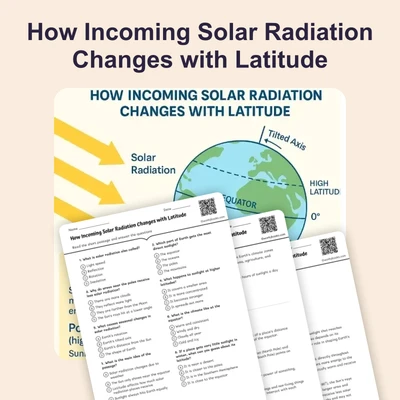
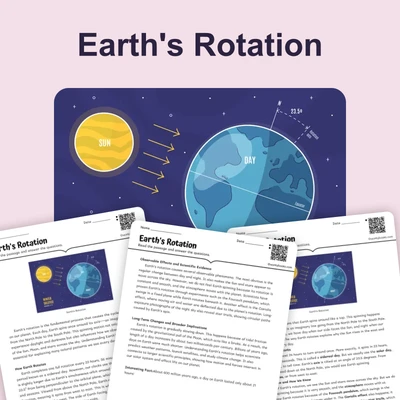
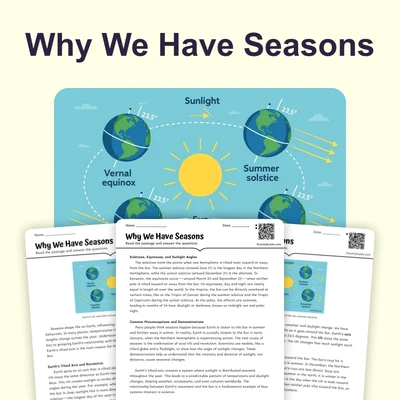
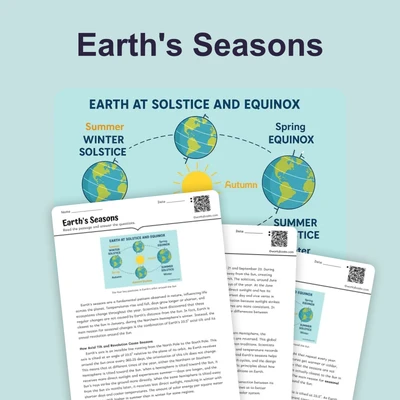
Earth tilts at an angle of 23.5 degrees as it orbits the Sun. This tilt means different parts of Earth receive varying amounts of sunlight throughout the year. During summer in the Northern Hemisphere, the Arctic Circle tilts toward the Sun. Evidence shows that locations above this circle can experience continuous daylight for weeks or even months. The same effect happens in the Antarctic Circle during the Southern Hemisphere's summer. When one pole tilts toward the Sun, the other tilts away and experiences darkness.
The midnight sun occurs because Earth's rotation cannot move these polar regions out of the Sun's light during summer. Scientists observe that the closer a location is to the poles, the longer the period of continuous daylight lasts. At the exact poles, the Sun can remain visible for about six months. The summer solstice marks the peak of this phenomenon in each hemisphere.
Tromsø, Norway, provides a clear example of how the midnight sun affects daily life. This city sits well above the Arctic Circle at 69 degrees north latitude. From late May to late July, residents experience the midnight sun. The Sun circles the sky without setting below the horizon. Communities in these regions adapt to extended daylight in various ways. Many people use blackout curtains to create darkness for sleeping. Some residents adjust their sleep schedules to match their body's natural rhythms rather than the clock.
Understanding the midnight sun helps scientists explain Earth's motion and its relationship with the Sun. This phenomenon demonstrates how Earth's tilt and orbit create different patterns of daylight across the planet. The midnight sun also affects local ecosystems, influencing plant growth and animal behavior during summer months. These patterns show the important connections between Earth's position in space and conditions on its surface.
Interesting Fact: During the midnight sun period in some Arctic locations, temperatures can reach 20°C (68°F) or higher, even at midnight. This extended sunlight allows plants to grow rapidly during the short Arctic summer.
Comprehension quiz (10 questions)
1. What is the midnight sun?
2. What causes the midnight sun to occur?
3. In the passage, what does the term 'latitude' mean?
4. How long does the midnight sun last in Tromsø, Norway?
5. Why does Earth's rotation not move polar regions out of sunlight during summer?
6. What can you infer about the relationship between distance from the poles and the length of the midnight sun?
7. How do communities adapt to the extended daylight of the midnight sun?
8. If you were designing a research study about the midnight sun's effect on plant growth, which location would provide the best data?
9. True or False: When the Northern Hemisphere experiences the midnight sun, the Southern Hemisphere experiences continuous darkness in its polar regions.
10. True or False: The midnight sun occurs because the Sun moves closer to Earth during summer months.
Perfect for the way you teach
- Build comprehension skills
- Auto-graded quiz
- Differentiated reading
- Read together at home
- Improve fluency
- Quiet reading time
- Reading curriculum support
- Independent practice
- Track Lexile growth