This learning resource is available in interactive and printable formats. The interactive worksheet can be played online and assigned to students. The Printable PDF version can be downloaded and printed for completion by hand.
This reading passage explores the question of who could vote in the United States in 1790, analyzing the causes and consequences of early voting laws. Students will learn that only white men with property could generally vote, while most Americans were excluded from politics, including women, enslaved people, free Black people, and Native Americans. The passage uses a compare/contrast structure, incorporates a primary source quote, and addresses the motivations behind voting restrictions as well as their impact on American democracy. Activities include a multiple-choice quiz, writing prompts, graphic organizers, and a timeline. The passage is aligned with D2.His.2.6-8 and RI.6.3, and includes differentiated and Spanish versions, making it accessible to a wide range of learners. A public domain image and glossary support vocabulary development. Read aloud audio is available. This resource is designed for deep engagement with historical thinking and evidence analysis, supporting both history and literacy standards.
CONTENT PREVIEW
Expand content preview
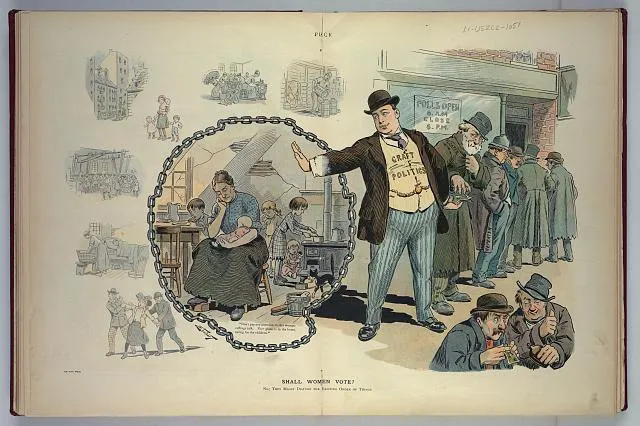
"Shall women vote?" by Ehrhart, S. D. (Samuel D.) / Library of Congress.
In 1790, the right to vote in the United States was extremely limited. After the American Revolution, leaders needed to decide who would have a say in the new government. In most states, only white men who owned property could vote in local and national elections. This restriction, called the property requirement, meant that the majority of people living in the country at the time could not participate in the political process.
The founders believed that owning property showed responsibility and independence. They thought property owners had a “stake in society” and would make careful decisions as voters. This belief influenced the development of suffrage, or the right to vote. Women, enslaved people, free Black individuals, Native Americans, and white men without property were all excluded from voting. As a result, the early electorate—the group of people allowed to vote—was very small and unrepresentative of the full population.
Different states had slightly different rules, but almost all used some form of property or tax requirement. For example, in New Jersey, some women who owned property could vote until 1807, but this was rare. In other states, the qualifications were stricter. The property requirement was a barrier that prevented most men, and nearly all women and minorities, from voting. This limited participation meant that many voices and interests were left out when important decisions were made.
The exclusion of large groups from voting led to debate and conflict. Some people argued that broadening democracy would make the government more fair and legitimate. Others feared that removing property requirements would lead to chaos or “mob rule.” Over time, as the nation grew and changed, more Americans began to question these limits. They demanded reforms to make voting more open and accessible.
The struggle to expand political rights was long and difficult. Gradually, states began to drop property requirements, allowing more white men to vote by the 1820s. However, it would take many more decades—and further social movements—before women, African Americans, and Native Americans gained full voting rights. Each change reflected ongoing debates about who truly counted as a citizen and what democracy should mean in practice.
The history of voting in the early republic shows how ideas about citizenship and equality have changed over time. By examining who could and could not vote in 1790, we better understand the challenges faced by those who fought for a more inclusive democracy, and why voting rights remain an important issue today.
Interesting Fact: In some early U.S. states, even owning a small amount of property, like a cow or a few tools, could qualify someone to vote.
Who could vote in 1790?
White male property ownersAll menAll adultsWomen and men
What did the property requirement mean?
Only property owners could voteAnyone could voteOnly women could voteOnly Native Americans could vote
Which state allowed some women to vote until 1807?
New JerseyVirginiaGeorgiaOhio
Why did leaders use property requirements?
They thought it showed responsibilityThey wanted chaosThey disliked property ownersTo include everyone
How did voting restrictions affect democracy?
It excluded many peopleIt included everyoneIt made all voices equalIt stopped elections
What happened by the 1820s?
Most states removed property rulesWomen voted everywhereNo one could voteOnly Native Americans voted
Only white men could vote in 1790. True or false?
TrueFalse
What does suffrage mean?
The right to voteOwning landMaking lawsBeing president
Perfect For:
👩🏫 Teachers
• Reading comprehension practice
• Auto-graded assessments
• Literacy skill development
👨👩👧👦 Parents
• Reading practice at home
• Comprehension improvement
• Educational reading time
🏠 Homeschoolers
• Reading curriculum support
• Independent reading practice
• Progress monitoring
Reading Features:
📖
Reading Passage
Engaging fiction or nonfiction text
❓
Comprehension Quiz
Auto-graded questions
📊
Instant Feedback
Immediate results and scoring
📄
Printable Version
Download for offline reading
🔊
Read Aloud
Voice-over with word highlighting
Reviews & Ratings
No reviews yet. Be the first to share your experience!
Related Content
New Nation America
This history reading passage, 'New Nation America,' covers how the United States struggled to become a united country af...
HSS 5.6.1RI.4.2
The Cherokee Nation: History and Culture
This reading passage explores the rich history and culture of the Cherokee Nation, one of the largest Native American tr...
D2.HIS.2.3-5D2.HIS.14.3-5RI.4.3RI.4.4RI.4.10
New Orleans: An Important Port
This engaging U.S. history reading passage explores the crucial role of New Orleans and the Louisiana Purchase in shapin...
D2.HIS.3.3-5D2.HIS.14.3-5RI.4.3RI.4.4
American Indians and U.S. Citizenship
This reading passage explores the complex history of American Indians and U.S. citizenship, focusing on the period after...
Battle of New Orleans 1815
This passage explores the pivotal Battle of New Orleans in 1815, focusing on Andrew Jackson’s leadership and the complex...
D2.HIS.2.3-5D2.HIS.3.3-5RI.4.3RI.4.4
Hamilton vs Jefferson
This engaging U.S. history reading passage explores the contrasting visions of Alexander Hamilton and Thomas Jefferson, ...
National Bank Debate
This engaging U.S. history passage explores the National Bank Debate and the constitutional disagreement between Alexand...
D2.HIS.2.3-5D2.HIS.3.3-5RI.4.3RI.4.4
Leaders Call for a New Constitution
This reading passage explores the pivotal moment in U.S. history when American leaders recognized the weaknesses of the ...
Lewis and Clark Expedition
This comprehensive U.S. History reading passage explores the Lewis and Clark Expedition (1804-1806), a pivotal journey l...
HSS 8.4.18.8.2RI.6-8.1RI.6-8.3
The Iroquois Influence on the Constitution
This comprehensive U.S. history reading passage investigates the possible influence of the Iroquois Confederacy’s Great ...
James Madison Early Life
This passage explores the formative years of James Madison—his upbringing in Virginia, his education, and his early expe...
The Louisiana Purchase Deal of 1803
This engaging U.S. history reading passage explores the Louisiana Purchase of 1803, when the United States doubled in si...
D2.HIS.1.3-5D2.HIS.3.3-5RI.4.3RI.4.4
Star-Spangled Banner Origins
This passage explores the complex history of the Star-Spangled Banner, focusing on its origins during the War of 1812, t...
D2.HIS.2.3-5D2.HIS.3.3-5RI.4.3RI.4.4
New Immigrants and New Jobs
This engaging reading passage explores the experiences of new immigrants and the rise of new jobs during the Progressive...
D2.HIS.2.3-5D2.HIS.3.3-5RI.4.3RI.4.4
Enslaved People Had No Citizenship Rights
This passage explores the realities faced by approximately four million enslaved people in the United States during the ...
Thomas Jefferson Biography
This engaging history reading passage provides a detailed look at Thomas Jefferson, one of America's most influential fo...
HSS 5.6.2RI.4.2
George Washington First President
This passage explores how George Washington became the first President of the United States in 1789 and the crucial prec...
The First Political Parties Form
This engaging passage explores the formation of America's first political parties, highlighting the Federalists and Demo...
D2.HIS.1-4.3-5RI.4.3RI.4.4
Alexander Hamilton Early Life
This passage explores the inspiring yet complex journey of Alexander Hamilton, tracing his rise from a Caribbean-born or...
James Monroe and the Monroe Doctrine
This engaging U.S. history reading passage introduces students to President James Monroe and the Monroe Doctrine, a key ...