This informative science passage for middle school students (grades 6-8) explores why a year contains 365 days and explains the relationship between Earth's orbit and our calendar system. Students discover that Earth takes 365.25 days to complete one full revolution around the Sun, and they learn how leap years compensate for the extra quarter-day to keep calendars synchronized with the seasons. The passage is aligned with NGSS MS-ESS1-1 and the Disciplinary Core Idea MS-ESS1.B: Earth and the Solar System. Through clear explanations and real-world examples, students understand the cause-and-effect relationship between Earth's orbital motion and timekeeping. The content includes audio integration for enhanced accessibility, key vocabulary terms with definitions, differentiated text for English Language Learners, Spanish translations, and engaging activities including comprehension questions, writing prompts, and graphic organizers. This comprehensive resource helps students grasp fundamental concepts about Earth's place in the solar system.
Written by Workybooks TeamPublished by Workybooks
Preview
Sample passage and quiz content
CONTENT PREVIEW
Expand content preview
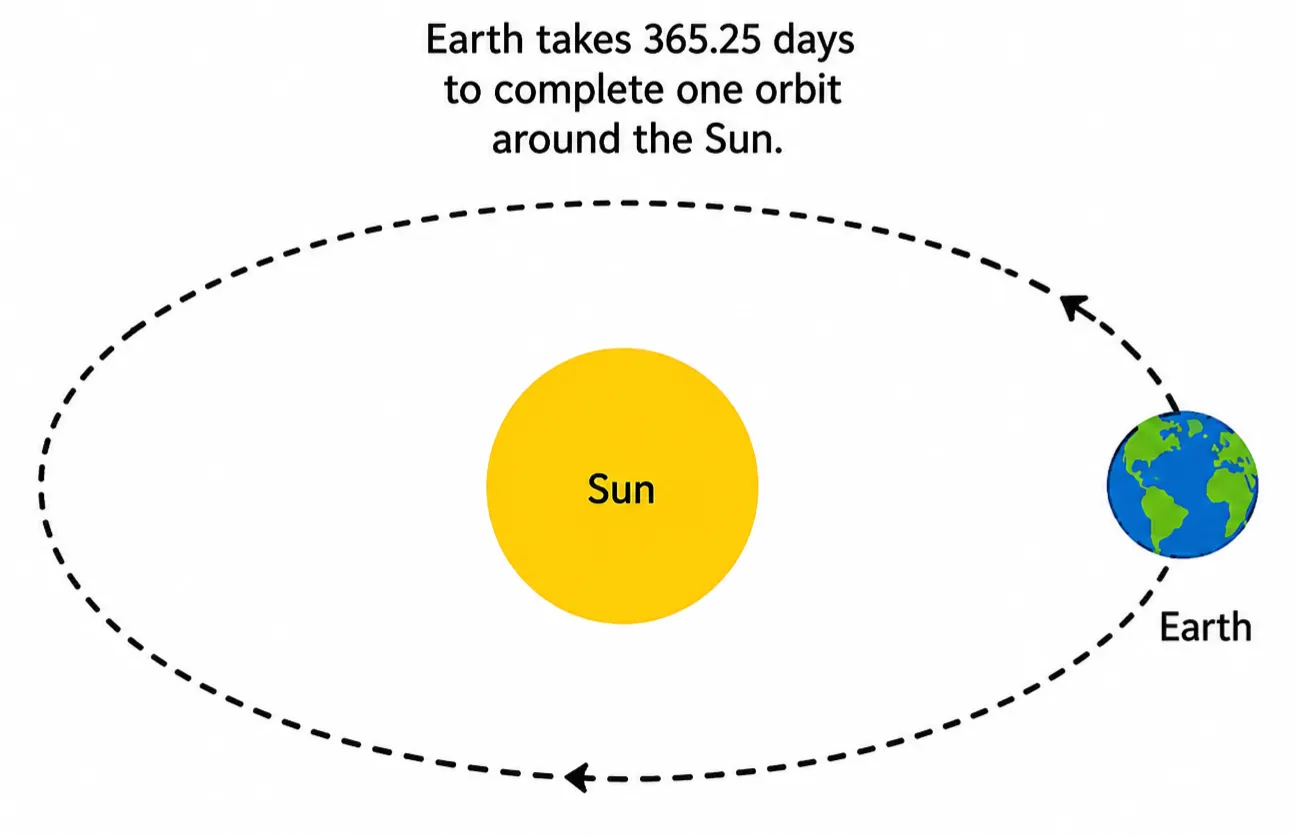
Earth completes one orbit around the Sun in one year.
A year equals 365 days because that is how long Earth takes to complete one full orbit around the Sun. Scientists observe that Earth travels in an elliptical path through space. This journey defines our concept of a year. The actual time required for one complete revolution is 365.25 days, not exactly 365 days.
Earth moves through space at approximately 67,000 miles per hour as it orbits the Sun. Evidence shows that this orbital motion remains consistent year after year. The extra 0.25 days each year creates a challenge for our calendar system. If calendars only counted 365 days, they would lose six hours annually. Over time, this difference would cause significant problems.
Calendars solve this problem by adding a leap day every four years. February gains an extra day during leap years, creating a 366-day year. This adjustment compensates for the four quarter-days that accumulate. Without leap years, calendars would drift out of sync with the seasons. After 100 years without this correction, calendars would be off by about 24 days.
The Gregorian calendar, adopted in 1582, uses this leap year system. Most years divisible by four become leap years. However, century years must be divisible by 400 to qualify as leap years. For example, the year 2000 was a leap year, but 1900 was not. This refined system keeps our calendar accurate.
Understanding Earth's orbital period matters for agriculture, climate science, and daily life. Farmers depend on predictable seasons for planting and harvesting crops. Scientists use precise orbital measurements to study climate patterns over time. Our calendar system connects human activities to Earth's motion through space. This connection demonstrates how astronomy affects everyday life on Earth.
Interesting Fact: If we did not use leap years, summer would eventually occur in December in the Northern Hemisphere after about 700 years. The seasons would completely reverse their calendar positions.
How long does it take Earth to complete one full orbit around the Sun?
365 days exactly365.25 days366 days364 days
What is the main reason calendars add a leap day every four years?
To make February longerTo celebrate a special eventTo compensate for the extra 0.25 days in Earth's orbitTo confuse people about dates
What does the term 'revolution' mean in this passage?
A war or conflictOne complete trip around the SunThe spinning of Earth on its axisA change in government
According to the passage, what would happen if we did not use leap years?
Nothing would changeThe calendar would drift out of sync with the seasonsEarth would stop orbiting the SunYears would become shorter
What does 'sync' mean in the context of this passage?
To move backwardsTo stop completelyTo match up or happen at the same timeTo speed up
Why is the year 2000 mentioned as different from the year 1900?
2000 was a leap year but 1900 was not1900 was a leap year but 2000 was notBoth were leap yearsNeither was a leap year
Based on the passage, how does understanding Earth's orbit help farmers?
It helps them predict weather patternsIt allows them to depend on predictable seasons for planting and harvestingIt tells them when to buy new equipmentIt has no effect on farming
If calendars did not correct for the extra 0.25 days each year, how far off would they be after 100 years?
About 6 daysAbout 12 daysAbout 24 daysAbout 50 days
True or False: Earth travels at approximately 67,000 miles per hour as it orbits the Sun.
TrueFalse
True or False: Without leap years, summer would eventually occur in December in the Northern Hemisphere.
TrueFalse
Who it's for
Perfect for the way you teach
Teachers
Build comprehension skills
Auto-graded quiz
Differentiated reading
Parents
Read together at home
Improve fluency
Quiet reading time
Homeschoolers
Reading curriculum support
Independent practice
Track Lexile growth
Topics
Earth orbityear lengthleap yearrevolutioncalendarseasonsMS-ESS1-1Earth-Sun systemorbital period
Reviews & Ratings
No reviews yet. Be the first to share your experience!
More reading you might love
20 more
What is Solar Radiation
This NGSS-aligned science reading passage for middle school students explores the concept of solar radiation. Solar radi...
MS-ESS1-1
How Incoming Solar Radiation Changes with Latitude
This NGSS-aligned science reading passage helps middle school students understand how solar radiation, or insolation, ch...
MS-ESS1-1
Tides and Tidal Forces
This middle school science passage explores the mechanisms of tides and tidal forces, aligning with NGSS standards MS-ES...
MS-ESS1-1MS-ESS1-2
The Night Sky
This comprehensive science reading passage for grades 6-8 aligns with NGSS standard MS-ESS1-1 and explores the systems a...
MS-ESS1-1
Ancient Astronomy
This engaging passage for grades 6-8 explores the history of astronomy through the lens of ancient observations. Student...
MS-ESS1-1
Tools of Modern Astronomy
This passage introduces middle school students to modern astronomy, aligning with NGSS standard MS-ESS1-1. It explains h...
MS-ESS1-1
How Astronomy Became a Science
This passage explores the transformative period known as the Scientific Revolution, with a special focus on the history ...
MS-ESS1-1
Earth's Rotation
This middle school science passage, aligned with NGSS standard MS-ESS1-1, focuses on Earth's rotation—how Earth spins on...
MS-ESS1-1
Earth's Revolution
This middle school science passage explores the science behind Earth's revolution around the Sun, closely aligned with N...
MS-ESS1-1
Why We Have Seasons
This comprehensive middle school science reading passage explains the mechanisms behind Earth's seasons, directly addres...
MS-ESS1-1
Earth's Seasons
This comprehensive reading passage for grades 6-8 explains why Earth has seasons, revealing the scientific mechanisms be...
MS-ESS1-1
Phases of the Moon
This comprehensive middle school science passage explains the phases of the Moon, focusing on the mechanisms behind the ...
MS-ESS1-1
Tides
This comprehensive middle school science reading passage explores the phenomenon of ocean tides, aligned to NGSS standar...
MS-ESS1-1MS-ESS1-2
Eclipses
This comprehensive passage for grades 6-8 explores the science behind eclipses, including solar and lunar eclipses, thei...
MS-ESS1-1
The Moon's Characteristics
This comprehensive science reading passage for grades 6-8 examines the Moon's physical characteristics, including its si...
MS-ESS1-1MS-ESS1-2
Lunar Eclipses
This passage introduces middle school students to the phenomenon of lunar eclipses, connecting observable events to the ...
MS-ESS1-1
The Sun's Characteristics
This engaging science passage introduces middle school students to the Sun’s key characteristics, such as its classifica...
MS-ESS1-1MS-ESS1-2
What Is a Galaxy?
This comprehensive middle school science passage answers the question: What is a galaxy? Aligned to NGSS standard MS-ESS...
MS-ESS1-1
The Milky Way: Our Home Galaxy
This comprehensive science passage introduces middle school students to the Milky Way, the barred spiral galaxy that is ...
MS-ESS1-1
Types of Galaxies
This comprehensive middle school science passage introduces students to the classification and characteristics of galaxi...