This learning resource is available in interactive and printable formats. The interactive worksheet can be played online and assigned to students. The Printable PDF version can be downloaded and printed for completion by hand.
This passage explores the legal status of women in the early United States during the era of the New Nation. Students will analyze how laws such as coverture limited women's rights, including their ability to vote and own property, and will consider multiple perspectives on these restrictions. The passage also incorporates a primary source quote and emphasizes the complexities and contradictions of gender roles in early American society. Activities include a multiple-choice quiz, writing prompts, and graphic organizers such as cause-and-effect and chronological development tables. The resource includes a Spanish translation, a differentiated reading version, and read aloud audio to support diverse learners. This resource aligns with CA HSS 8.3.3, 8.3.7 and Common Core ELA standards RI.6.3, RI.6.4, and W.6.2, making it ideal for inquiry-based learning about U.S. legal and social history.
CONTENT PREVIEW
Expand content preview
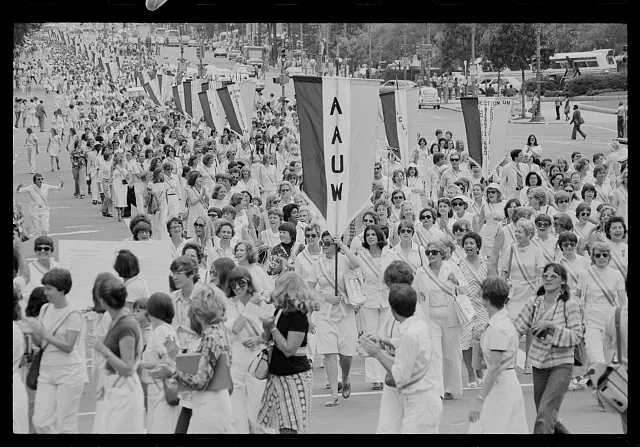
"Women's Equal Rights Parade" by Leffler, Warren K. / Library of Congress.
During the 1790s, the legal status of women in the United States was shaped by both law and custom. After the American Revolution, the new nation promoted ideas of liberty and equality for many, but these principles did not fully extend to women. Married women, in particular, were affected by the doctrine of coverture. Under coverture, a married woman's property and legal identity were controlled by her husband. She could not own land, sign contracts, or vote in elections. This restriction was reinforced by both state laws and social expectations.
Despite these limitations, women played essential roles in their families and communities. They managed households, raised children, and supported their husbands' work. Many women also contributed to the nation's development through voluntary associations and religious groups. These organizations allowed women to work together for causes such as education, charity, and social reform, even though they had little direct political power.
Some women found ways to influence society despite their limited legal rights. For example, wives of prominent political leaders, like Abigail Adams, used their positions to advocate for women's interests. Abigail famously urged her husband, John Adams, to "remember the ladies" as he helped shape new laws. Although her efforts did not lead to immediate legal change, they set an important precedent for future generations. Women also used their voices in literature, letters, and petitions to make their concerns known.
However, the status of women varied depending on race, class, and location. Enslaved women and free Black women faced even greater obstacles than white women. Their labor was essential to the nation's economy, but they had even fewer rights and protections. At the same time, some women in frontier regions had more opportunities for economic contribution due to the demands of settlement life. These differences highlight the complexity of women's experiences in the new nation.
Over time, women's contributions began to challenge the boundaries set by law and tradition. By participating in education, business, and reform movements, women slowly expanded their roles. Advocates for women's rights argued that equality should include women as well as men. The debates and actions of the 1790s laid the groundwork for future changes in women's citizenship and legal status.
Women's status in the 1790s demonstrates both the limitations they faced and the important ways they contributed to American society. The struggle for greater rights would continue into the next century, but the foundation was set during this pivotal period.
Interesting Fact: In 1792, Mary Wollstonecraft published "A Vindication of the Rights of Woman," which was widely read in America and inspired early discussions about women's equality.
What did coverture mean for married women?
Husbands controlled their propertyWomen could voteWomen ran businessesAll women owned land
Who was Abigail Adams?
A political leader's wifeA famous scientistA lawmakerA teacher
What book did Mary Wollstonecraft write in 1792?
A Vindication of the Rights of WomanCommon SenseUncle Tom's CabinThe Federalist Papers
Why did women's experiences differ by race and region?
Laws and social class variedAll women had equal rightsOnly men workedWomen could always vote
How did voluntary associations help women?
Gave them a way to work togetherAllowed them to voteMade them lawmakersGave them land
What effect did Abigail Adams's actions have?
Set a precedent for changeChanged the law immediatelyStopped women from workingEnded coverture
Women could vote in the 1790s.
TrueFalse
What is the meaning of 'restriction'?
A rule that limits actionsA person with rightsA type of clothingA voting location
Perfect For:
👩🏫 Teachers
• Reading comprehension practice
• Auto-graded assessments
• Literacy skill development
👨👩👧👦 Parents
• Reading practice at home
• Comprehension improvement
• Educational reading time
🏠 Homeschoolers
• Reading curriculum support
• Independent reading practice
• Progress monitoring
Reading Features:
📖
Reading Passage
Engaging fiction or nonfiction text
❓
Comprehension Quiz
Auto-graded questions
📊
Instant Feedback
Immediate results and scoring
📄
Printable Version
Download for offline reading
🔊
Read Aloud
Voice-over with word highlighting
Reviews & Ratings
No reviews yet. Be the first to share your experience!
Related Content
New Nation America
This history reading passage, 'New Nation America,' covers how the United States struggled to become a united country af...
HSS 5.6.1RI.4.2
The Cherokee Nation: History and Culture
This reading passage explores the rich history and culture of the Cherokee Nation, one of the largest Native American tr...
D2.HIS.2.3-5D2.HIS.14.3-5RI.4.3RI.4.4RI.4.10
New Orleans: An Important Port
This engaging U.S. history reading passage explores the crucial role of New Orleans and the Louisiana Purchase in shapin...
D2.HIS.3.3-5D2.HIS.14.3-5RI.4.3RI.4.4
American Indians and U.S. Citizenship
This reading passage explores the complex history of American Indians and U.S. citizenship, focusing on the period after...
Battle of New Orleans 1815
This passage explores the pivotal Battle of New Orleans in 1815, focusing on Andrew Jackson’s leadership and the complex...
D2.HIS.2.3-5D2.HIS.3.3-5RI.4.3RI.4.4
Hamilton vs Jefferson
This engaging U.S. history reading passage explores the contrasting visions of Alexander Hamilton and Thomas Jefferson, ...
National Bank Debate
This engaging U.S. history passage explores the National Bank Debate and the constitutional disagreement between Alexand...
D2.HIS.2.3-5D2.HIS.3.3-5RI.4.3RI.4.4
Leaders Call for a New Constitution
This reading passage explores the pivotal moment in U.S. history when American leaders recognized the weaknesses of the ...
Lewis and Clark Expedition
This comprehensive U.S. History reading passage explores the Lewis and Clark Expedition (1804-1806), a pivotal journey l...
HSS 8.4.18.8.2RI.6-8.1RI.6-8.3
The Iroquois Influence on the Constitution
This comprehensive U.S. history reading passage investigates the possible influence of the Iroquois Confederacy’s Great ...
James Madison Early Life
This passage explores the formative years of James Madison—his upbringing in Virginia, his education, and his early expe...
The Louisiana Purchase Deal of 1803
This engaging U.S. history reading passage explores the Louisiana Purchase of 1803, when the United States doubled in si...
D2.HIS.1.3-5D2.HIS.3.3-5RI.4.3RI.4.4
Star-Spangled Banner Origins
This passage explores the complex history of the Star-Spangled Banner, focusing on its origins during the War of 1812, t...
D2.HIS.2.3-5D2.HIS.3.3-5RI.4.3RI.4.4
Enslaved People Had No Citizenship Rights
This passage explores the realities faced by approximately four million enslaved people in the United States during the ...
Thomas Jefferson Biography
This engaging history reading passage provides a detailed look at Thomas Jefferson, one of America's most influential fo...
HSS 5.6.2RI.4.2
New Immigrants and New Jobs
This engaging reading passage explores the experiences of new immigrants and the rise of new jobs during the Progressive...
D2.HIS.2.3-5D2.HIS.3.3-5RI.4.3RI.4.4
George Washington First President
This passage explores how George Washington became the first President of the United States in 1789 and the crucial prec...
The First Political Parties Form
This engaging passage explores the formation of America's first political parties, highlighting the Federalists and Demo...
D2.HIS.1-4.3-5RI.4.3RI.4.4
James Monroe and the Monroe Doctrine
This engaging U.S. history reading passage introduces students to President James Monroe and the Monroe Doctrine, a key ...
D2.HIS.1-4.3-5RI.4.1RI.4.2RI.4.3
The Star-Spangled Banner and War
This reading passage explores the inspiring story of 'The Star-Spangled Banner' and its origins during the War of 1812. ...