Sonar and Echolocation
Interactive passage with audio narration, comprehension questions, and printable PDF.
By completing this purchase you agree to our Terms of Use and Privacy Policy. Your subscription renews automatically until you cancel. You can cancel anytime from your account settings. All sales are final and non-refundable. Digital content is available for download in your account immediately upon purchase.
What's included
Sonar and Echolocation preview and details
About this printable Sonar and Echolocation science reading passage, NGSS-aligned (Grades 5-8)
Sample passage and quiz from Sonar and Echolocation
Reading passage and comprehension quiz preview
Sonar and Echolocation
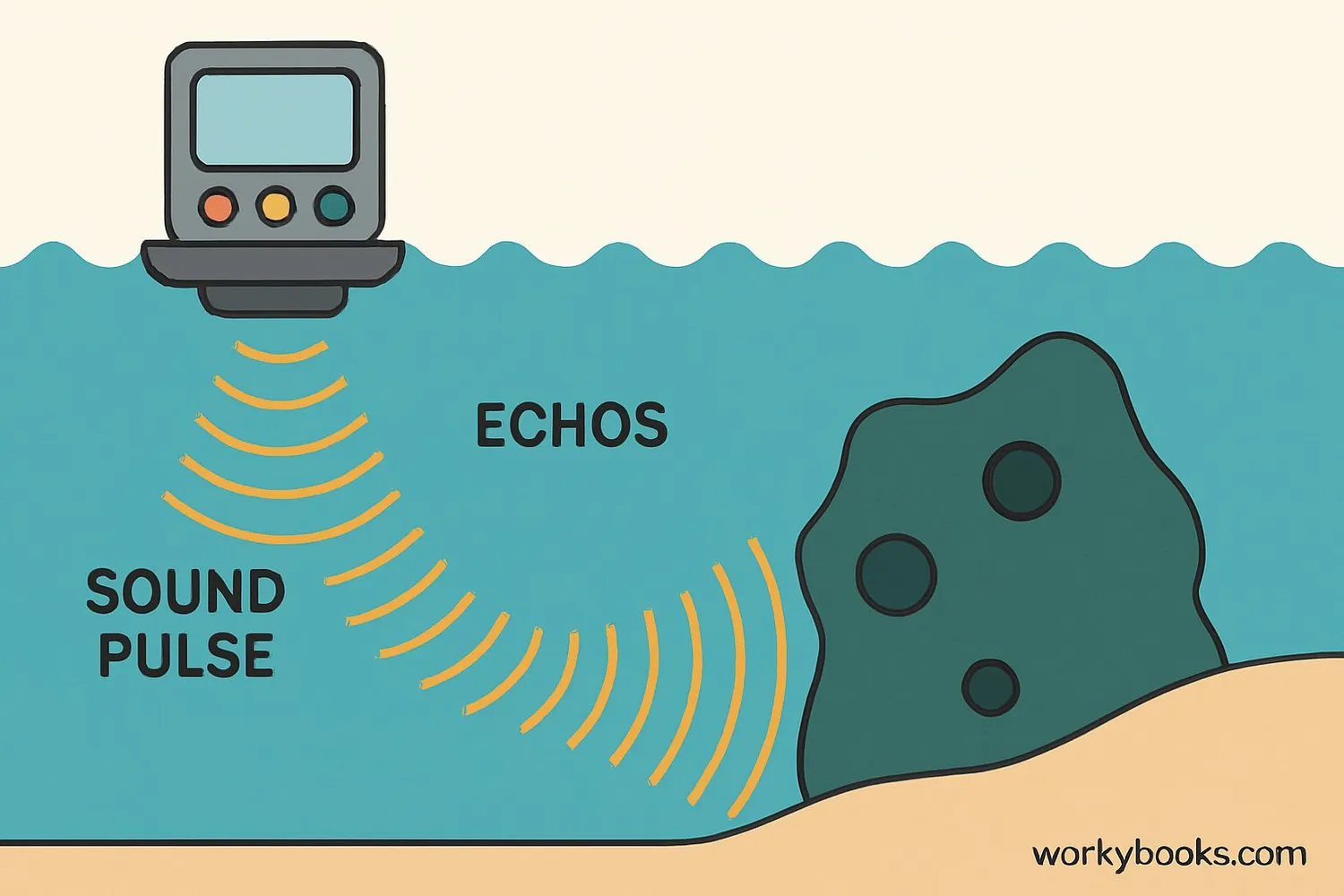
Sonar technology has changed the way humans explore and understand the underwater world. Submarines and ships use sonar to detect objects, map the ocean floor, and navigate safely in dark or murky waters. The process relies on a simple but powerful idea: using sound waves and their echoes to find out what lies beneath the surface. Scientists and engineers have developed sonar systems by studying how sound behaves in water, creating tools that have helped discover shipwrecks, study marine life, and even protect the environment.
How Sonar Works
A sonar system emits a short sound pulse, or "ping," into the water. When this sound pulse hits an object, such as a sunken ship or a school of fish, it bounces back as an echo. The sonar equipment measures the time it takes for the echo to return. Since the speed of sound in water is about 1,500 meters per second, the distance to the object can be calculated using the formula: distance = (speed of sound x time) / 2. This method allows sonar to detect objects hundreds or even thousands of meters away. Modern sonar can also create detailed images of the seafloor by sending out multiple sound pulses and analyzing the reflected echoes.
Applications and Biological Echolocation
Sonar is essential for navigation, scientific research, and safety. Submarines use it to avoid collisions, while research vessels map the ocean floor to study geological features. Sonar has revealed the existence of underwater mountains and deep ocean trenches. Interestingly, nature has developed a similar system: echolocation. Animals like bats, dolphins, and some birds emit high-frequency sounds and listen for the returning echoes to locate prey or obstacles. For example, a bat can detect a tiny insect in complete darkness by analyzing the timing and pattern of echoes. Dolphins use echolocation to hunt fish and communicate with each other in cloudy or dark water. Both sonar and echolocation show how sound waves provide critical information about an environment that cannot be seen directly.
Comparing Technology and Nature
Sonar and biological echolocation share the same basic principle—using sound to detect objects—but they are adapted for different needs. Sonar systems can operate over much greater distances and in deeper water than most animals can manage. However, animals have evolved remarkable sensitivity and precision. For example, a bat’s echolocation is so accurate it can tell the difference between a flying moth and a falling leaf. Scientists study these natural adaptations to improve sonar technology. This process, called biomimicry, helps engineers design more sensitive and efficient sonar devices.
Understanding sonar and echolocation highlights the role of sound in navigation and survival. These systems demonstrate the importance of cause and effect: a sound is produced, it travels, bounces off objects, and returns as an echo, providing information about the surroundings. By exploring both technology and biology, scientists can solve problems and unlock new discoveries in challenging environments.
Interesting Fact: Some species of whales can use echolocation to detect objects that are several kilometers away, making them some of the most skilled natural navigators on Earth.
Comprehension quiz (10 questions)
1. What does sonar use to locate objects underwater?
2. What is an echo, according to the passage?
3. Why do submarines and ships use sonar?
4. What is the formula for finding the distance to an object using sonar?
5. In the passage, what does the word 'biomimicry' mean?
6. What is the main similarity between sonar and echolocation?
7. How do bats use echolocation?
8. Which of the following is NOT an application of sonar mentioned in the passage?
9. True or False: Sonar can only be used by humans, not by animals.
10. True or False: The echo in sonar and echolocation provides information about the location of objects.
Perfect for the way you teach
- Build comprehension skills
- Auto-graded quiz
- Differentiated reading
- Read together at home
- Improve fluency
- Quiet reading time
- Reading curriculum support
- Independent practice
- Track Lexile growth