Reading PassagePremium

Are the Planets Ever in a Line

Interactive passage with audio narration, comprehension questions, and printable PDF.

No ratings yet
Grades 5–8ScienceElaEnglish · SpanishInteractive · Printable
Aligned toMS-ESS1-3
Just this resource
$1.50
One-time purchase
Best value
Unlock everything
$49.99$29.99/yr
40% off until Aug 1 — 10,000+ resources
Renews at $49.99/year.
Unlock above to use these actions

What's included

Reading passage
Audio narration
Comprehension quiz
Writing activity
Glossary & flashcards
Differentiated version
Spanish translation

Are the Planets Ever in a Line preview and details

About this printable Are the Planets Ever in a Line science reading passage, NGSS-aligned (Grades 5-8)

This 400-500 word informational science passage for grades 6-8 addresses a common visual misconception about planetary alignment in our solar system. Aligned with NGSS standard MS-ESS1-3 and disciplinary core idea MS-ESS1.B, the passage explains why textbook diagrams show planets in neat rows when in reality they orbit at wildly different distances and rarely align. Students explore the concept of orbital distance, the vast empty space in our solar system, and why scientific diagrams compress scale for readability. The passage includes audio integration for accessibility, vocabulary development with 8-10 key science terms, and real-world examples of actual planetary alignments. Activities include multiple-choice comprehension questions, writing prompts, and graphic organizers that help students compare diagram representations with actual planetary positions. This resource helps students develop critical thinking about scientific models and representations while building foundational understanding of Earth and space systems.
Written by Workybooks TeamPublished by Workybooks
Preview

Sample passage and quiz from Are the Planets Ever in a Line

Reading passage and comprehension quiz preview

Are All Planets in Line
Planets-in-line
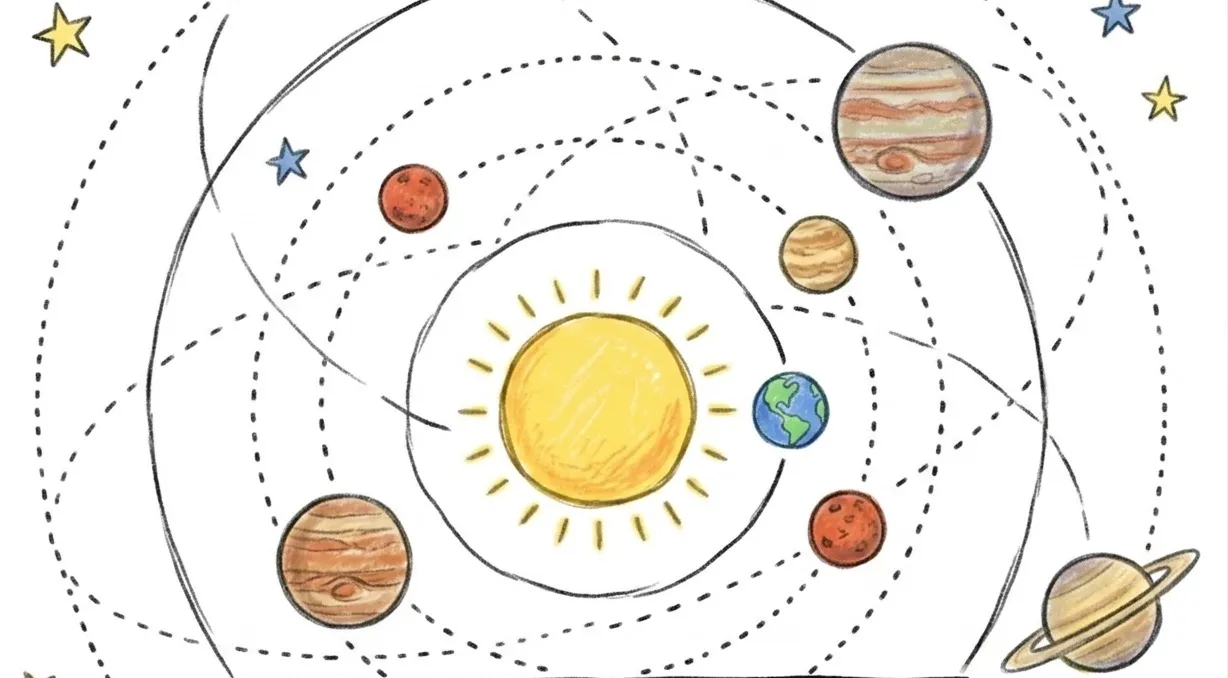
While science fiction movies and stylized textbooks often show the planets perfectly lined up like beads on a string, the reality of our solar system is much more dynamic and chaotic.

Are all planets in line? No, planets do not line up in neat rows as many diagrams suggest. Textbook diagrams often show planets arranged in a straight line for easy viewing. However, this creates a visual misconception about how planets actually move through space. In reality, planets orbit the Sun at vastly different distances and speeds, making alignment extremely rare.

The solar system is mostly empty space. Scientists explain that the distances between planets are enormous compared to the planets themselves. For example, Earth orbits about 93 million miles from the Sun, while Neptune orbits nearly 2.8 billion miles away. If Earth were the size of a marble, Neptune would be located more than half a mile away. Diagrams compress this scale so all planets fit on one page, but this compression hides the true spacing.

Each planet follows its own elliptical orbit around the Sun at different speeds. Mercury completes an orbit in just 88 Earth days, while Neptune takes 165 Earth years. Because planets move at different rates, they constantly change positions relative to each other. Evidence shows that planets scatter around their orbits like runners on a track moving at different speeds. They may occasionally pass near the same side of the Sun, but true alignment is uncommon.

Planetary alignments do occur, but not in perfect straight lines. In 2020, Jupiter and Saturn appeared very close together in Earth's sky, an event called a conjunction. This happened because both planets were positioned on the same side of the Sun from our viewpoint. However, they were still separated by hundreds of millions of miles in actual space. Scientists observe these events to study gravitational interactions between planets.

Understanding the true scale of the solar system matters for space exploration and scientific accuracy. When planning spacecraft missions, scientists must calculate exact planetary positions and distances. The Voyager spacecraft used a rare alignment of outer planets in the 1970s to visit multiple worlds in one mission. This alignment saved fuel and time, but it only happens once every 176 years. Recognizing that diagrams simplify reality helps students think critically about scientific models and representations.

Interesting Fact: All eight planets can appear on the same side of the Sun within a 180-degree arc every few decades, but getting them within a narrow angle happens only once every several centuries.

Comprehension quiz (10 questions)

1. Why do textbook diagrams show planets in a straight line?

Because planets actually orbit in straight lines
To make all planets fit on one page for easy viewing
Because planets always stay aligned in space
To show that planets are all the same distance from the Sun

2. How far is Neptune from the Sun compared to Earth?

About the same distance as Earth
Twice as far as Earth
Nearly 2.8 billion miles away, much farther than Earth's 93 million miles
Exactly 93 million miles away

3. What does the term 'elliptical orbit' mean in the passage?

A circular path around the Sun
A straight line through space
The oval-shaped path that a planet follows around the Sun
A zigzag pattern between planets

4. What is a conjunction?

When planets crash into each other
When two or more celestial objects appear very close together in the sky
When all planets line up in a perfect row
When a planet stops moving in its orbit

5. Why do planets rarely line up in space?

Because they all move at the same speed
Because they orbit at different distances and speeds
Because the Sun pushes them apart
Because they follow straight paths

6. How did the Voyager spacecraft benefit from planetary alignment?

It could take better pictures of the planets
It could visit multiple planets in one mission, saving fuel and time
It could travel in a straight line
It could move faster than usual

7. According to the passage, what can scientists study by observing planetary conjunctions?

How to make better diagrams
Gravitational interactions between planets
The color of planets
The temperature of the Sun

8. How often does a rare alignment of outer planets occur that allows spacecraft to visit multiple worlds?

Every year
Every 10 years
Once every 176 years
Never

9. True or False: The solar system is mostly empty space with planets far apart from each other.

True
False

10. True or False: All eight planets align in a perfect straight line every few years.

True
False
Who it's for

Perfect for the way you teach

Teachers
  • Build comprehension skills
  • Auto-graded quiz
  • Differentiated reading
Parents
  • Read together at home
  • Improve fluency
  • Quiet reading time
Homeschoolers
  • Reading curriculum support
  • Independent practice
  • Track Lexile growth
Topics

Reviews & Ratings

No reviews yet. Be the first to share your experience!

More reading you might love

20 more
Passage
Sunspots and Solar Flares - reading educational content
Grades 4–5

Sunspots and Solar Flares

earth science · RI.4.1

Free
Passage
The Hottest Planet in the Solar System - reading educational content
Grades 3–7

The Hottest Planet in the Solar System

science · MS-ESS1-3

Free
Passage
Mercury: Closest to the Sun - reading educational content
Grades 5–8

Mercury: Closest to the Sun

science · MS-ESS1-2

$1.50
Passage
Venus: Earth's Twin? - reading educational content
Grades 5–8

Venus: Earth's Twin?

science · MS-ESS1-2

$1.50
Passage
Mars: The Red Planet - reading educational content
Grades 5–8

Mars: The Red Planet

science · MS-ESS1-2

$1.50
Passage
What Is the Solar System? - reading educational content
Grades 5–8

What Is the Solar System?

science · MS-ESS1-2

$1.50
Passage
Structure of the Solar System - reading educational content
Grades 5–8

Structure of the Solar System

science · MS-ESS1-2

$1.50
Passage
Scale of the Solar System - reading educational content
Grades 5–8

Scale of the Solar System

science · MS-ESS1-3

$1.50
Passage
Exploration of the Solar System - reading educational content
Grades 5–8

Exploration of the Solar System

science · MS-ESS1-3

$1.50
Passage
Optical Telescopes - reading educational content
Grades 5–8

Optical Telescopes

science · MS-ESS1-3

$1.50
Passage
Future of Alien Search - reading educational content
Grades 5–8

Future of Alien Search

science · MS-ESS1-3

$1.50
Passage
Communicating with Aliens - reading educational content
Grades 5–8

Communicating with Aliens

science · MS-ESS1-3

$1.50
Passage
Measuring Distances in Space - reading educational content
Grades 5–8

Measuring Distances in Space

earth science · MS-ESS1-3

$1.50
Passage
 Astronomy - reading educational content
Grades 5–8

Astronomy

earth science · MS-ESS1-2

$1.50
Passage
The Solar System - reading educational content
Grades 5–8

The Solar System

science · MS-ESS1-2

$1.50
Passage
The Inner Planets - reading educational content
Grades 5–8

The Inner Planets

science · MS-ESS1-2

$1.50
Passage
The Outer Planets - reading educational content
Grades 5–8

The Outer Planets

science · MS-ESS1-2

$1.50
Passage
Light-Years and Cosmic Distances - reading educational content
Grades 5–8

Light-Years and Cosmic Distances

science · MS-ESS1-3

$1.50
Passage
Space Stations - reading educational content
Grades 5–8

Space Stations

science · MS-ESS1-3

$1.50
Passage
Types of Spacecraft - reading educational content
Grades 5–8

Types of Spacecraft

science · MS-ESS1-3

$1.50
Copyright © 2026 Workybooks. Made with ♥ in California.