Berlin Wall Falls 1989
Interactive passage with audio narration, comprehension questions, and printable PDF.
By completing this purchase you agree to our Terms of Use and Privacy Policy. Your subscription renews automatically until you cancel. You can cancel anytime from your account settings. All sales are final and non-refundable. Digital content is available for download in your account immediately upon purchase.
What's included
Berlin Wall Falls 1989 preview and details
About this printable Berlin Wall Falls 1989 reading passage (Grades 6-8)
Sample passage and quiz from Berlin Wall Falls 1989
Reading passage and comprehension quiz preview
Berlin Wall Falls 1989
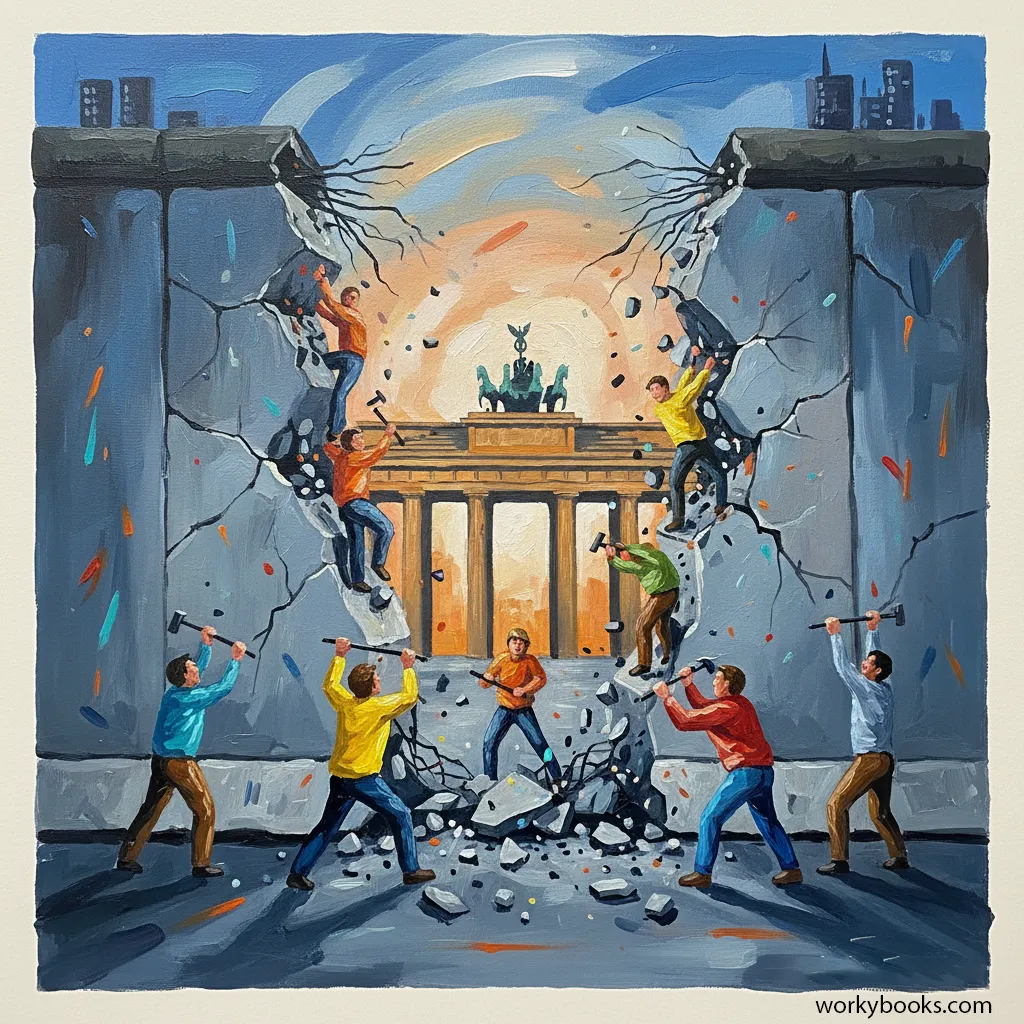
The Berlin Wall was a concrete barrier built in 1961 by the East German government to separate East Berlin from West Berlin. Its purpose was to stop the flow of people leaving communist East Germany for democratic West Germany. The Wall became a powerful symbol of division during the Cold War, a period of intense rivalry between the Soviet Union and the United States. Families, friends, and neighbors were suddenly split apart, and the city of Berlin stood at the center of global tension.
The reasons for the Berlin Wall’s construction were complex. East Germany’s leaders worried about losing skilled workers and young people to the West. Many East Germans wanted more freedom and better economic opportunities, which they believed existed in West Berlin. By building the Wall, the government hoped to maintain control and prevent citizens from fleeing. However, the Wall also created hardship and resentment. The West German government and many Western countries condemned the Wall as a violation of human rights.
As years passed, the Wall became a flashpoint for protests and international disputes. In June 1963, President John F. Kennedy visited Berlin and declared, "Ich bin ein Berliner," meaning "I am a Berliner." This statement showed solidarity with the people of Berlin and signaled American support for democracy. The speech inspired hope among West Berliners, but life remained difficult for those in the East. Soviet and East German authorities insisted the Wall was necessary for security, yet many questioned this justification.
By the late 1980s, several factors contributed to the Wall’s collapse. Economic problems weakened the Soviet Union and its communist allies. New Soviet leader Mikhail Gorbachev introduced reforms like glasnost (openness) and perestroika (restructuring) to modernize the system. These changes inspired more protests in Eastern Europe. Crowds in East Germany demanded political rights and the ability to travel freely. Western leaders, such as U.S. President Ronald Reagan, called for change. In 1987, Reagan famously said at the Brandenburg Gate, "Mr. Gorbachev, tear down this wall!" This quote became a rallying cry for those who believed the Wall had to fall.
On November 9, 1989, East German officials announced new travel rules. Confused communications led border guards to open the gates, and thousands of East and West Berliners rushed to the Wall. People used hammers and chisels to break pieces off the Wall, celebrating their newfound unity. The event was broadcast worldwide. This peaceful revolution marked the beginning of the end for communist rule in Eastern Europe. In less than a year, Germany was officially reunified.
The fall of the Berlin Wall had enormous consequences. It ended nearly three decades of division in Berlin. It also helped bring about the end of the Cold War, as countries across Eastern Europe broke away from Soviet influence. However, not everyone benefited immediately. Some East Germans faced economic hardship in the new united Germany. Still, the Wall’s destruction remains a symbol of hope and the power of ordinary people to change history.
Interesting Fact: After the Wall fell, pieces of it were collected as souvenirs and can be found in museums on every continent.
Comprehension quiz (8 questions)
1. When was the Berlin Wall built?
2. Who was the Soviet leader in the late 1980s?
3. What city did the Berlin Wall divide?
4. Why did East Germans protest in the 1980s?
5. What did President Reagan famously say in 1987?
6. How did the Wall’s fall affect Europe?
7. The Berlin Wall fell in 1989. True or false?
8. What does 'reunified' mean?
Common Core standards for Berlin Wall Falls 1989
Explain events, procedures, ideas, or concepts in a historical, scientific, or technical text, including what happened and why, based on specific information in the text.
Determine the meaning of general academic and domain-specific words or phrases in a text relevant to a grade 4 topic or subject area.
Write informative/explanatory texts to examine a topic and convey ideas and information clearly.
Perfect for the way you teach
- Build comprehension skills
- Auto-graded quiz
- Differentiated reading
- Read together at home
- Improve fluency
- Quiet reading time
- Reading curriculum support
- Independent practice
- Track Lexile growth