Community Resilience
Interactive passage with audio narration, comprehension questions, and printable PDF.
By completing this purchase you agree to our Terms of Use and Privacy Policy. Your subscription renews automatically until you cancel. You can cancel anytime from your account settings. All sales are final and non-refundable. Digital content is available for download in your account immediately upon purchase.
What's included
Community Resilience preview and details
About this printable Community Resilience science reading passage, NGSS-aligned (Grades 5-8)
Sample passage and quiz from Community Resilience
Reading passage and comprehension quiz preview
Community Resilience
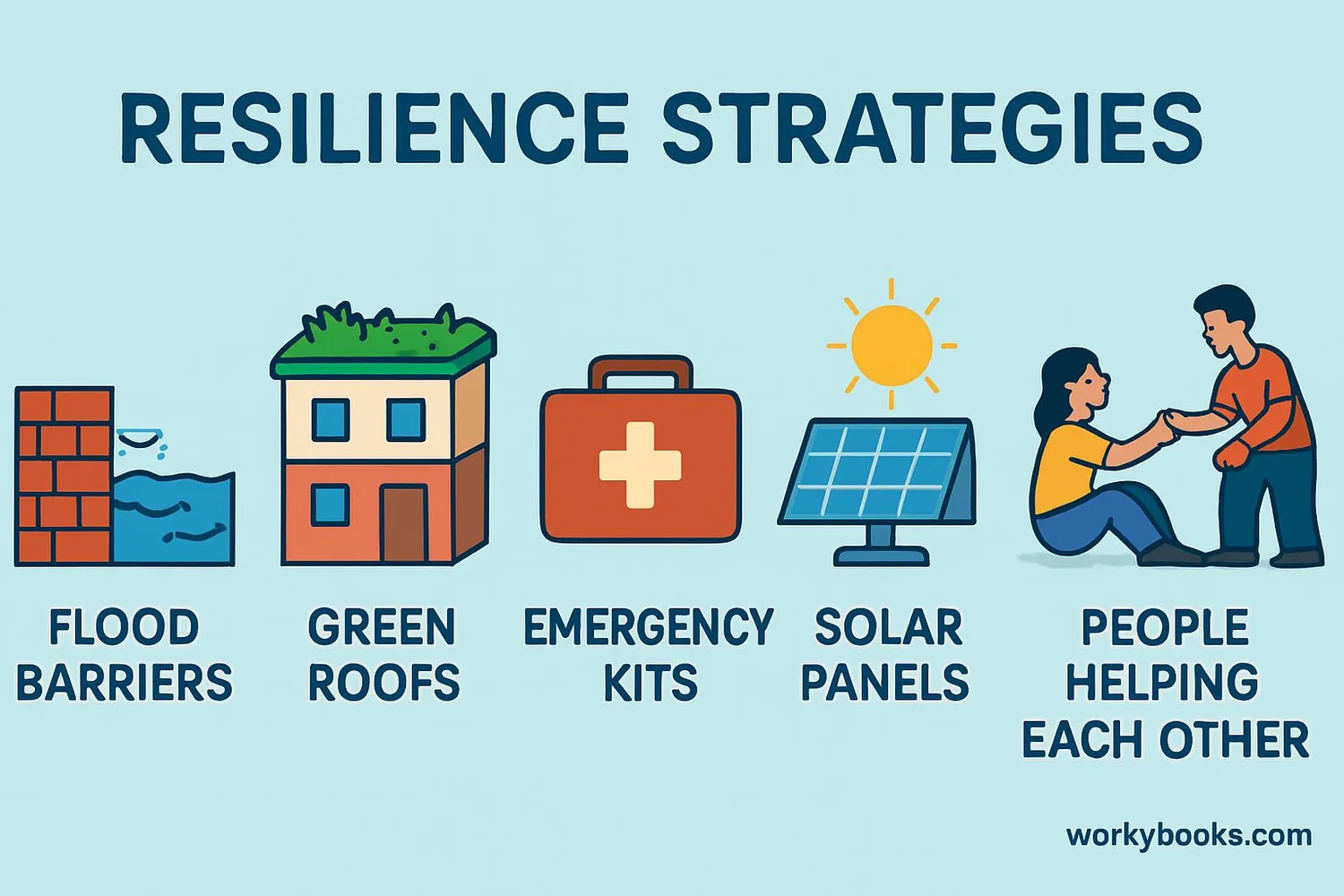
Community resilience is the ability of a group of people to prepare for, respond to, and recover from disasters such as floods, earthquakes, or hurricanes. When disasters strike, some communities can bounce back quickly while others struggle for months or years. Scientists and emergency planners study why this happens and what can make communities stronger in the face of hazards. The main goal is to reduce the impact of disasters and make sure everyone has a fair chance to recover.
How Community Systems Affect Resilience
Resilience depends on how well different systems in a community work together. Physical systems like infrastructure—roads, bridges, power lines, and water pipes—are essential for everyday life and emergency response. If these are strong, people can get help, information, and supplies after a disaster. Social systems, such as social capital (the connections and trust between people), also play a vital role. Communities with strong social capital can organize quickly, share resources, and support vulnerable members. Vulnerability factors—such as poverty, age, disability, language barriers, and poor housing—can increase risks. For example, after Hurricane Katrina, low-income neighborhoods with weak infrastructure and less social capital suffered more damage and recovered more slowly than wealthier areas.
Planning and Reducing Risk
Communities use several strategies to build resilience. Hazard mitigation plans identify risks and set rules to reduce damage, such as not building homes in flood zones. Emergency response plans organize how first responders and citizens will communicate and act during a crisis. Recovery plans help guide rebuilding and support for affected people. Making infrastructure more resilient—by strengthening bridges, protecting power supplies, and creating backup systems—helps maintain 'lifelines' like water, electricity, and transportation. Land-use planning avoids putting critical buildings in hazard-prone areas. Insurance spreads financial risk, making it easier for people and communities to rebuild after losses.
Equity and Psychological Resilience
Disasters do not affect everyone equally. Economic factors mean poor communities often experience more damage and have fewer resources to recover. Recovery can be unequal, with some groups left behind. Scientists and planners now focus on equity, making sure all members of a community are protected and supported. Building back better means using the recovery period to improve safety, mental health, and community strength. Psychological resilience—the ability to cope and recover emotionally—is as important as physical rebuilding, and mental health services are now included in recovery plans.
Community resilience is a system made up of people, infrastructure, planning, and social support. By understanding what makes communities vulnerable and what helps them recover, we can use science and engineering to protect lives and create a safer, more fair future for everyone.
Interesting Fact: Some cities, like Tokyo and San Francisco, have redesigned entire neighborhoods and built advanced earthquake-resistant buildings to improve community resilience and save lives.
Comprehension quiz (10 questions)
1. What is community resilience?
2. Which of the following is NOT a part of infrastructure?
3. What does the term 'social capital' mean in the passage?
4. Which is an example of a vulnerability factor?
5. What is the main purpose of hazard mitigation plans?
6. Why is equity important in disaster recovery?
7. How do strong social connections help communities during disasters?
8. True or False: Making infrastructure more resilient helps maintain water, electricity, and transportation during disasters.
9. True or False: Psychological resilience is only important for adults after disasters.
10. How can land-use planning increase safety in a community?
Perfect for the way you teach
- Build comprehension skills
- Auto-graded quiz
- Differentiated reading
- Read together at home
- Improve fluency
- Quiet reading time
- Reading curriculum support
- Independent practice
- Track Lexile growth