Comparing Inner Planet Atmospheres
Interactive passage with audio narration, comprehension questions, and printable PDF.
By completing this purchase you agree to our Terms of Use and Privacy Policy. Your subscription renews automatically until you cancel. You can cancel anytime from your account settings. All sales are final and non-refundable. Digital content is available for download in your account immediately upon purchase.
What's included
Comparing Inner Planet Atmospheres preview and details
About this printable Comparing Inner Planet Atmospheres science reading passage, NGSS-aligned (Grades 5-8)
Sample passage and quiz from Comparing Inner Planet Atmospheres
Reading passage and comprehension quiz preview
How Do Inner Planet Atmospheres Compare
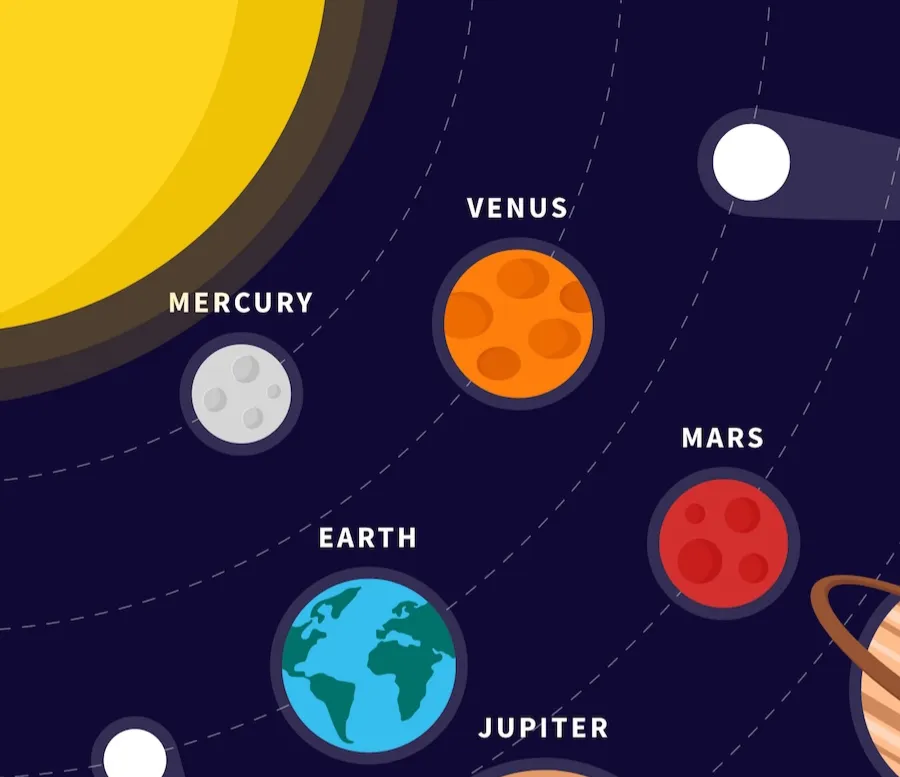
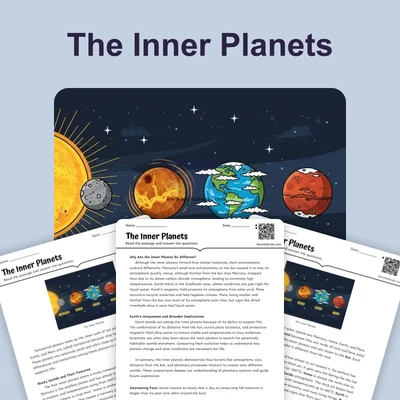
The four inner planets—Mercury, Venus, Earth, and Mars—all formed from similar materials billions of years ago. Yet today, their atmospheres could not be more different. Scientists explain these differences by examining three key factors: gravity strength, distance from the Sun, and geological activity. Together, these factors determine whether a planet can hold onto gases or loses them to space.
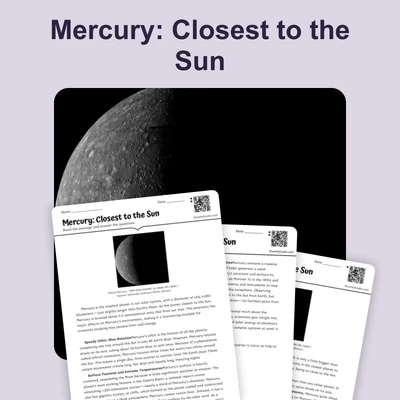
Mercury sits closest to the Sun and has very weak gravity because of its small size. Evidence shows that solar wind—streams of charged particles from the Sun—constantly blasts Mercury's surface. The planet's weak gravity cannot hold gases against this powerful force. Mercury also lacks geological activity to release new gases from its interior. As a result, Mercury has almost no atmosphere at all, just traces of atoms temporarily captured from the solar wind.
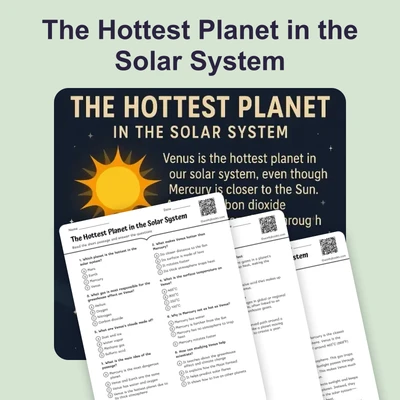
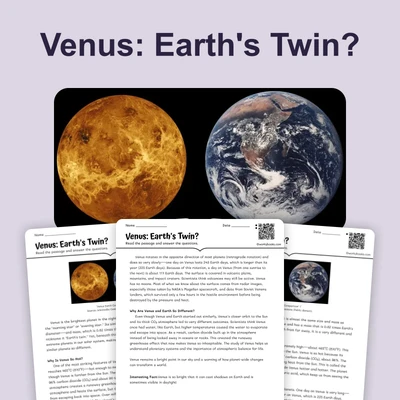
Venus, the second planet from the Sun, tells a very different story. Venus has strong gravity similar to Earth's and can hold onto gases effectively. Volcanic activity released enormous amounts of carbon dioxide and other gases over time. However, Venus sits close enough to the Sun that water vapor could not condense into oceans. Without liquid water to absorb carbon dioxide, the gas accumulated in the atmosphere. Today, Venus has a crushing atmosphere 90 times thicker than Earth's, composed mostly of carbon dioxide. This thick blanket traps heat and creates surface temperatures hot enough to melt lead.
Earth, the third planet, has conditions that scientists describe as balanced. Earth's gravity is strong enough to hold an atmosphere but not trap excessive gases. The planet's distance from the Sun allows liquid water to exist on the surface. Earth's oceans absorb much of the carbon dioxide, preventing a runaway greenhouse effect like Venus. Ongoing geological activity releases gases, while plants and other processes maintain atmospheric balance. Earth's atmosphere contains mostly nitrogen and oxygen, supporting diverse life forms.
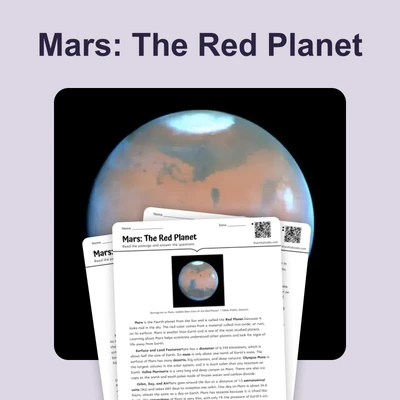
Mars, the fourth inner planet, once had a thicker atmosphere and possibly liquid water on its surface. However, Mars is smaller than Earth, giving it weaker gravity. Scientists observe that Mars lost much of its atmosphere over billions of years. The planet's core cooled and stopped generating a protective magnetic field. Without this shield, solar wind stripped away atmospheric gases. Today, Mars has an atmosphere only about 1% as thick as Earth's, composed mainly of carbon dioxide but too thin to trap much heat.
Understanding planetary atmospheres matters because it helps scientists predict conditions on planets beyond our solar system. The same physical principles apply everywhere. Gravity, stellar distance, and geological activity work together to shape planetary environments. These factors explain why Earth remains the only inner planet with conditions suitable for life as we know it.
Interesting Fact: If you could stand on Venus, the atmospheric pressure would feel like being 900 meters underwater on Earth. The thick atmosphere would crush most spacecraft within hours.
Comprehension quiz (10 questions)
1. Why does Mercury have almost no atmosphere?
2. What is the main gas that makes up Venus's thick atmosphere?
3. According to the passage, what does the term 'solar wind' mean?
4. Which factor helps Earth maintain a balanced atmosphere?
5. Why did Mars lose most of its atmosphere over time?
6. Based on the passage, what can scientists infer about planets with weak gravity?
7. How does Venus's atmosphere compare to Earth's in thickness?
8. What would happen if Earth did not have liquid water oceans?
9. True or False: All four inner planets started with similar materials when they formed.
10. True or False: Mars currently has a thicker atmosphere than Earth.
Perfect for the way you teach
- Build comprehension skills
- Auto-graded quiz
- Differentiated reading
- Read together at home
- Improve fluency
- Quiet reading time
- Reading curriculum support
- Independent practice
- Track Lexile growth