Could Humans Live on Mars
Interactive passage with audio narration, comprehension questions, and printable PDF.
By completing this purchase you agree to our Terms of Use and Privacy Policy. Your subscription renews automatically until you cancel. You can cancel anytime from your account settings. All sales are final and non-refundable. Digital content is available for download in your account immediately upon purchase.
What's included
Could Humans Live on Mars preview and details
About this printable Could Humans Live on Mars science reading passage, NGSS-aligned (Grades 5-8)
Sample passage and quiz from Could Humans Live on Mars
Reading passage and comprehension quiz preview
Could Humans Live on Mars
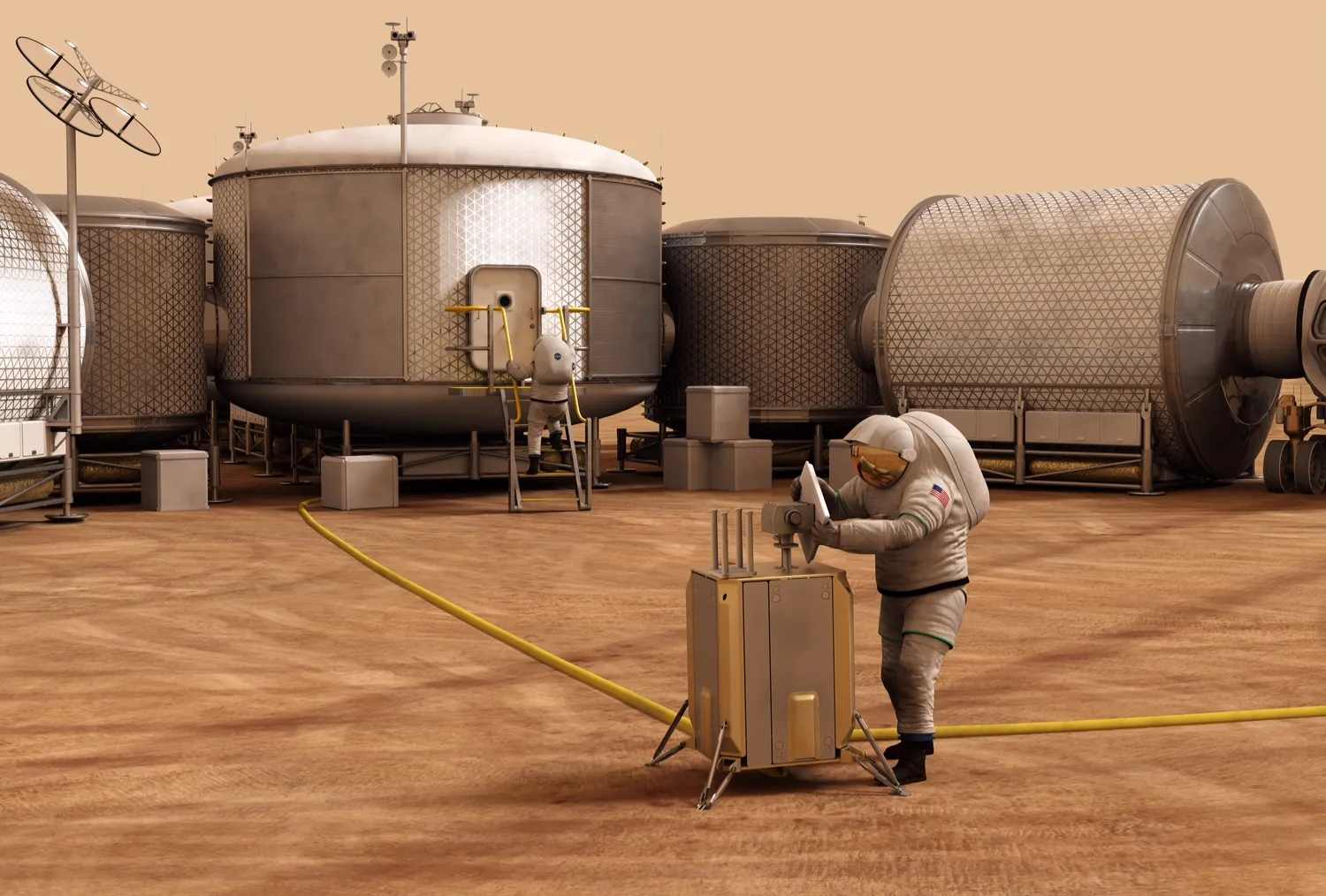
Artist's concept of Martian habitat. Mars has air, but not the kind that people can breathe. Even on the warmest days, the temperature is too cold for people to live comfortably. When astronauts go to Mars, they will always need to be in spacesuits or inside buildings to live. "Martian habitat with colonists" by NASA / Wikimedia Commons
Imagine you have booked a trip to Mars. What would this vacation actually be like? Scientists explain that Mars tourism would be very different from any Earth vacation. The journey alone would take more than six months each way. This happens because Mars and Earth orbit the Sun at different speeds and distances.
Once you arrive on Mars, you would need to wear a pressure suit at all times outside. Mars has a very thin atmosphere made mostly of carbon dioxide. The atmospheric pressure on Mars is less than one percent of Earth's pressure. Without a pressure suit, a human's blood would boil. The atmosphere also cannot block harmful radiation from the Sun.
Walking on Mars would feel strange because of the planet's low gravity. Mars has only 38 percent of Earth's gravity. If you weigh 100 pounds on Earth, you would weigh just 38 pounds on Mars. You could jump much higher and carry heavy objects more easily. However, scientists observe that low gravity can weaken muscles and bones over time.
The temperature on Mars changes dramatically throughout each day. Evidence shows that daytime temperatures near the equator can reach 70 degrees Fahrenheit. At night, temperatures can drop to minus 100 degrees Fahrenheit. The thin atmosphere cannot hold heat like Earth's thicker atmosphere does.
What would tourists actually see on Mars? The planet features spectacular landmarks unlike anything on Earth. Olympus Mons is the largest volcano in our solar system. It stands about 16 miles high, nearly three times taller than Mount Everest. Valles Marineris is a canyon system stretching more than 2,500 miles across Mars. This makes it ten times longer than Earth's Grand Canyon. Mars also has polar ice caps made of water ice and frozen carbon dioxide.
Understanding Mars conditions matters for future space exploration. Scientists use this knowledge to design equipment and plan missions. Each Mars study helps us learn more about how planets form and change over time.
Interesting Fact: A day on Mars lasts 24 hours and 37 minutes, making it very similar to an Earth day. However, a Mars year equals 687 Earth days because Mars takes longer to orbit the Sun.
Comprehension quiz (10 questions)
1. How long does the journey to Mars take one way?
2. What is Mars' atmosphere mostly made of?
3. What percentage of Earth's gravity does Mars have?
4. In the passage, what does the word 'pressure suit' mean?
5. Based on the passage, what does 'landmarks' refer to?
6. Why would walking on Mars feel strange?
7. What can you infer about why Mars cannot hold heat at night?
8. If you weigh 80 pounds on Earth, how much would you weigh on Mars?
9. How could scientists use information about Mars conditions to help future space exploration?
10. True or False: A day on Mars is much shorter than a day on Earth.
Perfect for the way you teach
- Build comprehension skills
- Auto-graded quiz
- Differentiated reading
- Read together at home
- Improve fluency
- Quiet reading time
- Reading curriculum support
- Independent practice
- Track Lexile growth