Reading PassagePremium

Does Europa Have an Ocean

Interactive passage with audio narration, comprehension questions, and printable PDF.

No ratings yet
Grades 5–8ScienceElaEnglish · SpanishInteractive · Printable
Aligned toMS-ESS1-3
Just this resource
$1.50
One-time purchase
Best value
Unlock everything
$49.99$29.99/yr
40% off until Aug 1 — 10,000+ resources
Renews at $49.99/year.
Unlock above to use these actions

What's included

Reading passage
Audio narration
Comprehension quiz
Writing activity
Glossary & flashcards
Differentiated version
Spanish translation

Does Europa Have an Ocean preview and details

About this printable Does Europa Have an Ocean science reading passage, NGSS-aligned (Grades 5-8)

This engaging middle school science passage explores whether Jupiter's moon Europa harbors a liquid water ocean beneath its frozen surface. Aligned with NGSS standards MS-ESS1.B and MS-ESS1-3, the passage traces a fascinating cause-and-effect chain: Jupiter's massive gravity flexes Europa's interior, generating friction that produces heat, which melts ice beneath the moon's surface. Students examine multiple lines of evidence including surface cracks, water plumes, and magnetic field measurements that suggest a global subsurface ocean exists. The passage explains why this discovery makes Europa a prime candidate in the search for life beyond Earth. Audio-integrated content supports diverse learners, while differentiated versions ensure accessibility for all reading levels. Activities include comprehension questions, writing prompts, and graphic organizers that reinforce understanding of planetary science, gravitational forces, and scientific evidence.
Written by Workybooks TeamPublished by Workybooks
Preview

Sample passage and quiz from Does Europa Have an Ocean

Reading passage and comprehension quiz preview

Does Europa Have an Ocean
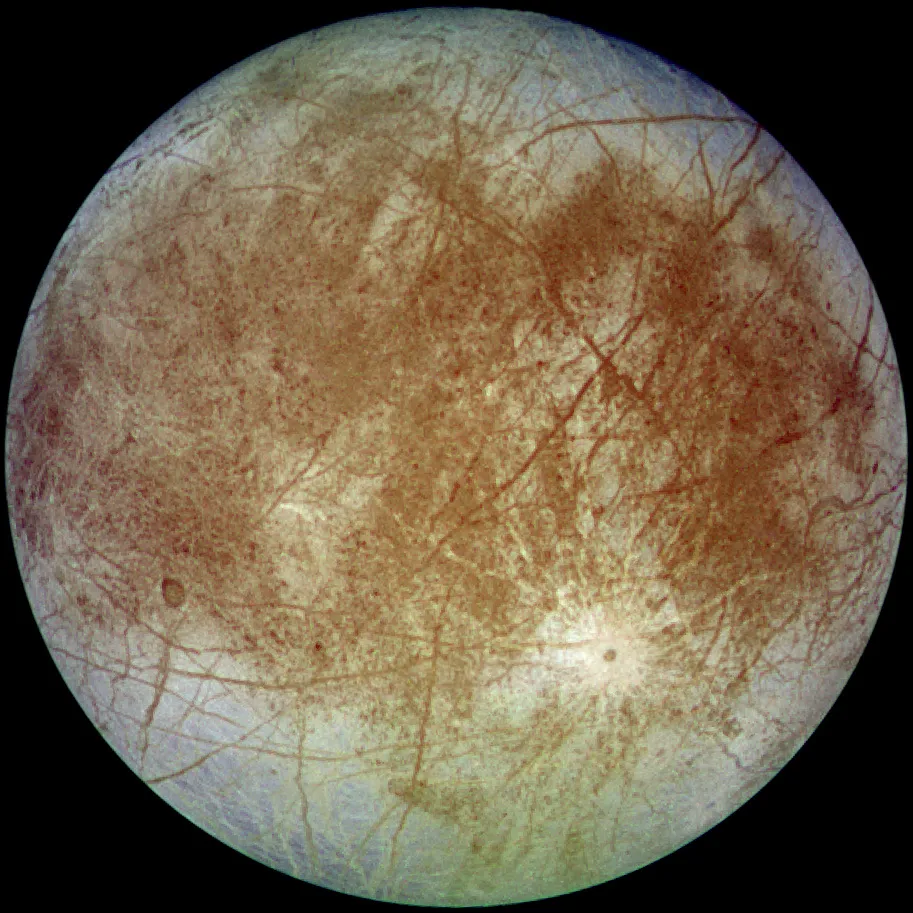
Europa-moon

"Europa-moon" by NASA/JPL/DLR / Wikimedia Commons (Public domain).

Scientists believe that Europa, one of Jupiter's moons, may have a global ocean of liquid water beneath its frozen surface. This ocean could be one of the best places in our solar system to search for life beyond Earth. The key to understanding Europa's ocean lies in the powerful gravitational forces from Jupiter itself.

Jupiter is the largest planet in our solar system. Its massive gravity pulls strongly on Europa as the moon orbits around it. This gravitational pull is not constant because Europa's orbit is slightly oval-shaped. As Europa moves closer to and farther from Jupiter, the planet's gravity flexes and squeezes the moon's interior. This process is called tidal heating. The constant flexing creates friction inside Europa, similar to how bending a wire back and forth makes it warm. This friction generates enough heat to melt ice beneath Europa's frozen surface. Scientists estimate that Europa's ice shell may be 15 to 25 kilometers thick, with a liquid ocean possibly 100 kilometers deep underneath.

Evidence for this hidden ocean comes from several sources. NASA's Galileo spacecraft observed Europa's surface and found long cracks and ridges in the ice. These features suggest that the ice shell moves and shifts, which could happen if liquid water exists below. In 2013, scientists using the Hubble Space Telescope detected water vapor plumes erupting from Europa's surface. These plumes may come from the subsurface ocean breaking through cracks in the ice. Additionally, measurements of Europa's magnetic field indicate that the moon contains a layer of electrically conductive material. Liquid saltwater conducts electricity well, supporting the ocean hypothesis.

The possibility of an ocean on Europa matters greatly to astrobiology, the study of life in the universe. On Earth, liquid water is essential for all known life forms. If Europa has a warm ocean with dissolved minerals from its rocky core, it might provide the right conditions for simple life forms to exist. Future missions, such as NASA's Europa Clipper, will investigate this moon more closely. Understanding Europa helps scientists learn how planetary systems work and where life might exist beyond our planet.

Interesting Fact: Europa's ocean may contain twice as much water as all of Earth's oceans combined, despite Europa being only about one-quarter the diameter of Earth.

Comprehension quiz (10 questions)

1. What is the main reason scientists believe Europa may have a liquid ocean beneath its surface?

Heat from the sun melts the ice
Jupiter's gravity creates tidal heating through friction
Volcanic activity on Europa produces heat
Chemical reactions in the ice create warmth

2. How thick is Europa's ice shell estimated to be?

5 to 10 kilometers
15 to 25 kilometers
50 to 75 kilometers
100 to 150 kilometers

3. What does the term 'tidal heating' mean in the context of Europa?

Heating caused by ocean tides on Europa's surface
Heat generated when Jupiter's gravity flexes Europa's interior
Warming from solar radiation during Europa's orbit
Heat produced by tidal waves in Europa's ocean

4. Which piece of evidence supports the existence of an ocean on Europa?

Europa's surface temperature is above freezing
Water vapor plumes were detected erupting from the surface
Europa has an atmosphere made of oxygen
The moon orbits Jupiter very quickly

5. Why is liquid water important in the search for life beyond Earth?

It makes planets easier to observe with telescopes
It is essential for all known life forms on Earth
It creates a protective atmosphere around moons
It prevents asteroids from hitting the surface

6. What did NASA's Galileo spacecraft observe on Europa's surface?

Active volcanoes and lava flows
Long cracks and ridges in the ice
Large craters from asteroid impacts
Frozen lakes on the surface

7. How does friction inside Europa create heat?

By causing chemical reactions in the ice
By allowing sunlight to penetrate deeper
By creating resistance as materials rub together during flexing
By producing electrical currents in the ocean

8. What does astrobiology study?

The formation of stars and galaxies
The physical properties of asteroids
Life in the universe, including beyond Earth
The chemical composition of planets

9. True or False: Europa's orbit around Jupiter is perfectly circular.

True
False

10. True or False: Europa may contain more water than all of Earth's oceans combined.

True
False
Who it's for

Perfect for the way you teach

Teachers
  • Build comprehension skills
  • Auto-graded quiz
  • Differentiated reading
Parents
  • Read together at home
  • Improve fluency
  • Quiet reading time
Homeschoolers
  • Reading curriculum support
  • Independent practice
  • Track Lexile growth
Topics

Reviews & Ratings

No reviews yet. Be the first to share your experience!

More reading you might love

20 more
Passage
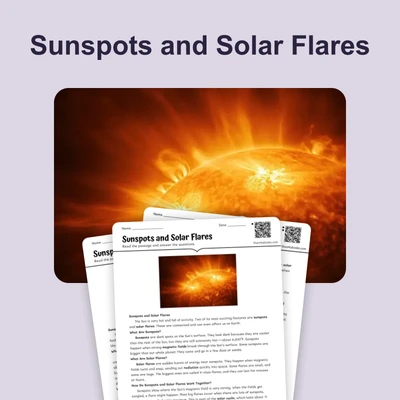
Sunspots and Solar Flares - reading educational content
Grades 4–5

Sunspots and Solar Flares

earth science · RI.4.1

Free
Passage
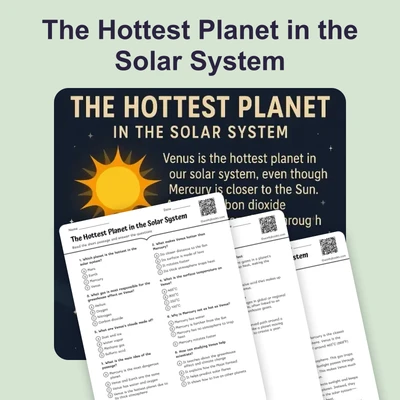
The Hottest Planet in the Solar System - reading educational content
Grades 3–7

The Hottest Planet in the Solar System

science · MS-ESS1-3

Free
Passage
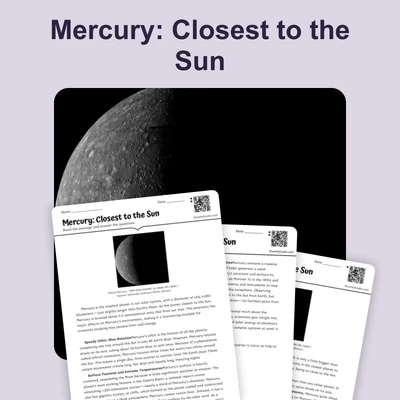
Mercury: Closest to the Sun - reading educational content
Grades 5–8

Mercury: Closest to the Sun

science · MS-ESS1-2

$1.50
Passage
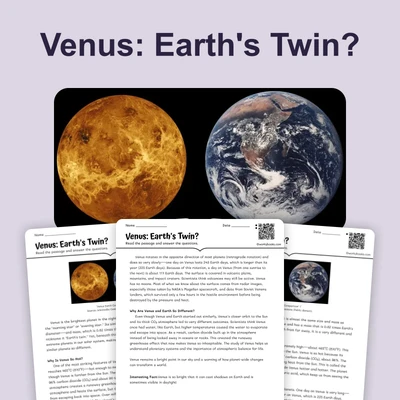
Venus: Earth's Twin? - reading educational content
Grades 5–8

Venus: Earth's Twin?

science · MS-ESS1-2

$1.50
Passage
Mars: The Red Planet - reading educational content
Grades 5–8

Mars: The Red Planet

science · MS-ESS1-2

$1.50
Passage
What Is the Solar System? - reading educational content
Grades 5–8

What Is the Solar System?

science · MS-ESS1-2

$1.50
Passage
Structure of the Solar System - reading educational content
Grades 5–8

Structure of the Solar System

science · MS-ESS1-2

$1.50
Passage
Scale of the Solar System - reading educational content
Grades 5–8

Scale of the Solar System

science · MS-ESS1-3

$1.50
Passage
Exploration of the Solar System - reading educational content
Grades 5–8

Exploration of the Solar System

science · MS-ESS1-3

$1.50
Passage
Optical Telescopes - reading educational content
Grades 5–8

Optical Telescopes

science · MS-ESS1-3

$1.50
Passage
Future of Alien Search - reading educational content
Grades 5–8

Future of Alien Search

science · MS-ESS1-3

$1.50
Passage
Communicating with Aliens - reading educational content
Grades 5–8

Communicating with Aliens

science · MS-ESS1-3

$1.50
Passage
Measuring Distances in Space - reading educational content
Grades 5–8

Measuring Distances in Space

earth science · MS-ESS1-3

$1.50
Passage
 Astronomy - reading educational content
Grades 5–8

Astronomy

earth science · MS-ESS1-2

$1.50
Passage
The Solar System - reading educational content
Grades 5–8

The Solar System

science · MS-ESS1-2

$1.50
Passage
The Inner Planets - reading educational content
Grades 5–8

The Inner Planets

science · MS-ESS1-2

$1.50
Passage
The Outer Planets - reading educational content
Grades 5–8

The Outer Planets

science · MS-ESS1-2

$1.50
Passage
Light-Years and Cosmic Distances - reading educational content
Grades 5–8

Light-Years and Cosmic Distances

science · MS-ESS1-3

$1.50
Passage
Space Stations - reading educational content
Grades 5–8

Space Stations

science · MS-ESS1-3

$1.50
Passage
Types of Spacecraft - reading educational content
Grades 5–8

Types of Spacecraft

science · MS-ESS1-3

$1.50
Copyright © 2026 Workybooks. Made with ♥ in California.