Reading PassagePremium

What Ice Cores Reveal

Interactive passage with audio narration, comprehension questions, and printable PDF.

No ratings yet
Grades 5–8ScienceReadingElaEnglish · SpanishInteractive · Printable
Aligned toMS-ESS3-5MS-ESS1-4
Just this resource
$1.50
One-time purchase
Best value
Unlock everything
$49.99/yr
10,000+ resources, AI tools
Unlock above to use these actions

What's included

Reading passage
Audio narration
Comprehension quiz
Writing activity
Glossary & flashcards
Differentiated version
Spanish translation

What Ice Cores Reveal preview and details

About this printable What Ice Cores Reveal science reading passage, NGSS-aligned (Grades 5-8)

This 400-500 word informational science passage explores how ice cores serve as natural archives of Earth's climate history. Aligned with NGSS standards MS-ESS3-5 and MS-ESS1-4, the passage explains how scientists drill deep into glaciers and ice sheets to extract cylindrical samples containing layers of ice formed year by year. Trapped within these layers are tiny air bubbles—actual samples of the ancient atmosphere. Students learn how researchers analyze these bubbles to reconstruct both past temperatures and carbon dioxide levels extending back hundreds of thousands of years. The passage emphasizes the striking correlation between temperature and CO2 levels throughout Earth's history and highlights that current atmospheric CO2 concentrations far exceed any levels found in the natural record. This audio-integrated resource includes a simplified version for struggling readers, Spanish translations, vocabulary glossary, comprehension questions, writing activities, and graphic organizers to support diverse learners in understanding this crucial climate science evidence.
Written by Workybooks TeamPublished by Workybooks
Preview

Sample passage and quiz from What Ice Cores Reveal

Reading passage and comprehension quiz preview

What Ice Cores Reveal
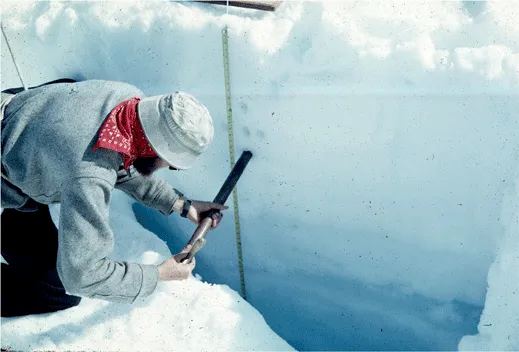
Taku glacier firn ice sampling

"Taku glacier firn ice sampling" / Wikimedia Commons 

Ice cores are cylindrical samples that scientists drill from deep within glaciers and ice sheets. These cores function like frozen time capsules. Each layer of ice represents a single year of snowfall that compressed over time. Scientists can extract cores reaching depths of several miles, capturing climate information from hundreds of thousands of years ago.

The most valuable feature of ice cores is the tiny air bubbles trapped inside. When snow falls and compresses into ice, small pockets of air become sealed within. These bubbles contain actual samples of Earth's ancient atmosphere. Scientists carefully extract the air and analyze its chemical composition. They measure the amounts of different gases, especially carbon dioxide. They also examine the ice itself to determine past temperatures. Evidence shows that ice contains different forms of oxygen atoms called isotopes. The ratio of these isotopes changes with temperature, allowing researchers to reconstruct climate conditions.

Data from ice cores reveal a striking pattern. Temperature and carbon dioxide levels have risen and fallen together throughout Earth's history. When CO2 was high, temperatures were warm. When CO2 dropped, temperatures cooled. This relationship appears consistent across hundreds of thousands of years. Scientists have drilled ice cores in Antarctica that extend back 800,000 years. The Vostok ice core, extracted from East Antarctica, provides one of the longest continuous climate records available. Analysis of this core shows natural fluctuations in CO2 levels ranging between about 180 and 280 parts per million.

Today's atmospheric CO2 concentration exceeds 420 parts per million. This level is far higher than anything recorded in ice cores from the past 800,000 years. The increase occurred rapidly over just the past 150 years. Scientists explain that this change corresponds with increased burning of fossil fuels by humans. The ice core evidence matters because it demonstrates that current conditions are unusual compared to Earth's recent geological history. This data helps scientists understand how Earth's climate system responds to changes in greenhouse gases.

Interesting Fact: The deepest ice core ever drilled reached a depth of 12,000 feet in Antarctica. At the bottom, the ice was nearly 800,000 years old.

Comprehension quiz (10 questions)

1. What do ice cores contain that provides samples of Earth's ancient atmosphere?

Frozen water droplets
Tiny air bubbles
Ancient plant material
Rock fragments

2. How do scientists determine past temperatures from ice cores?

By measuring the thickness of ice layers
By counting air bubbles in the ice
By examining the ratio of oxygen isotopes
By testing the color of the ice

3. What pattern have scientists discovered about temperature and CO2 levels in ice core data?

They move in opposite directions
They rise and fall together
Temperature changes but CO2 stays constant
They have no relationship

4. In the context of the passage, what does the word 'compressed' mean?

Melted and refrozen
Pressed together tightly
Spread out over a large area
Mixed with other materials

5. What does 'fluctuations' mean as used in the passage?

Steady increases over time
Complete disappearance
Changes that go up and down
Permanent stability

6. Based on the passage, why is the Vostok ice core important?

It was the first ice core ever drilled
It provides one of the longest continuous climate records
It contains the most air bubbles
It was drilled in the North Pole

7. What can you infer about the relationship between human activity and current CO2 levels?

Human activity has no effect on CO2 levels
Burning fossil fuels has likely contributed to unusually high CO2 levels
Humans have decreased CO2 levels over time
Natural processes alone explain current CO2 levels

8. If scientists discovered an ice core with CO2 levels of 250 parts per million, what could they predict about the temperature during that time period?

It would be extremely hot
It would be within the natural range shown in the ice core record
It would be colder than any time in Earth's history
Temperature cannot be predicted from CO2 levels

9. True or False: Each layer in an ice core represents approximately one year of snowfall.

True
False

10. True or False: Current atmospheric CO2 levels are within the natural range found in ice cores from the past 800,000 years.

True
False
Who it's for

Perfect for the way you teach

Teachers
  • Build comprehension skills
  • Auto-graded quiz
  • Differentiated reading
Parents
  • Read together at home
  • Improve fluency
  • Quiet reading time
Homeschoolers
  • Reading curriculum support
  • Independent practice
  • Track Lexile growth
Topics

Reviews & Ratings

No reviews yet. Be the first to share your experience!

More reading you might love

19 more
Passage
Stratigraphic Columns: Decoding Earth’s Geological Layers - reading educational content
Grades 5–8

Stratigraphic Columns: Decoding Earth’s Geological Layers

science · MS-ESS2-2

Free
Passage
Scientific Inquiry in Earth Science - reading educational content
Grades 5–8

Scientific Inquiry in Earth Science

earth and space science · MS-ESS1-4

$1.50
Passage
Radiocarbon Dating - reading educational content
Grades 5–8

Radiocarbon Dating

physical science · MS-PS1-1

Free
Passage
Relative Dating - reading educational content
Grades 5–8

Relative Dating

science · MS-ESS1-4

$1.50
Passage
Fossils: Evidence of Past Life - reading educational content
Grades 5–8

Fossils: Evidence of Past Life

earth and space science · MS-ESS1-4

$1.50
Passage
Types of Fossils and Preservation - reading educational content
Grades 5–8

Types of Fossils and Preservation

science · MS-ESS1-4

$1.50
Passage
Reading the Fossil Record - reading educational content
Grades 5–8

Reading the Fossil Record

science · MS-ESS1-4

$1.50
Passage
History of Life on Earth - reading educational content
Grades 5–8

History of Life on Earth

earth and space science · MS-ESS1-4

$1.50
Passage
Mass Extinctions - reading educational content
Grades 5–8

Mass Extinctions

earth and space science · MS-ESS1-4

$1.50
Passage
Interpreting Earth's History from Rock Layers - reading educational content
Grades 5–8

Interpreting Earth's History from Rock Layers

science · MS-ESS1-4

$1.50
Passage
Climate Through Earth's History - reading educational content
Grades 5–8

Climate Through Earth's History

weather and climate · MS-ESS1-4

$1.50
Passage
What Is the Geologic Time Scale - reading educational content
Grades 6–8

What Is the Geologic Time Scale

earth and space science · MS-ESS1-4

$1.50
Passage
What Are Index Fossils - reading educational content
Grades 6–8

What Are Index Fossils

science · MS-ESS1-4

$1.50
Passage
What Does the Grand Canyon Record Tell Us - reading educational content
Grades 6–8

What Does the Grand Canyon Record Tell Us

science · MS-ESS1-4

$1.50
Passage
What Happened During the Cenozoic Era - reading educational content
Grades 6–8

What Happened During the Cenozoic Era

science · MS-ESS1-4

$1.50
Passage
Could Mammoths Be Brought Back  - reading educational content
Grades 5–8

Could Mammoths Be Brought Back

earth and space science · MS-ESS1-4

$1.50
Passage
Are We in Sixth Mass Extinction - reading educational content
Grades 5–8

Are We in Sixth Mass Extinction

earth and space science · MS-ESS1-4

$1.50
Passage
What Does the Grand Canyon Reveal - reading educational content
Grades 5–8

What Does the Grand Canyon Reveal

earth and space science · MS-ESS1-4

$1.50
Passage
What Is the Phanerozoic Eon - reading educational content
Grades 5–8

What Is the Phanerozoic Eon

earth and space science · MS-ESS1-4

$1.50
Copyright © 2026 Workybooks. Made with ♥ in California.