

Electrical Conductors and Insulators — Reading Comprehension
Rate this
Premium Resource
Present
Present in classroom. No work saved
Assign
Classroom with student accounts, Track progress
Quick Play
No student accounts, assign with a link
Grades
5
6
7
8
Standards
MS-PS2-3
PRINT+DIGITAL RESOURCE
This learning resource is available in interactive and printable formats. The interactive worksheet can be played online and assigned to students. The Printable PDF version can be downloaded and printed for completion by hand.
This comprehensive science passage for grades 6-8 delves into the concepts of electrical conductors and insulators, aligning with NGSS standard MS-PS2-3. Students will learn how and why certain materials, like metals, allow electric charges to flow easily, while others, such as rubber and plastic, resist this flow. The passage explains the atomic-level mechanisms, including the role of free electrons, and introduces semiconductors like silicon. Real-world applications, such as wire design and safety equipment, are explored to connect scientific principles with everyday technology and safety. The resource includes a glossary, Spanish translation, differentiated reading version, comprehension quiz, writing prompts, and graphic organizers. Audio integration is also supported, making this an accessible and engaging learning tool for diverse classrooms.
CONTENT PREVIEW
Expand content preview
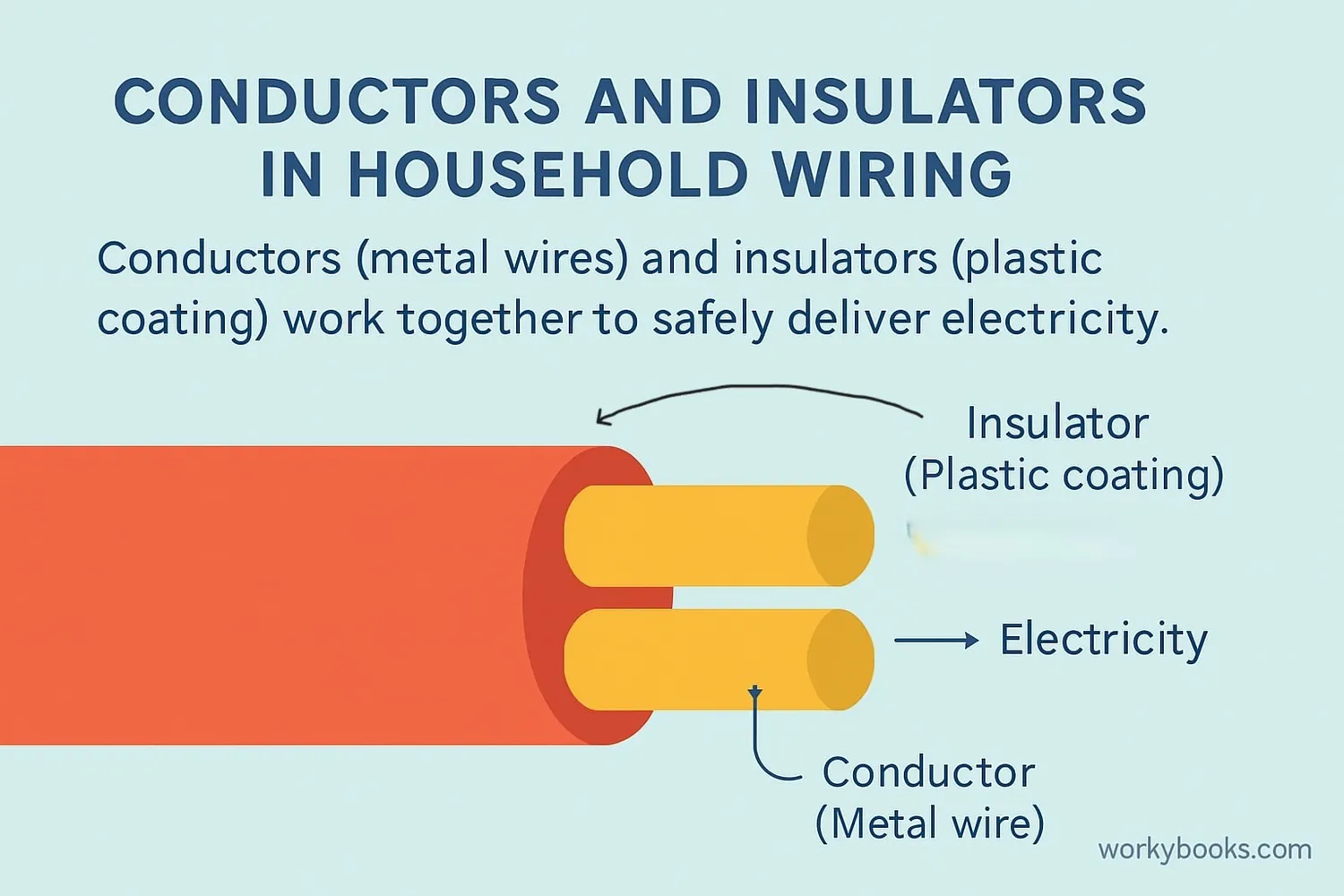
Conductors and insulators working together in electrical systems
Electrical conductors and insulators are crucial for controlling how electricity is used safely and efficiently in our world. Power lines, electronic devices, and even household appliances depend on the right choice of materials to work correctly and prevent dangerous situations. Understanding why some materials let electricity flow easily, while others block it, helps engineers and scientists design safer technology and better systems.
How Conductors and Insulators Work at the Atomic Level
At the core of these materials' properties is their atomic structure. In conductors like copper, aluminum, and silver, certain electrons are not tightly bound to their atoms. These "free electrons" can move easily from atom to atom. When a voltage is applied, these electrons carry electric current rapidly through the material. For example, copper is widely used in electrical wiring because it allows more than 95% of applied charge to flow without significant resistance. In contrast, insulators such as rubber, glass, wood, and most plastics have electrons that are tightly held. This makes it very difficult for charge to move, so insulators block or greatly slow down the flow of electricity.
Semiconductors: The Middle Ground
Some materials, called semiconductors, have electrical properties between conductors and insulators. Silicon is the most famous semiconductor and is used in almost all modern electronics. Under normal conditions, silicon resists the flow of charge. However, by adding small amounts of other elements, its ability to conduct electricity can be precisely controlled. This unique property enables semiconductors to act as switches or amplifiers in devices such as computers and smartphones.
Real-World Applications and Safety
Choosing the correct material for electrical applications is critical. For example, power cords are made with a copper wire core for high conductivity, surrounded by a thick plastic or rubber insulator for safety. The insulator prevents accidental shocks and ensures the current only flows where it is intended. In high-voltage environments, glass and ceramic insulators are used to keep electrical lines separated and safe. The careful combination of conductors, insulators, and semiconductors allows engineers to design everything from simple circuits to complex microchips. These choices impact energy efficiency, safety standards, and even environmental sustainability.
In summary, the behavior of electrical conductors and insulators is determined by their atomic structures and the way electrons move within them. This understanding forms the foundation for modern technology and everyday safety. As scientific research advances, new materials and improved designs continue to shape how we use and control electricity.
Interesting Fact: The human body is a natural conductor of electricity, which is why touching a live wire without insulation can be extremely dangerous!
What is the primary role of an electrical conductor?
To allow electric charges to flow easilyTo block the flow of lightTo prevent heat from escapingTo absorb sound waves
Which material is commonly used as a conductor in electrical wires?
CopperRubberGlassWood
What is the main function of an insulator in a power cord?
To prevent electric current from escaping and keep people safeTo increase the speed of electricityTo attract more electronsTo make the wire lighter
In the passage, what are free electrons?
Electrons that can move easily from atom to atomElectrons that are tightly bound to atomsElectrons that have no chargeElectrons that stop electricity
What does the term 'semiconductor' mean as used in the passage?
A material that has electrical properties between conductors and insulatorsA material that only blocks electricityA material that only allows heat to passA material that cannot be used in electronics
Based on the passage, why is choosing the right material important in electrical applications?
It ensures safety and efficient flow of electricityIt makes devices look betterIt prevents the device from getting dirtyIt reduces the size of devices
Why are glass and ceramic used in high-voltage environments?
Because they are strong insulators that keep electrical lines separated and safeBecause they conduct electricity very wellBecause they are lightweight metalsBecause they reflect light
True or False: Insulators have free electrons that can move easily.
TrueFalse
True or False: Semiconductors can have their electrical properties changed by adding other elements.
TrueFalse
What percentage of applied charge can copper allow to flow without significant resistance, according to the passage?
More than 95%About 50%Less than 10%Exactly 100%
Perfect For:
👩🏫 Teachers
• Reading comprehension practice
• Auto-graded assessments
• Literacy skill development
👨👩👧👦 Parents
• Reading practice at home
• Comprehension improvement
• Educational reading time
🏠 Homeschoolers
• Reading curriculum support
• Independent reading practice
• Progress monitoring
Reading Features:
📖
Reading Passage
Engaging fiction or nonfiction text
❓
Comprehension Quiz
Auto-graded questions
📊
Instant Feedback
Immediate results and scoring
📄
Printable Version
Download for offline reading
🔊
Read Aloud
Voice-over with word highlighting
Reviews & Ratings
No reviews yet. Be the first to share your experience!
Related Content
Types of Magnets
This science passage for grades 6-8 explains the types of magnets—permanent, temporary, natural, and briefly electromagn...
MS-PS2-3
Magnetic Materials
This passage, aligned to NGSS standard MS-PS2-3, explores the science behind magnetic materials and their importance in ...
MS-PS2-3
What Is Electricity?
This middle school science passage introduces the concept of electricity, aligned with NGSS standard MS-PS2-3. Students ...
MS-PS2-3
Electric Charge
This comprehensive middle school science passage introduces the concept of electric charge as a fundamental property of ...
MS-PS2-3
How Charges Interact
This standards-aligned passage for grades 6-8 introduces students to how electric charges interact, focusing on the fund...
MS-PS2-3MS-PS2-5
Electric Current
This comprehensive middle school science passage, aligned with NGSS standard MS-PS2-3, introduces students to the concep...
MS-PS2-3
Electric Circuits
This middle school science passage explores electric circuits in depth, aligning with NGSS standard MS-PS2-3. Students w...
MS-PS2-3
Series and Parallel Circuits
This informative passage for grades 6-8 explains the scientific mechanisms behind series and parallel electrical circuit...
MS-PS2-3
Electrical Safety
This comprehensive informational passage for grades 6-8 explores the science behind electrical safety, focusing on the m...
MS-PS2-3
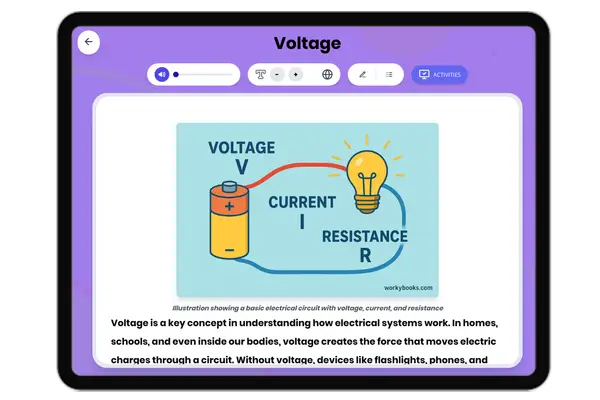
Voltage
This comprehensive passage for grades 6-8 explores the concept of voltage, defined as the electrical potential differenc...
MS-PS2-3
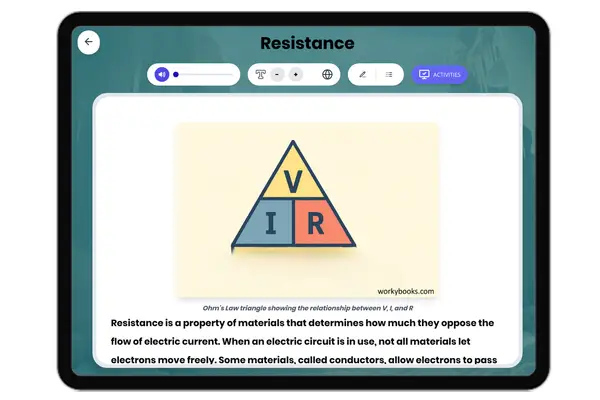
Resistance
This engaging middle school science passage explores the concept of resistance, a fundamental idea in the study of elect...
MS-PS2-3
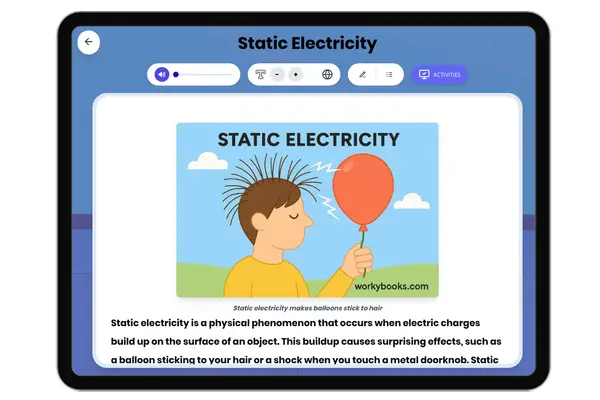
Static Electricity
This passage provides a comprehensive exploration of static electricity, aimed at students in grades 6-8 and aligned wit...
MS-PS2-3MS-PS2-5
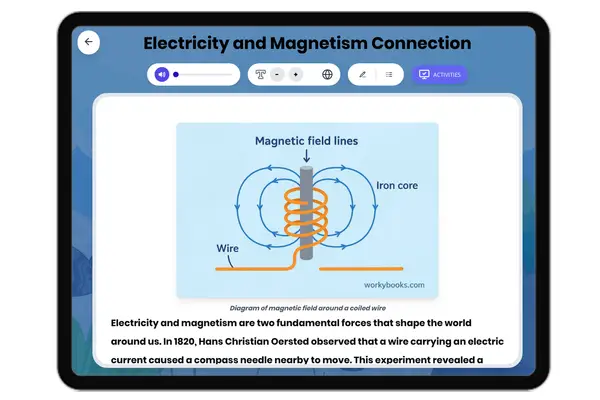
Electricity and Magnetism Connection
This comprehensive science passage for grades 6-8 explores the deep connection between electricity and magnetism, beginn...
MS-PS2-3MS-PS2-5
Electromagnets
This middle school science passage introduces students to electromagnets, aligning with NGSS standard MS-PS2-3. It cover...
MS-PS2-3
Uses of Electromagnets
This engaging middle school science passage explores the uses of electromagnets, aligned with NGSS standard MS-PS2-3. St...
MS-PS2-3
Electromagnetic Induction
This middle school science reading passage explores the concept of electromagnetic induction, focusing on Faraday's grou...
MS-PS2-3MS-PS3-5
Electric Motors
This comprehensive middle school science passage explores the science of electric motors, aligning with NGSS standards M...
MS-PS2-3MS-PS3-5
Transformers
This middle school science passage explores the science of transformers—devices that change the voltage of electricity u...
MS-PS2-3
Strength of Electromagnets
This middle school science passage explores the factors that affect the strength of electromagnets, including the number...