This learning resource is available in interactive and printable formats. The interactive worksheet can be played online and assigned to students. The Printable PDF version can be downloaded and printed for completion by hand.
This comprehensive middle school science passage introduces the concept of electric charge as a fundamental property of matter, aligned to NGSS MS-PS2-3. Students will learn about positive (proton) and negative (electron) charges, the structure of atoms, and the law of conservation of charge, with units measured in coulombs. The passage explains how electric charge influences interactions between particles and connects these ideas to real-world applications, such as static electricity and technology. Key vocabulary is highlighted and defined, and the reading is accessible to grades 6-8, including a differentiated version for struggling readers. Activities include a quiz, writing prompts, and two graphic organizers to reinforce understanding. Audio integration supports diverse learners, making this a valuable resource for classrooms exploring matter and its properties.
CONTENT PREVIEW
Expand content preview
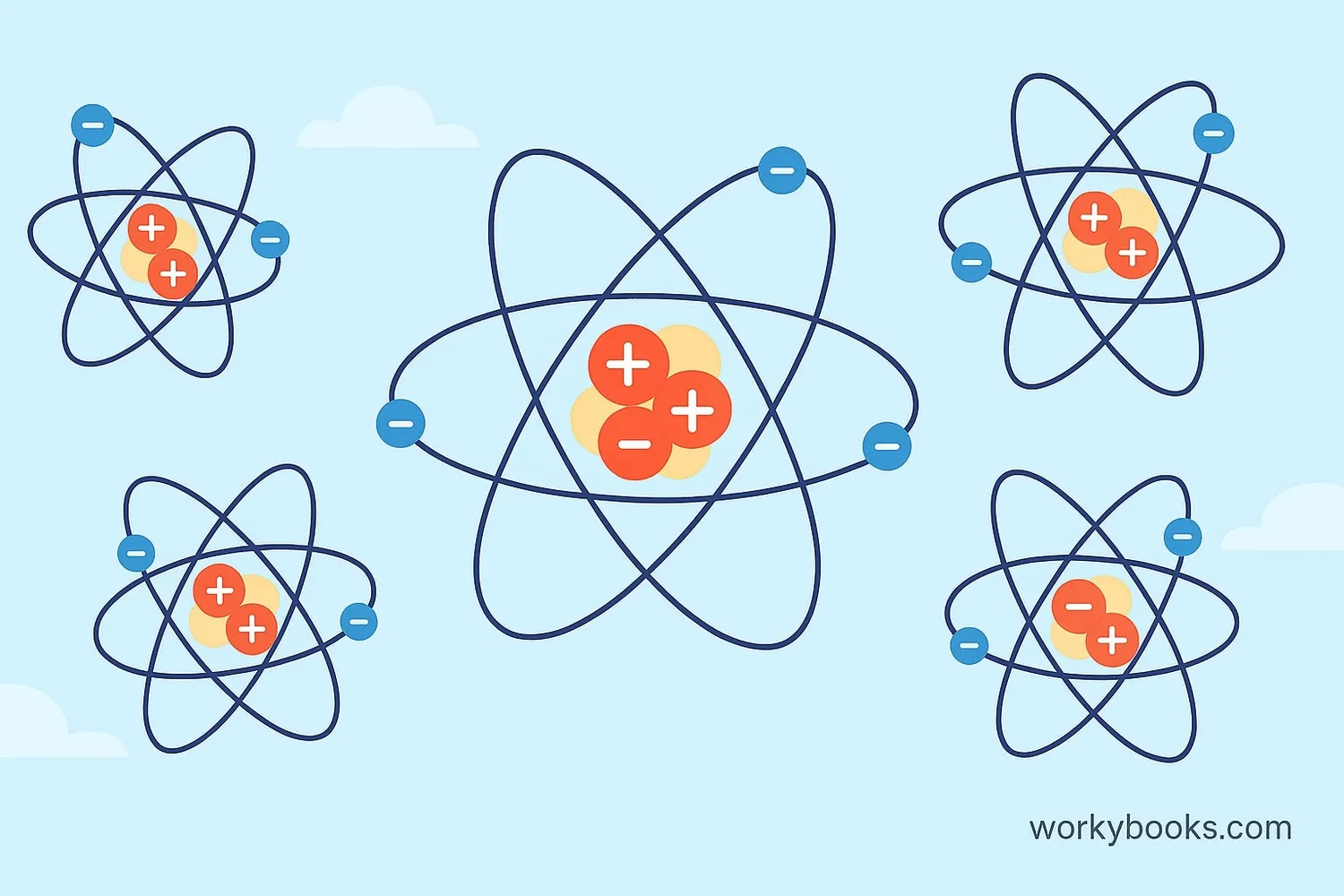
Illustration showing atoms with positive and negative charges
Electric charge is a fundamental property of matter that determines how particles interact at the smallest scale. Every object is made of atoms, and each atom contains even smaller particles: protons, electrons, and neutrons. The presence and movement of electric charge explain many phenomena in our daily lives, from the shock you feel after walking on carpet to the operation of complex electronics. Understanding electric charge helps us explain how matter behaves, connects to the structure of atoms, and reveals how energy and information flow in the world around us.
What Is Electric Charge? At the heart of every atom, protons carry a positive charge, while electrons carry a negative charge. Neutrons have no charge at all. These charges are not just labels; they are real physical properties that affect how particles attract or repel each other. A neutral object has the same number of positive and negative charges, so they balance out. The unit used to measure electric charge is the coulomb (C). For example, a single proton has a charge of about 1.6 × 10⁻¹⁹ coulombs, but in everyday objects, the total charge can be much larger.
How Charges Interact and Move Opposite charges attract, while like charges repel. This rule explains why electrons stay around the nucleus and why objects can stick together or push apart. If you rub a balloon on your hair, electrons transfer from your hair to the balloon. Now, the balloon has extra negative charge and your hair has extra positive charge, making them attract. This process follows the law of conservation of charge: electric charge cannot be created or destroyed, only moved from one place to another. In all chemical and physical processes, the total charge before and after remains the same.
Applications and Broader Implications Understanding electric charge has real-world applications. In electronics, the flow of electric charge—called electric current—powers devices like phones and computers. Static electricity, lightning, and even the way your body transmits nerve signals are all based on charge movement. The balance between positive and negative charges inside atoms keeps matter stable. When this balance is disrupted, it leads to important effects, such as static shocks or the operation of batteries. Scientists use the concept of charge conservation to explain why certain reactions or events are possible (or impossible) in nature and technology.
Electric charge is central to our understanding of matter and energy. It connects the microscopic structure of atoms to the macroscopic world, from everyday experiences to advanced technology. This core idea is a foundation for exploring more complex topics in physics, chemistry, and engineering.
Interesting Fact: Lightning is a giant spark caused by the rapid movement of electric charge through the air. A single lightning bolt can transfer more than 5 coulombs of charge in less than a second!
What is electric charge?
A property of matter that causes particles to attract or repel each other.A type of energy found only in metals.The weight of an atom.A type of chemical reaction.
Which particle in the atom carries a negative charge?
ProtonElectronNeutronNucleus
What does it mean if an object is neutral?
It has more protons than electrons.It has more electrons than protons.It has equal numbers of positive and negative charges.It has no particles.
In the passage, what happens when you rub a balloon on your hair?
Electrons move from the balloon to your hair.Electrons move from your hair to the balloon.Protons move from the balloon to your hair.Neutrons move from your hair to the balloon.
What is the unit used to measure electric charge?
AmpereJouleCoulombVolt
What does the law of conservation of charge state?
Charge can be created and destroyed.Charge can only be transferred, not created or destroyed.Only protons carry charge.Charge stays in the nucleus only.
Which of the following statements can be inferred from the passage?
Electric charge is only important in science experiments.The balance of positive and negative charges keeps matter stable.Neutrons carry negative charge.Static electricity cannot occur in nature.
How does electric charge relate to everyday technology?
Electric charge is only found in atoms, not technology.Electric charge flows as electric current to power devices.Electric charge does not affect electronics.Electric charge is the same as heat.
True or False: Protons have a negative electric charge.
TrueFalse
True or False: Lightning is a natural example of electric charge moving through the air.
TrueFalse
Perfect For:
👩🏫 Teachers
• Reading comprehension practice
• Auto-graded assessments
• Literacy skill development
👨👩👧👦 Parents
• Reading practice at home
• Comprehension improvement
• Educational reading time
🏠 Homeschoolers
• Reading curriculum support
• Independent reading practice
• Progress monitoring
Reading Features:
📖
Reading Passage
Engaging fiction or nonfiction text
❓
Comprehension Quiz
Auto-graded questions
📊
Instant Feedback
Immediate results and scoring
📄
Printable Version
Download for offline reading
🔊
Read Aloud
Voice-over with word highlighting
Reviews & Ratings
No reviews yet. Be the first to share your experience!
Related Content
Types of Magnets
This science passage for grades 6-8 explains the types of magnets—permanent, temporary, natural, and briefly electromagn...
MS-PS2-3
Magnetic Materials
This passage, aligned to NGSS standard MS-PS2-3, explores the science behind magnetic materials and their importance in ...
MS-PS2-3
What Is Electricity?
This middle school science passage introduces the concept of electricity, aligned with NGSS standard MS-PS2-3. Students ...
MS-PS2-3
How Charges Interact
This standards-aligned passage for grades 6-8 introduces students to how electric charges interact, focusing on the fund...
MS-PS2-3MS-PS2-5
Electric Current
This comprehensive middle school science passage, aligned with NGSS standard MS-PS2-3, introduces students to the concep...
MS-PS2-3
Electrical Conductors and Insulators
This comprehensive science passage for grades 6-8 delves into the concepts of electrical conductors and insulators, alig...
MS-PS2-3
Electric Circuits
This middle school science passage explores electric circuits in depth, aligning with NGSS standard MS-PS2-3. Students w...
MS-PS2-3
Series and Parallel Circuits
This informative passage for grades 6-8 explains the scientific mechanisms behind series and parallel electrical circuit...
MS-PS2-3
Electrical Safety
This comprehensive informational passage for grades 6-8 explores the science behind electrical safety, focusing on the m...
MS-PS2-3
Voltage
This comprehensive passage for grades 6-8 explores the concept of voltage, defined as the electrical potential differenc...
MS-PS2-3
Resistance
This engaging middle school science passage explores the concept of resistance, a fundamental idea in the study of elect...
MS-PS2-3
Static Electricity
This passage provides a comprehensive exploration of static electricity, aimed at students in grades 6-8 and aligned wit...
MS-PS2-3MS-PS2-5
Electricity and Magnetism Connection
This comprehensive science passage for grades 6-8 explores the deep connection between electricity and magnetism, beginn...
MS-PS2-3MS-PS2-5
Electromagnets
This middle school science passage introduces students to electromagnets, aligning with NGSS standard MS-PS2-3. It cover...
MS-PS2-3
Uses of Electromagnets
This engaging middle school science passage explores the uses of electromagnets, aligned with NGSS standard MS-PS2-3. St...
MS-PS2-3
Electromagnetic Induction
This middle school science reading passage explores the concept of electromagnetic induction, focusing on Faraday's grou...
MS-PS2-3MS-PS3-5
Electric Motors
This comprehensive middle school science passage explores the science of electric motors, aligning with NGSS standards M...
MS-PS2-3MS-PS3-5
Transformers
This middle school science passage explores the science of transformers—devices that change the voltage of electricity u...
MS-PS2-3
Strength of Electromagnets
This middle school science passage explores the factors that affect the strength of electromagnets, including the number...