Types of Magnets
Interactive passage with audio narration, comprehension questions, and printable PDF.
By completing this purchase you agree to our Terms of Use and Privacy Policy. Your subscription renews automatically until you cancel. You can cancel anytime from your account settings. All sales are final and non-refundable. Digital content is available for download in your account immediately upon purchase.
What's included
Types of Magnets preview and details
About this printable Types of Magnets science reading passage, NGSS-aligned (Grades 5-8)
Sample passage and quiz from Types of Magnets
Reading passage and comprehension quiz preview
Types of Magnets

Magnetism is a force of nature responsible for many essential phenomena, from the operation of compasses to the function of electronic devices. Scientists classify magnets based on how they acquire and retain their magnetic properties. Understanding the different types of magnets helps explain why certain materials attract or repel, how technology harnesses magnetic forces, and the role of magnetism in Earth's systems.
How Magnets Work and Their Mechanisms
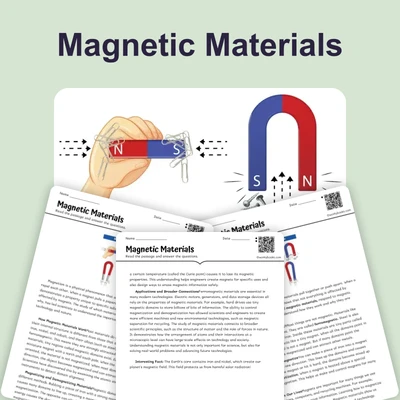
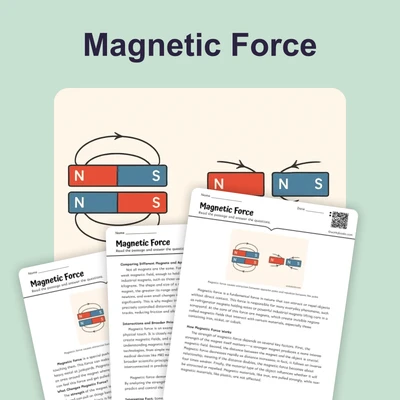
At the core of magnetism is the movement of electrons. In a permanent magnet, like a bar or horseshoe magnet, the atoms are aligned so that their electron spins point in the same direction. This alignment creates a persistent magnetic field, which does not disappear unless the magnet is heated to a high temperature or struck with force. Temporary magnets, such as a chain of paper clips, only become magnetic when near a strong magnet. Their atoms temporarily align, causing them to attract other metals, but when the external magnet is removed, the alignment is lost, and so is the magnetism. Natural magnets, such as lodestone (a form of magnetite), occur naturally in Earth's crust. The mineral's unique crystal structure allows its electrons to align spontaneously, producing a magnetic field without external influence.
Comparing Strength, Uses, and Interactions
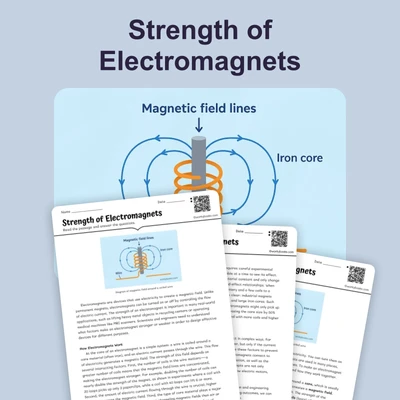
Permanent magnets tend to be stronger and more reliable for long-term use than temporary magnets. Bar, horseshoe, and ring magnets are common shapes, each designed for specific purposes: bar magnets for demonstrations, horseshoe magnets for lifting, and ring magnets in speakers. Temporary magnets are weak and lose their magnetism quickly; they are useful for illustrating magnetic induction, such as in classroom experiments. Natural magnets are less powerful compared to engineered magnets but are historically significant—they were used in the earliest compasses. Electromagnets (covered in detail in Unit 19) are magnets created by passing electric current through a wire coil. They can be switched on or off and are adjustable in strength, making them essential in devices like electric motors and cranes. Each type interacts with magnetic fields differently, affecting their applications in technology and daily life.
Scientific and Societal Implications
Studying the mechanisms and differences among types of magnets reveals larger scientific principles, such as the conservation of energy and the relationship between electricity and magnetism. For example, understanding why permanent magnets retain their magnetic force while temporary magnets do not has led to technological advances in data storage and energy generation. The Earth's magnetic field, a giant natural magnet, protects us from cosmic radiation and guides migratory animals. Magnetism is also crucial for medical technologies like MRI machines and for sustainable energy solutions like wind turbines.
In summary, the various types of magnets—permanent, temporary, natural, and electromagnets—play key roles in science and society. Their unique mechanisms, strengths, and uses demonstrate the complexity and importance of magnetism as a force in nature and technology.
Interesting Fact: Some ancient sailors relied on natural lodestone to find their way at sea hundreds of years before modern compasses were invented!
Comprehension quiz (10 questions)
1. Which of the following best describes a permanent magnet?
2. What is an example of a temporary magnet mentioned in the passage?
3. The word 'alignment' in the passage most likely means:
4. What is a lodestone?
5. Why do temporary magnets lose their magnetism when the external magnet is removed?
6. Which type of magnet can be turned on and off and is used in electric motors and cranes?
7. True or False: Natural magnets are usually stronger than permanent magnets made in factories.
8. True or False: The Earth's magnetic field protects us from cosmic radiation.
9. How are electromagnets different from permanent magnets?
10. If you wanted to lift heavy pieces of metal in a junkyard, which type of magnet would be most useful and why?
Perfect for the way you teach
- Build comprehension skills
- Auto-graded quiz
- Differentiated reading
- Read together at home
- Improve fluency
- Quiet reading time
- Reading curriculum support
- Independent practice
- Track Lexile growth