Electricity and Magnetism Connection — Reading Comprehension
Rate this
Premium Resource
Present
Present in classroom. No work saved
Assign
Classroom with student accounts, Track progress
Quick Play
No student accounts, assign with a link
Grades
5
6
7
8
Standards
MS-PS2-3
MS-PS2-5
PRINT+DIGITAL RESOURCE
This learning resource is available in interactive and printable formats. The interactive worksheet can be played online and assigned to students. The Printable PDF version can be downloaded and printed for completion by hand.
This comprehensive science passage for grades 6-8 explores the deep connection between electricity and magnetism, beginning with the pivotal experiment by Hans Christian Oersted in 1820. Students will learn how moving electric charges create magnetic fields, and how this discovery laid the foundation for modern electromagnetism. The passage aligns with NGSS standards MS-PS2-3 and MS-PS2-5, and integrates historical context, real-world examples, and clear explanations of mechanisms and systems at work. Academic vocabulary is introduced in context, and a glossary supports deeper understanding. Activities include a multiple-choice quiz, writing prompts, and graphic organizers designed for critical thinking and evidence-based reasoning. Both standard and differentiated (simplified) passage versions are available, each with a Spanish translation. Audio integration supports accessibility for diverse learners. This resource is ideal for science classrooms aiming to build understanding of fundamental forces that shape our technological world.
CONTENT PREVIEW
Expand content preview
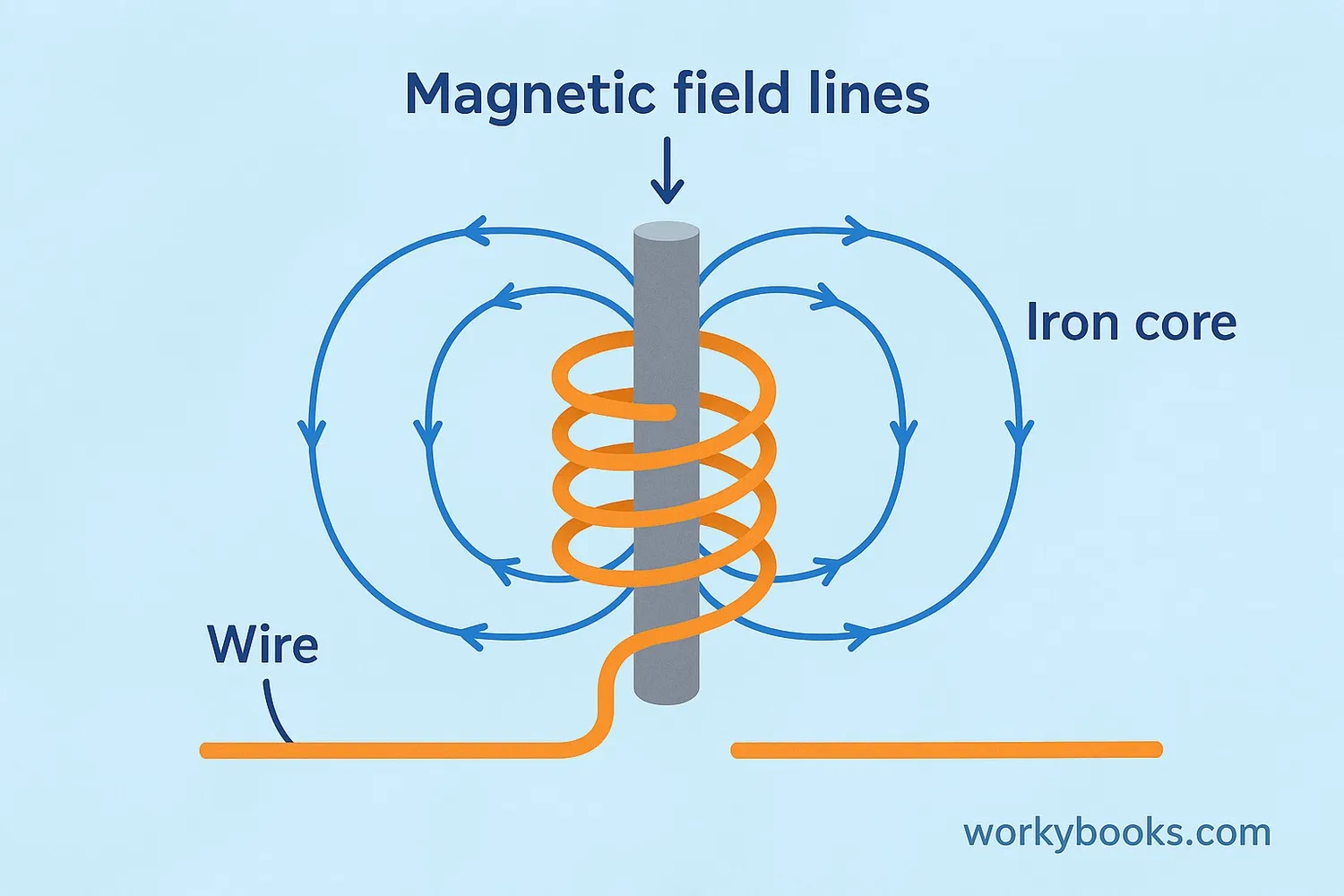
Diagram of magnetic field around a coiled wire
Electricity and magnetism are two fundamental forces that shape the world around us. In 1820, Hans Christian Oersted observed that a wire carrying an electric current caused a compass needle nearby to move. This experiment revealed a significant scientific relationship: moving electric charges create magnetic effects. The discovery of the connection between electricity and magnetism led to the field of electromagnetism, which has transformed technology and our understanding of physics.
The Mechanism: How Electricity Creates Magnetism
When electric charges flow through a wire, they produce an invisible magnetic field around the wire. This field forms circular patterns centered on the wire, which can be detected using a compass. The direction of the magnetic field depends on the direction of the current. For example, if the current flows north, the magnetic field wraps around the wire following a right-hand rule. The strength of the field increases with the amount of current—doubling the current doubles the magnetic field’s strength. This relationship is foundational in electromagnetism and helps explain how electric motors and generators work.
Applications and Interactions
This connection is used in many everyday devices. In electric motors, current-carrying wires create magnetic fields that interact with permanent magnets, causing the motor to spin. In generators, moving a wire through a magnetic field creates an electric current, the reverse process. Magnetic resonance imaging (MRI) machines use strong magnetic fields generated by electric currents to create images of the human body. These examples show how electricity and magnetism interact to produce useful effects in technology and medicine.
Historical and Scientific Significance
Before Oersted’s experiment, electricity and magnetism were thought to be separate forces. The realization that electric current creates a magnetic field was a turning point. It led to the understanding that these forces are two aspects of a single phenomenon, now called electromagnetism. This discovery influenced scientists like Michael Faraday and James Clerk Maxwell, whose work showed that changing magnetic fields can also create electric currents. The connection between electricity and magnetism is fundamental to the operation of power plants, wireless communication, and much of modern technology.
In summary, the relationship between electricity and magnetism demonstrates how different forces in nature can be deeply interconnected. The cause-and-effect chain—electric current producing a magnetic field—forms the basis for many technologies, showing how scientific discovery leads to practical innovation.
Interesting Fact: Every time you use a speaker or headphones, electromagnetism is at work converting electric signals into sound!
What did Oersted discover in 1820?
An electric current can create a magnetic field.Magnets can create electricity automatically.Electricity and magnetism are not related.Electric current always flows north.
Which device uses the principle that moving a wire through a magnetic field creates electricity?
Electric motorBatteryGeneratorCompass
What happens to the strength of a magnetic field if the electric current in a wire is doubled?
It doubles.It is cut in half.It stays the same.It disappears.
What is the right-hand rule used for?
To predict the direction of a magnetic field around a wire.To measure electric current.To build a battery.To find north with a compass.
What is a magnetic field?
A visible area of light around a magnet.An invisible area of force around a magnet or current-carrying wire.A type of metal.A sound wave.
Which scientist first observed the connection between electricity and magnetism in 1820?
Michael FaradayHans Christian OerstedJames Clerk MaxwellIsaac Newton
Why was Oersted's experiment important for science?
It showed that electric current creates magnetic fields, linking electricity and magnetism.It proved electricity and magnetism are not related.It invented the electric motor.It showed magnets could float.
True or False: Changing a magnetic field can create an electric current.
TrueFalse
True or False: A compass needle moves near a current-carrying wire because of a magnetic field.
TrueFalse
What is one real-world application of electromagnetism mentioned in the passage?
Solar panelsMRI machinesWind turbinesThermometers
Perfect For:
👩🏫 Teachers
• Reading comprehension practice
• Auto-graded assessments
• Literacy skill development
👨👩👧👦 Parents
• Reading practice at home
• Comprehension improvement
• Educational reading time
🏠 Homeschoolers
• Reading curriculum support
• Independent reading practice
• Progress monitoring
Reading Features:
📖
Reading Passage
Engaging fiction or nonfiction text
❓
Comprehension Quiz
Auto-graded questions
📊
Instant Feedback
Immediate results and scoring
📄
Printable Version
Download for offline reading
🔊
Read Aloud
Voice-over with word highlighting
Reviews & Ratings
No reviews yet. Be the first to share your experience!
Related Content
Types of Magnets
This science passage for grades 6-8 explains the types of magnets—permanent, temporary, natural, and briefly electromagn...
MS-PS2-3
Magnetic Materials
This passage, aligned to NGSS standard MS-PS2-3, explores the science behind magnetic materials and their importance in ...
MS-PS2-3
What Is Electricity?
This middle school science passage introduces the concept of electricity, aligned with NGSS standard MS-PS2-3. Students ...
MS-PS2-3
Electric Charge
This comprehensive middle school science passage introduces the concept of electric charge as a fundamental property of ...
MS-PS2-3
How Charges Interact
This standards-aligned passage for grades 6-8 introduces students to how electric charges interact, focusing on the fund...
MS-PS2-3MS-PS2-5
Electric Current
This comprehensive middle school science passage, aligned with NGSS standard MS-PS2-3, introduces students to the concep...
MS-PS2-3
Electrical Conductors and Insulators
This comprehensive science passage for grades 6-8 delves into the concepts of electrical conductors and insulators, alig...
MS-PS2-3
Electric Circuits
This middle school science passage explores electric circuits in depth, aligning with NGSS standard MS-PS2-3. Students w...
MS-PS2-3
Series and Parallel Circuits
This informative passage for grades 6-8 explains the scientific mechanisms behind series and parallel electrical circuit...
MS-PS2-3
Electrical Safety
This comprehensive informational passage for grades 6-8 explores the science behind electrical safety, focusing on the m...
MS-PS2-3
Voltage
This comprehensive passage for grades 6-8 explores the concept of voltage, defined as the electrical potential differenc...
MS-PS2-3
Resistance
This engaging middle school science passage explores the concept of resistance, a fundamental idea in the study of elect...
MS-PS2-3
Static Electricity
This passage provides a comprehensive exploration of static electricity, aimed at students in grades 6-8 and aligned wit...
MS-PS2-3MS-PS2-5
Electromagnets
This middle school science passage introduces students to electromagnets, aligning with NGSS standard MS-PS2-3. It cover...
MS-PS2-3
Uses of Electromagnets
This engaging middle school science passage explores the uses of electromagnets, aligned with NGSS standard MS-PS2-3. St...
MS-PS2-3
Electromagnetic Induction
This middle school science reading passage explores the concept of electromagnetic induction, focusing on Faraday's grou...
MS-PS2-3MS-PS3-5
Electric Motors
This comprehensive middle school science passage explores the science of electric motors, aligning with NGSS standards M...
MS-PS2-3MS-PS3-5
Transformers
This middle school science passage explores the science of transformers—devices that change the voltage of electricity u...
MS-PS2-3
Strength of Electromagnets
This middle school science passage explores the factors that affect the strength of electromagnets, including the number...