Voltage
Interactive passage with audio narration, comprehension questions, and printable PDF.
By completing this purchase you agree to our Terms of Use and Privacy Policy. Your subscription renews automatically until you cancel. You can cancel anytime from your account settings. All sales are final and non-refundable. Digital content is available for download in your account immediately upon purchase.
What's included
Voltage preview and details
About this printable Voltage science reading passage, NGSS-aligned (Grades 5-8)
Sample passage and quiz from Voltage
Reading passage and comprehension quiz preview
Voltage
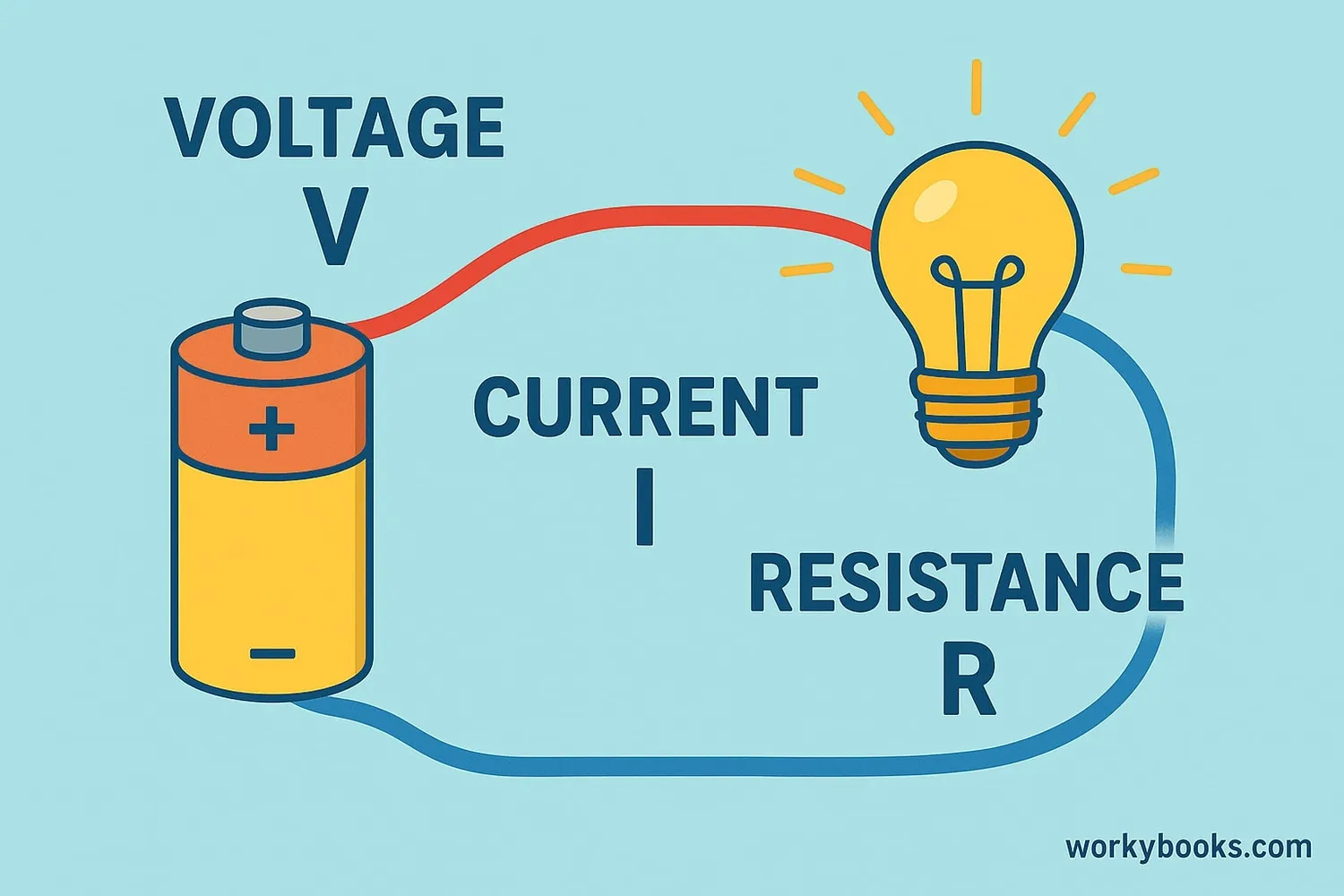
Voltage is a key concept in understanding how electrical systems work. In homes, schools, and even inside our bodies, voltage creates the force that moves electric charges through a circuit. Without voltage, devices like flashlights, phones, and computers would not function. Scientists define voltage as the electrical potential difference between two points. This difference is what causes charges to move, much like water flows from a higher place to a lower place.
How Voltage Creates Movement in Circuits
Voltage acts like the pressure in a water pipe. A battery, for example, provides voltage by creating a difference in electrical potential from one end (positive) to the other end (negative). When a conductor such as a wire connects these ends, electric charges—called electrons—flow from the negative to the positive side. The higher the voltage, the greater the push. This push is measured in units called volts (V). A typical AA battery provides about 1.5 volts, while a household outlet in the United States supplies about 120 volts. Car batteries deliver around 12 volts. These differences explain why plugging a small device directly into a wall outlet can damage it—the push is much stronger than what the device is built to handle.
Voltage, Current, and Resistance: The System at Work
Voltage does not work alone. It interacts with two other important concepts: current and resistance. Current is the flow of electric charges, similar to the amount of water flowing in a pipe. Resistance is the opposition to that flow, like a narrow section in the pipe that slows water down. The relationship between voltage, current, and resistance is described by Ohm’s Law: Voltage equals current multiplied by resistance (V = I × R). This means that for a given resistance, increasing the voltage increases the current, and increasing the resistance reduces the current. Materials like copper have low resistance, making them good conductors, while materials like rubber have high resistance and act as insulators.
Real-World Applications and Broader Implications
Understanding voltage is essential for designing safe and efficient electrical systems. Engineers must choose the right voltage for each device to ensure it works properly and safely. For example, using a high voltage in power lines allows electricity to travel long distances with less loss, while household devices use lower voltages for safety. In medicine, controlled voltages help operate equipment like pacemakers and EEG machines. The principles of voltage also help us understand natural phenomena, such as lightning, which results from a massive electrical potential difference between clouds and the ground.
Voltage is part of a larger system of energy transfer and transformation. It connects to the basic scientific idea that energy can be stored, transferred, and changed from one form to another. By studying voltage, scientists and engineers continue to develop safer and more powerful technologies.
Interesting Fact:
A bolt of lightning can carry a voltage of up to 100 million volts—enough energy to power a small town for an instant!
Comprehension quiz (10 questions)
1. What is the main role of voltage in an electrical circuit?
2. Which unit is used to measure voltage?
3. According to the passage, what happens if you plug a small device directly into a wall outlet?
4. In the analogy used, voltage is most similar to what in a water pipe?
5. What does the term 'resistance' mean in the context of electricity?
6. What does Ohm’s Law show the relationship between?
7. Which of the following is an example of a good conductor?
8. True or False: Household outlets in the United States supply about 12 volts.
9. True or False: Lightning is an example of extremely high voltage in nature.
10. If a material has high resistance, what happens to the current when voltage stays the same?
Perfect for the way you teach
- Build comprehension skills
- Auto-graded quiz
- Differentiated reading
- Read together at home
- Improve fluency
- Quiet reading time
- Reading curriculum support
- Independent practice
- Track Lexile growth