Series and Parallel Circuits — Reading Comprehension
Rate this|
13
Present
Present in classroom. No work saved
Assign
Classroom with student accounts, Track progress
Quick Play
No student accounts, assign with a link
Grades
5
6
7
8
Standards
MS-PS2-3
PRINT+DIGITAL RESOURCE
This learning resource is available in interactive and printable formats. The interactive worksheet can be played online and assigned to students. The Printable PDF version can be downloaded and printed for completion by hand.
This informative passage for grades 6-8 explains the scientific mechanisms behind series and parallel electrical circuits, aligning with NGSS standard MS-PS2-3. Students will explore how electricity moves through different circuit types, why Christmas lights often go out in series, and how home wiring uses parallel circuits for safety and convenience. The content introduces key vocabulary such as current, voltage, resistance, and component, all clearly defined in context. Real-world examples, cause-and-effect reasoning, and a connection to broader scientific principles are provided. The passage is accompanied by a glossary, comprehension quiz, writing prompts, and graphic organizers to reinforce concepts. Audio support is integrated for accessibility. This resource is ideal for classrooms seeking to deepen understanding of physical science and electricity with standards-based, multimodal materials.
CONTENT PREVIEW
Expand content preview
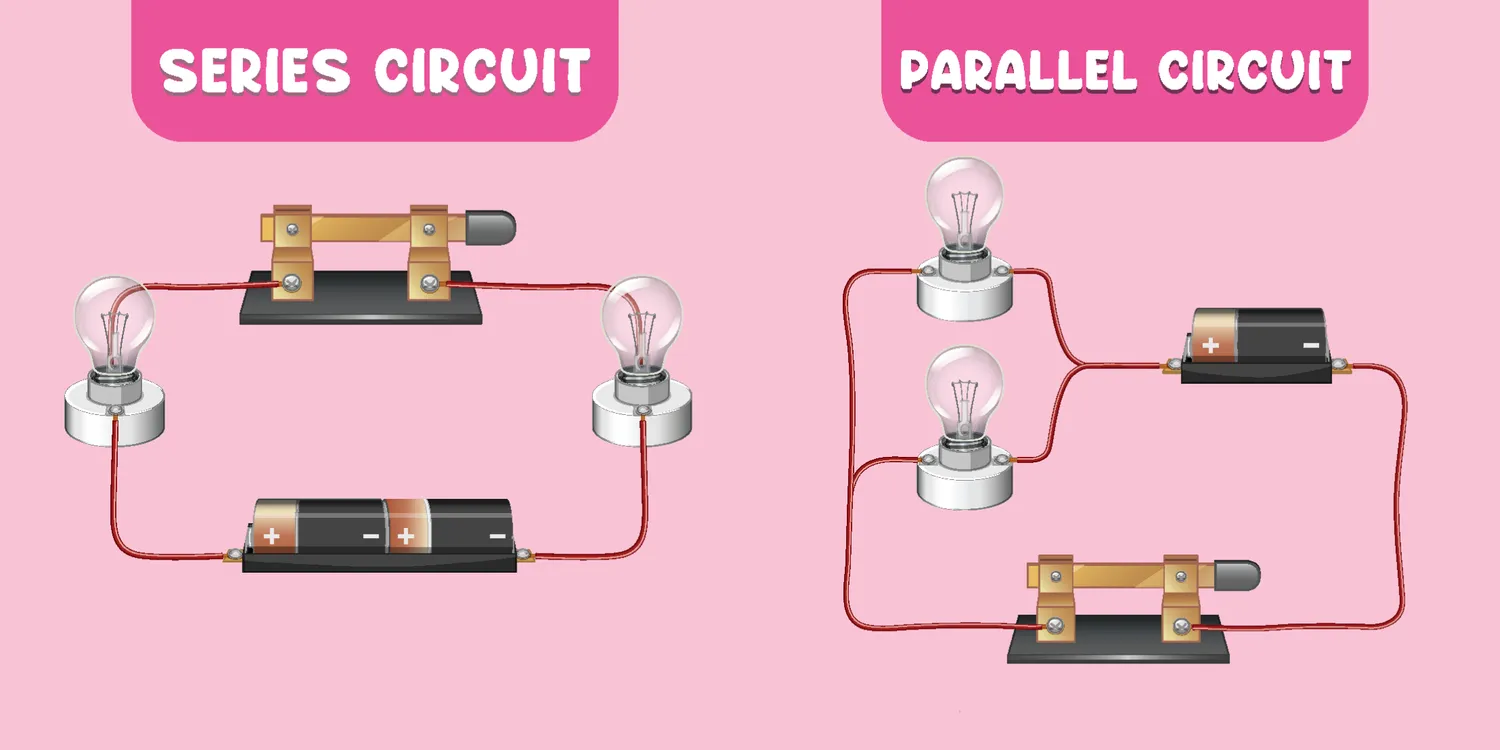
Series circuit (top) and parallel circuit (bottom)
Electrical circuits are systems that allow electric current to flow and power devices. Understanding the difference between series circuits and parallel circuits is fundamental in science and engineering. In homes and schools, the way components are connected determines whether a device will work if another fails. The study of how these circuits function helps us build safer, more reliable technology and infrastructure.
How Series Circuits Work
In a series circuit, all components are arranged in a single path, like a line of lights. The electric current flows through each component one after another. This means the current is the same at every point in the circuit, but the voltage from the power source is divided among the components. If one component, such as a light bulb, fails or is removed, the entire circuit breaks and all devices stop working. For example, older Christmas light sets were made in series, so one burned-out bulb could leave the whole string dark. This property can be useful for simple warning systems, but it makes series circuits less reliable for important applications.
Parallel Circuits: Reliable and Efficient
A parallel circuit connects each component on its own branch, creating multiple paths for the current. In this setup, each device receives the same voltage as the power source, but the current divides among the branches based on each component’s resistance. If one branch is interrupted, the other branches continue to work normally. This is why home wiring uses parallel circuits: if one lamp burns out, the others stay lit. Parallel circuits are also more energy-efficient because the brightness of bulbs does not decrease as more are added. Research shows that parallel circuits are essential for complex systems, from household appliances to large power grids.
Comparing Series and Parallel Circuits
The choice between series and parallel circuits depends on the application. Series circuits are simpler but less reliable, while parallel circuits provide independence and safety. Quantitative studies show that in a series circuit with three equal bulbs and a 9-volt battery, each bulb only gets 3 volts, making them dimmer. In a parallel circuit, each bulb receives the full 9 volts and shines brightly. However, parallel circuits require more wiring and careful design to prevent overloading. Engineers use both types in different contexts, balancing efficiency, safety, and cost.
Understanding these circuit structures helps explain how electrical systems work in everyday life and connects to the broader principles of energy transfer and system design that are central to physical science.
Interesting Fact: The wiring in your home is a parallel circuit, so you can use multiple devices at once without affecting each other’s performance.
Which statement best describes a series circuit?
All components are in one path and current flows through each in turn.Each component has its own branch and current splits among them.Every component receives the same current and voltage.It is the type used in home wiring.
What happens if one bulb fails in a series circuit?
All bulbs go out.Only the failed bulb goes out.The other bulbs get brighter.The circuit keeps working normally.
In a parallel circuit, what is true about the voltage across each component?
Each component gets the same voltage as the power source.Voltage is divided equally among components.Voltage is lower in each branch.No voltage reaches the branches.
Which best explains why home wiring uses parallel circuits?
So each device works independently even if another fails.To save on wiring costs.To make bulbs dimmer.Because series circuits are too complex.
What does 'resistance' mean in the context of circuits?
How much a part slows down electric current.The total voltage in the circuit.The speed of current flow.A type of electrical switch.
What is a 'branch' in a parallel circuit?
A separate path for current flow.The power source.A light bulb in a series circuit.The main wire of the circuit.
If three identical bulbs are connected in series to a 9V battery, how much voltage does each bulb receive?
3 volts9 volts6 volts0 volts
If three identical bulbs are connected in parallel to a 9V battery, how much voltage does each bulb receive?
9 volts3 volts4.5 volts0 volts
A parallel circuit is more reliable than a series circuit. (True/False)
TrueFalse
In a series circuit, removing one component does not affect the rest. (True/False)
TrueFalse
Perfect For:
👩🏫 Teachers
• Reading comprehension practice
• Auto-graded assessments
• Literacy skill development
👨👩👧👦 Parents
• Reading practice at home
• Comprehension improvement
• Educational reading time
🏠 Homeschoolers
• Reading curriculum support
• Independent reading practice
• Progress monitoring
Reading Features:
📖
Reading Passage
Engaging fiction or nonfiction text
❓
Comprehension Quiz
Auto-graded questions
📊
Instant Feedback
Immediate results and scoring
📄
Printable Version
Download for offline reading
🔊
Read Aloud
Voice-over with word highlighting
Reviews & Ratings
No reviews yet. Be the first to share your experience!
Related Content
Types of Magnets
This science passage for grades 6-8 explains the types of magnets—permanent, temporary, natural, and briefly electromagn...
MS-PS2-3
Magnetic Materials
This passage, aligned to NGSS standard MS-PS2-3, explores the science behind magnetic materials and their importance in ...
MS-PS2-3
What Is Electricity?
This middle school science passage introduces the concept of electricity, aligned with NGSS standard MS-PS2-3. Students ...
MS-PS2-3
Electric Charge
This comprehensive middle school science passage introduces the concept of electric charge as a fundamental property of ...
MS-PS2-3
How Charges Interact
This standards-aligned passage for grades 6-8 introduces students to how electric charges interact, focusing on the fund...
MS-PS2-3MS-PS2-5
Electric Current
This comprehensive middle school science passage, aligned with NGSS standard MS-PS2-3, introduces students to the concep...
MS-PS2-3
Electric Circuits
This middle school science passage explores electric circuits in depth, aligning with NGSS standard MS-PS2-3. Students w...
MS-PS2-3
Electrical Safety
This comprehensive informational passage for grades 6-8 explores the science behind electrical safety, focusing on the m...
MS-PS2-3
Voltage
This comprehensive passage for grades 6-8 explores the concept of voltage, defined as the electrical potential differenc...
MS-PS2-3
Resistance
This engaging middle school science passage explores the concept of resistance, a fundamental idea in the study of elect...
MS-PS2-3
Static Electricity
This passage provides a comprehensive exploration of static electricity, aimed at students in grades 6-8 and aligned wit...
MS-PS2-3MS-PS2-5
Electricity and Magnetism Connection
This comprehensive science passage for grades 6-8 explores the deep connection between electricity and magnetism, beginn...
MS-PS2-3MS-PS2-5
Electromagnets
This middle school science passage introduces students to electromagnets, aligning with NGSS standard MS-PS2-3. It cover...
MS-PS2-3
Uses of Electromagnets
This engaging middle school science passage explores the uses of electromagnets, aligned with NGSS standard MS-PS2-3. St...
MS-PS2-3
Electromagnetic Induction
This middle school science reading passage explores the concept of electromagnetic induction, focusing on Faraday's grou...
MS-PS2-3MS-PS3-5
Electric Motor
This comprehensive middle school science passage explores the science of electric motors, aligning with NGSS standards M...
MS-PS2-3MS-PS3-5
How Transformers Work
This middle school science passage explores the science of transformers—devices that change the voltage of electricity u...
MS-PS2-3
Strength of Electromagnets
This middle school science passage explores the factors that affect the strength of electromagnets, including the number...
MS-PS2-3
Magnetic Force
This comprehensive science passage for grades 6-8 explores the mechanisms behind magnetic force, including how magnet st...