Electric Current
Interactive passage with audio narration, comprehension questions, and printable PDF.
By completing this purchase you agree to our Terms of Use and Privacy Policy. Your subscription renews automatically until you cancel. You can cancel anytime from your account settings. All sales are final and non-refundable. Digital content is available for download in your account immediately upon purchase.
What's included
Electric Current preview and details
About this printable Electric Current science reading passage, NGSS-aligned (Grades 5-8)
Sample passage and quiz from Electric Current
Reading passage and comprehension quiz preview
Electric Current
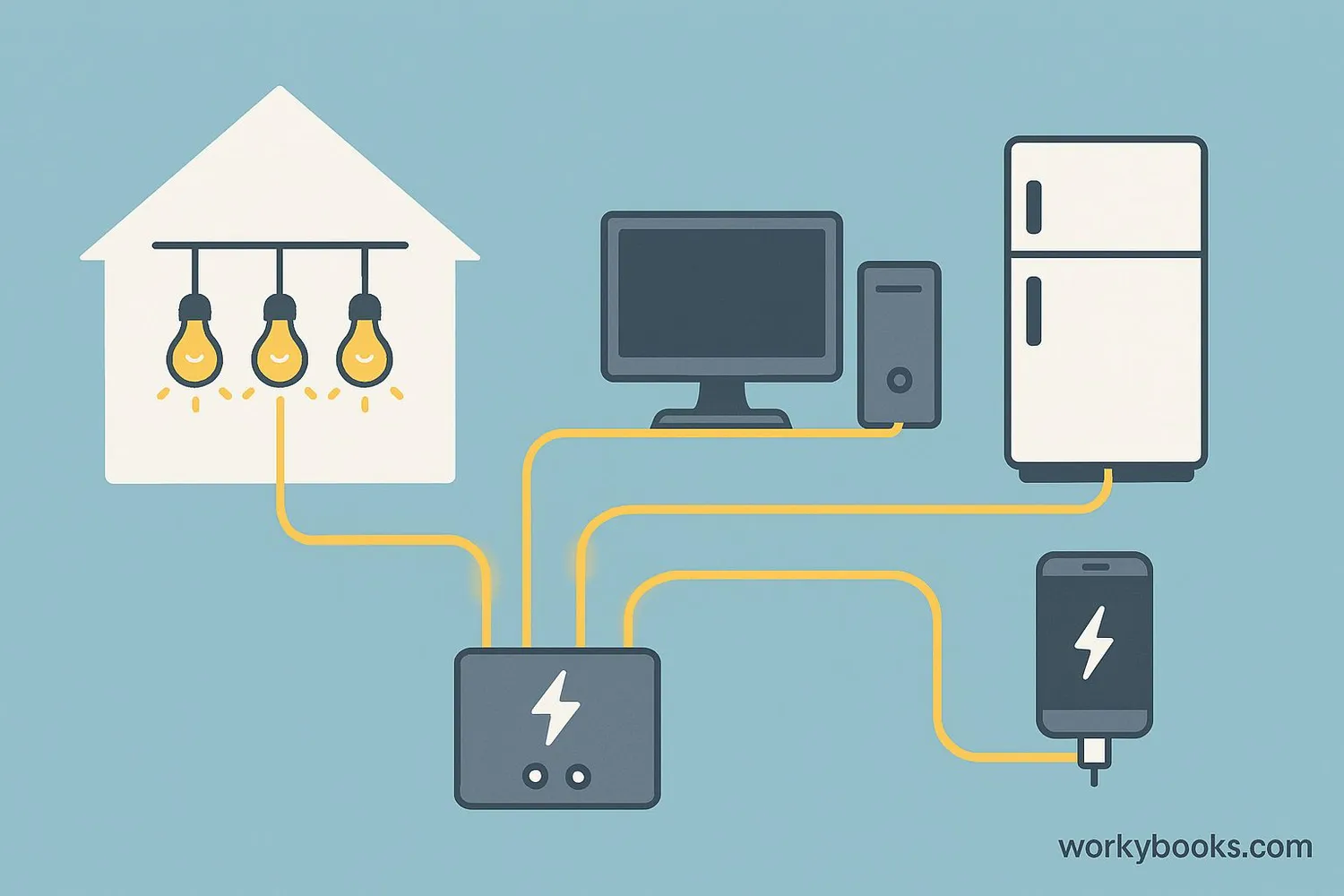
Electric current is a vital part of modern technology and daily life. In a simple flashlight, a switch turns on a beam of light by allowing current to flow through a bulb. The movement of electric charges makes countless devices work, from smartphones to refrigerators. Understanding how electric current works helps us see the science behind everyday objects and larger power systems.
At its core, electric current is the flow of tiny particles called electrons through a conductor, usually a metal wire. For this flow to happen, there must be a complete path, or circuit. The current only moves when the circuit is closed—just like water only flows through pipes if there are no breaks. The amount of current is measured in amperes (amps). A typical small flashlight uses about 0.5 amps, while a hair dryer may use 10 amps or more. The rate of current tells us how many charges pass a point each second.
How Electric Current Works
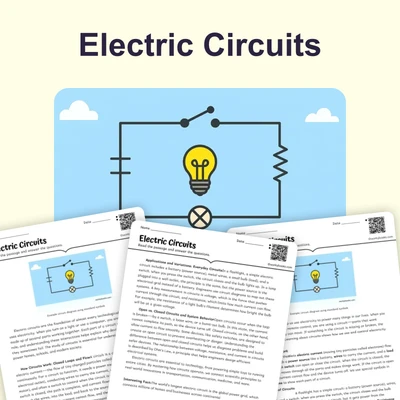
An electric circuit is made up of a power source (like a battery), wires, and a device that uses electricity, such as a bulb. When the circuit is closed, electrons move from the negative end of the battery, through the wires, and toward the positive end. This movement creates an electric current, which powers the device. Scientists measure the direction of current in two ways. Conventional current describes current as moving from the positive to the negative terminal, even though electrons actually flow the opposite way—from negative to positive. This difference comes from early scientific models, before electrons were discovered. The water-in-pipes analogy helps visualize this: current is like water flowing in a pipe, and the battery acts like a pump, pushing the water (charges) around the loop.
Applications and Interactions
Electric current is essential for lighting, heating, and powering electronic devices. In homes and schools, safe circuits prevent dangerous shocks by using insulation and circuit breakers. Engineers design circuits to control how much current flows, because too much current can damage devices or cause fires. In medical technology, tiny currents help doctors monitor heartbeats or stimulate nerves. The principles of current also apply to renewable energy: solar panels and wind turbines generate electricity by moving charges to create a current. Understanding current helps us improve energy efficiency, safety, and the development of new technology.
Complexities and Exceptions
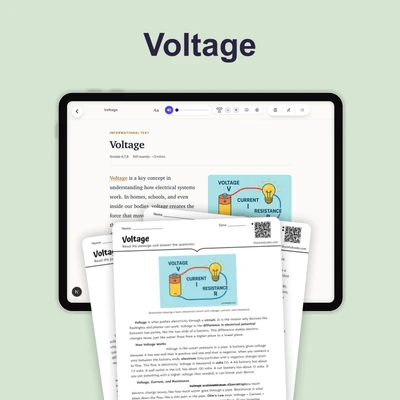
Not all materials are good conductors. Insulators like rubber or plastic do not let current flow easily, which is why they are used to coat wires. Some materials, called semiconductors, only allow current to flow under certain conditions and are crucial in devices like computers and solar cells. Short circuits, where current takes an unintended shortcut, can be dangerous and are prevented by careful circuit design. The laws of electricity, such as Ohm’s Law, help predict how current, voltage, and resistance interact.
Understanding electric current connects to broader scientific ideas, such as the conservation of energy and the design of technological systems. As our world relies more on electricity, learning about current and circuits gives us the tools to innovate and solve real-world problems.
Interesting Fact:
Lightning is a natural example of electric current, with a single bolt carrying up to 30,000 amps—much more than any household device!
Comprehension quiz (10 questions)
1. What is electric current?
2. What must be true for electric current to flow in a circuit?
3. What unit is used to measure electric current?
4. What is the main function of an insulator in a circuit?
5. What is the difference between conventional current and electron flow?
6. What analogy is used in the passage to help explain electric current?
7. Which of the following is an application of electric current mentioned in the passage?
8. Why are semiconductors important?
9. True or False: Current can only flow in a complete circuit.
10. True or False: Electrons in a circuit move from the positive to the negative terminal.
Perfect for the way you teach
- Build comprehension skills
- Auto-graded quiz
- Differentiated reading
- Read together at home
- Improve fluency
- Quiet reading time
- Reading curriculum support
- Independent practice
- Track Lexile growth