Electromagnets
Interactive passage with audio narration, comprehension questions, and printable PDF.
By completing this purchase you agree to our Terms of Use and Privacy Policy. Your subscription renews automatically until you cancel. You can cancel anytime from your account settings. All sales are final and non-refundable. Digital content is available for download in your account immediately upon purchase.
What's included
Electromagnets preview and details
About this printable Electromagnets science reading passage, NGSS-aligned (Grades 5-8)
Sample passage and quiz from Electromagnets
Reading passage and comprehension quiz preview
Electromagnets

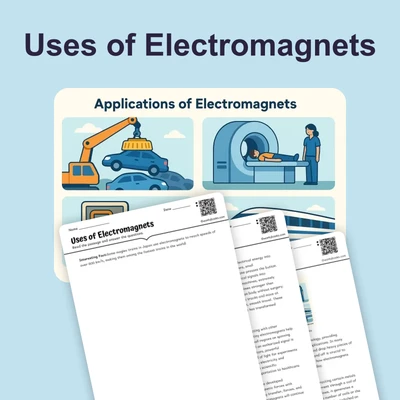
Electromagnets are found in industrial devices like MRI machines. Images by MART PRODUCTION / Pexels.
Electromagnets are essential components in modern technology, transforming how we use and control magnetism. In many recycling centers, large cranes use electromagnets to lift and move heavy scrap metal. These magnets can be switched on to attract metal and off to release it. But what exactly makes an electromagnet work, and why are they so useful compared to permanent magnets?
How Electromagnets Work
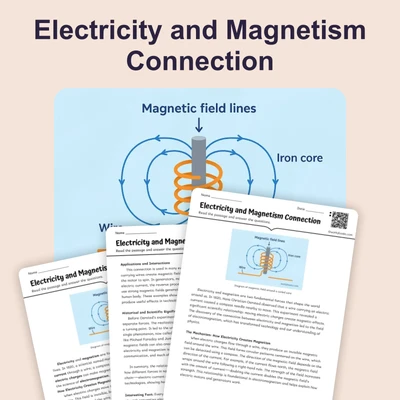
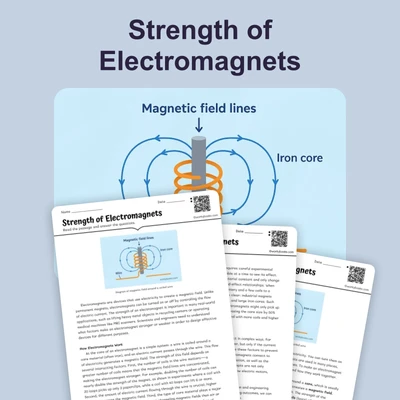
An electromagnet is a type of temporary magnet created by running an electric current through a coil of wire, often wrapped around an iron core. This arrangement is called a solenoid. When electric current flows through the wire, it produces a magnetic field around the wire. The iron core inside the coil becomes strongly magnetized, greatly increasing the magnet's strength. Unlike permanent magnets, which are always “on,” electromagnets only work when the electric current is flowing. If you disconnect the battery, the magnetic field disappears instantly. The strength of an electromagnet depends on the number of wire coils, the amount of current, and the type of core used. For example, increasing the number of coils or the current will make the electromagnet stronger. Reversing the direction of the current will switch the north and south poles of the magnet.
Advantages and Applications of Electromagnets
Electromagnets have several advantages over permanent magnets. First, they can be turned on and off with a switch, making them very useful in devices that need controlled magnetism. Second, their strength can be easily adjusted by changing the amount of current or the number of coils. Third, electromagnets can be made much stronger than most permanent magnets, especially when a soft iron core is used. Electromagnets are found in many household and industrial devices. Electric motors, doorbells, speakers, and MRI machines all use electromagnets in different ways. In junkyards, huge electromagnets are used to pick up and move car parts. Trains called maglevs use electromagnets to float above tracks, reducing friction and allowing for high-speed travel.
Interactions and Scientific Principles
The science behind electromagnets demonstrates the connection between electricity and magnetism, known as electromagnetism. This relationship is one of the four fundamental forces in physics. Scientists discovered electromagnetism by observing how electric current affects compass needles and iron filings. The ability to control magnetic fields with electricity has led to countless technological advances. For example, the direction of the electric current determines which end of the electromagnet is the north pole. This property allows engineers to design devices like electric switches, relays, and even maglev trains. Understanding electromagnets also helps scientists develop safer medical equipment and renewable energy solutions.
In summary, electromagnets are powerful tools that rely on the interaction between electricity and magnetism. Their strength, controllability, and ability to be turned on and off make them essential in modern technology. As we continue to explore electromagnetism, new innovations and applications are sure to emerge.
Interesting Fact: The world’s largest electromagnet, used in particle physics research, weighs over 1,000 tons and can create a magnetic field 100,000 times stronger than Earth’s!
Comprehension quiz (10 questions)
1. What is an electromagnet?
2. Which of the following is NOT a component needed to make a simple electromagnet?
3. What happens when the electric current is turned off in an electromagnet?
4. What is the main advantage of an electromagnet over a permanent magnet?
5. What does the term 'magnetic field' mean as used in the passage?
6. What does the word 'solenoid' refer to in the text?
7. If you increase the number of coils in an electromagnet, what will most likely happen?
8. Why are electromagnets important in maglev trains?
9. Electromagnets can be turned on and off. (True/False)
10. Permanent magnets only work when electricity is flowing. (True/False)
Perfect for the way you teach
- Build comprehension skills
- Auto-graded quiz
- Differentiated reading
- Read together at home
- Improve fluency
- Quiet reading time
- Reading curriculum support
- Independent practice
- Track Lexile growth