Reading PassagePremium

Examples of Commensalism in Nature

Interactive passage with audio narration, comprehension questions, and printable PDF.

No ratings yet
Grade 6ScienceEnglish · SpanishInteractive · Printable
Just this resource
$1.50
One-time purchase
Best value
Unlock everything
$49.99$29.99/yr
40% off until Aug 1 — 10,000+ resources
Renews at $49.99/year.
Unlock above to use these actions

What's included

Reading passage
Audio narration
Comprehension quiz
Writing activity
Glossary & flashcards
Differentiated version
Spanish translation

Examples of Commensalism in Nature preview and details

About this printable Examples of Commensalism in Nature science reading passage, NGSS-aligned (Grade 6)

This audio-integrated reading passage, "Examples of Commensalism in Nature," introduces Grade 2 students to the fascinating concept of commensalism. Students will learn about animal interactions where one animal benefits and the other is neither helped nor harmed. The passage provides simple examples, such as barnacles on whales and cattle egrets near cows, to illustrate this ecological relationship. Aligned with NGSS 2-LS2-2, it helps young learners understand how living things interact in their environment. The content is designed to be engaging and accessible, defining key terms and offering a fun fact to spark curiosity about the natural world.
Written by Workybooks TeamPublished by Workybooks
Preview

Sample passage and quiz from Examples of Commensalism in Nature

Reading passage and comprehension quiz preview

Commensalism in Nature
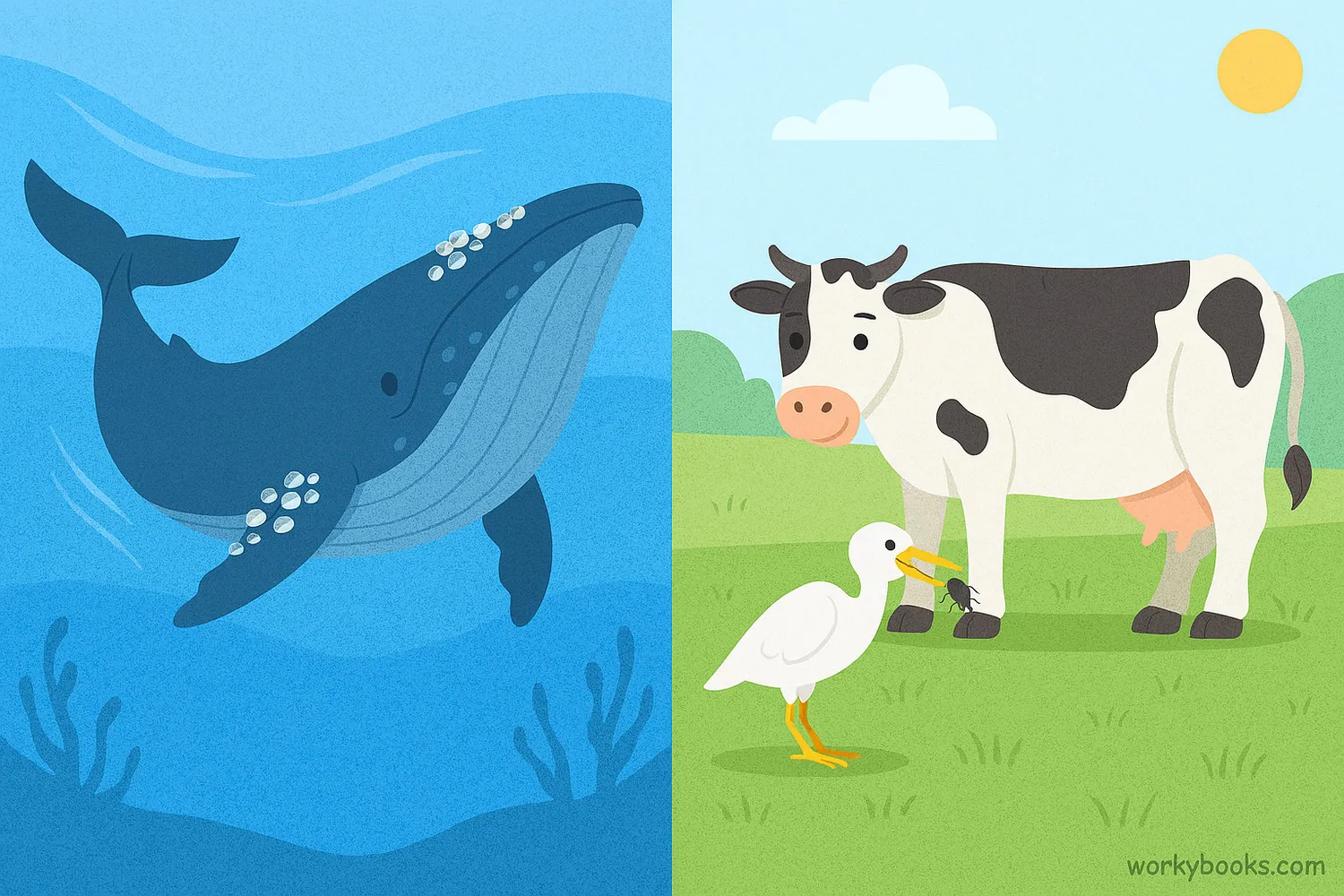
Whale with barnacles and cow with egret showing commensalism in nature.
Barnacles on whale and egret near cow—examples of commensalism where one benefits, one unaffected.

Commensalism in Nature

Animals often form special relationships called symbiosis. In some of these partnerships, both animals help each other. But in commensalism, only one animal gets something good, while the other is not helped or hurt. It’s like sitting next to someone eating popcorn and catching the pieces that fall—you get a snack, and they don’t even notice!

One famous example is the remora fish and the shark. Remoras have suction disks that let them attach to sharks. The remora gets a free ride and eats leftover food from the shark’s meals. The shark doesn’t seem to notice or care—it isn’t helped or harmed.

Another example is birds that build nests in trees. The birds get a safe home high off the ground. The tree doesn’t get anything from the birds, but it’s not harmed either.

Barnacles are tiny sea animals that stick to whales. The barnacles travel to food-rich waters on the whale’s back. The whale just carries them along and is not affected.

Cattle egrets are birds that follow cows in fields. When cows walk, they stir up insects. The egrets eat these insects, but the cows don’t notice the birds at all. In each of these cases, one animal is the host or "ride," while the other animal is the hitchhiker that gets the benefit.

Commensalism is different from mutualism, where both animals benefit, and parasitism, where one animal is harmed. Scientists study these relationships to learn how animals interact and help keep nature in balance.

Interesting Fact: Some scientists use cameras and tracking devices to find out how hitchhiker animals travel and survive with their hosts.

Comprehension quiz (8 questions)

1. What is commensalism?

One benefits, other not harmed
Both animals are harmed
Both animals help each other
One animal is always hurt

2. What do remora fish get from sharks?

Free ride and food
A new home
Protection from whales
Insects to eat

3. How do cattle egrets benefit from cows?

Eat insects cows stir up
Get milk from cows
Ride on the cows’ backs
Build nests on cows

4. Which is NOT an example of commensalism?

A tick on a dog
Remora on a shark
Barnacles on whales
Birds nesting in trees

5. If a bird builds a nest in a tree, what happens to the tree?

It is not affected
It gets more food
It is helped a lot
It loses its leaves

6. Why do scientists study commensalism?

To learn how animals interact
To stop all animal partnerships
To make animals pets
To feed the animals

7. Barnacles harm whales. True or false?

True
False

8. What does 'host' mean in commensalism?

Animal that is not affected
Animal that gets all the benefits
Animal that is always hurt
Animal that eats insects
Who it's for

Perfect for the way you teach

Teachers
  • Build comprehension skills
  • Auto-graded quiz
  • Differentiated reading
Parents
  • Read together at home
  • Improve fluency
  • Quiet reading time
Homeschoolers
  • Reading curriculum support
  • Independent practice
  • Track Lexile growth
Topics

Reviews & Ratings

No reviews yet. Be the first to share your experience!

More reading you might love

20 more
Passage
Producers: The Foundation of Ecosystems - reading educational content

Producers: The Foundation of Ecosystems

Reading Passage · MS-LS2-3

$1.50
Passage
Tracing Food Energy Back to the Sun - reading educational content

Tracing Food Energy Back to the Sun

Reading Passage · 5-LS1-1

$1.50
Passage
How Carnivores Get Their Energy - reading educational content

How Carnivores Get Their Energy

Reading Passage

$1.50
Passage
Arctic Fox Food Web and Ecosystem Role - reading educational content

Arctic Fox Food Web and Ecosystem Role

Reading Passage

$1.50
Passage
Predator and Prey in the Food Web - reading educational content

Predator and Prey in the Food Web

Reading Passage

$1.50
Passage
Consumers Get Energy By Eating - reading educational content

Consumers Get Energy By Eating

Reading Passage

$1.50
Passage
Energy for Living Things - reading educational content

Energy for Living Things

Reading Passage · 5-LS1-1

$1.50
Passage
Food Webs and Trophic Levels - reading educational content

Food Webs and Trophic Levels

Reading Passage · MS-LS2-3

$1.50
Passage
How Different Animals Get Energy from Food - reading educational content

How Different Animals Get Energy from Food

Reading Passage · 5-LS1-1

$1.50
Passage
Biomes: Aquatic Ecosystems - reading educational content

Biomes: Aquatic Ecosystems

Reading Passage · MS-LS2-1

$1.50
Passage
Photosynthesis in Ecosystems - reading educational content

Photosynthesis in Ecosystems

Reading Passage · MS-LS1-6

$1.50
Passage
Introduction to Cell Energy - reading educational content

Introduction to Cell Energy

Reading Passage · MS-LS1-6

Free
Passage
How Consumers Get Food - reading educational content

How Consumers Get Food

Reading Passage · 5-LS1-1

$1.50
Worksheet
Desert Ecosystems - worksheet educational content

Desert Ecosystems

Worksheet · W.5.2.D

Free
Passage
What Is the Main Source of Carbon in an Ecosystem? - reading educational content

What Is the Main Source of Carbon in an Ecosystem?

Reading Passage · MS-LS2-3

Free
Passage
What Kind of Energy Is Stored in Food - reading educational content

What Kind of Energy Is Stored in Food

Reading Passage · 5-LS1-1

$1.50
Passage
Water in Ecosystems - reading educational content

Water in Ecosystems

Reading Passage · MS-LS2-3

$1.50
Passage
Food Chains - reading educational content

Food Chains

Reading Passage · MS-LS2-3

Free
Passage
How Producers Make Food - reading educational content

How Producers Make Food

Reading Passage · 5-LS1-1

$1.50
Passage
Abiotic Factors in Ecosystems - reading educational content

Abiotic Factors in Ecosystems

Reading Passage · MS-LS2-1

$1.50
Copyright © 2026 Workybooks. Made with ♥ in California.