This learning resource is available in interactive and printable formats. The interactive worksheet can be played online and assigned to students. The Printable PDF version can be downloaded and printed for completion by hand.
This comprehensive reading passage introduces middle school students (grades 6-8) to the science of nuclear power plants, focusing on how controlled nuclear fission generates electricity. The text explains the main components of a nuclear power plant—such as the reactor core, control rods, coolant, steam generator, and turbine—and describes their roles in the process. Students learn how nuclear plants differ from fossil fuel plants, both relying on steam turbines but using different heat sources. Key advantages, like the absence of greenhouse gas emissions during operation and high energy output, are discussed alongside challenges such as nuclear waste, safety, and costs. The passage integrates real-world examples, scientific thinking, and broader implications for society and the environment, aligning with NGSS standards MS-PS3-4 and MS-ESS3-3. Activities include quizzes, writing prompts, and graphic organizers, with audio integration for accessibility. This resource helps students build scientific literacy and critical thinking about energy systems.
CONTENT PREVIEW
Expand content preview
Nuclear Power Plants
Nuclear power plants are a major source of electricity in many countries. They address the challenge of producing large amounts of energy without releasing greenhouse gases during operation. Understanding how these plants work helps us see the connections between energy, technology, and environmental impact. The main concept behind nuclear power is using controlled nuclear fission to generate heat, which is then converted into electricity through a complex system of components.
How Nuclear Power Plants Work
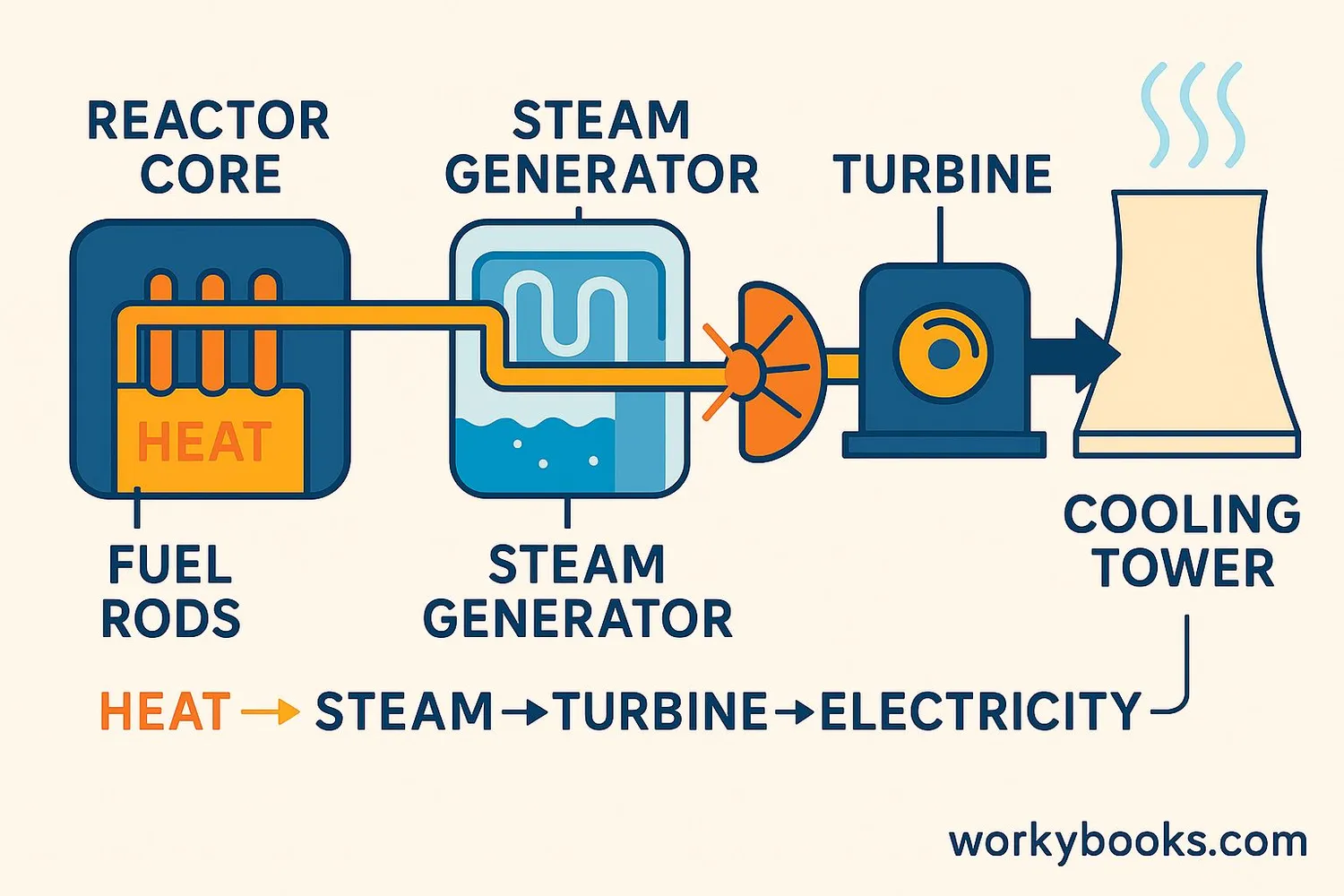
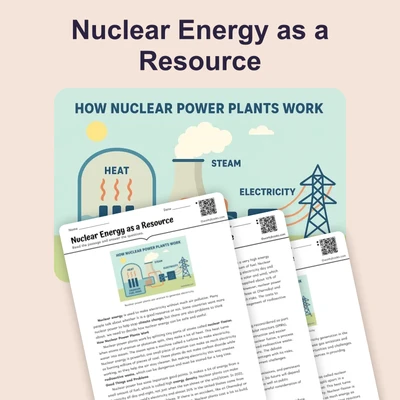
At the heart of a nuclear power plant is the reactor core. This is where nuclear fission occurs—a process in which the nucleus of a heavy atom, such as uranium-235, splits into smaller parts. When this happens, a large amount of energy is released as heat. To keep the reaction under control, control rods made of materials like boron or cadmium are inserted into the reactor core. These rods absorb some of the neutrons and prevent the reaction from becoming too fast or dangerous.
The heat from fission is transferred to a coolant, often water or liquid sodium, which circulates through the reactor. The hot coolant moves to a steam generator, where it heats water to produce steam. This high-pressure steam spins a turbine, which is connected to a generator that produces electricity. The used steam is then cooled, condensed back into water, and reused in the system, making the process highly efficient.
Comparison to Fossil Fuel Plants and Real-World Impacts
While both nuclear and fossil fuel power plants use steam to turn turbines and generate electricity, their heat sources are very different. Fossil fuel plants burn coal, oil, or natural gas, which releases carbon dioxide and other greenhouse gases into the atmosphere. In contrast, nuclear power plants rely on nuclear fission, which does not emit greenhouse gases during operation. For example, a single nuclear reactor can produce as much electricity as a fossil fuel plant that burns millions of tons of coal each year, but without the same air pollution.
However, nuclear power plants face challenges. They create radioactive waste that must be safely stored for thousands of years. Building and maintaining these plants is expensive, and accidents—though rare—can have serious consequences for health and the environment. Despite these issues, some countries, like France, generate more than 70% of their electricity from nuclear power, reducing their reliance on fossil fuels.
Advantages, Challenges, and Future Directions
One of the main advantages of nuclear power is its high energy output. A small amount of nuclear fuel can produce vast amounts of electricity, making it a reliable source for large cities. Nuclear plants also help fight climate change by reducing carbon emissions. Scientists are researching new technologies, such as advanced reactors and improved waste handling, to make nuclear energy safer and more sustainable. Still, the debate continues about how best to balance the benefits and risks of nuclear power as part of the global energy mix.
In summary, nuclear power plants use controlled fission to turn atomic energy into electricity, with important impacts on society and the environment. Their complex systems show how science and engineering work together to solve real-world problems and shape our future energy choices.
Interesting Fact: A single uranium fuel pellet—about the size of a fingertip—can produce as much energy as one ton of coal, 149 gallons of oil, or 17,000 cubic feet of natural gas!
What is the main purpose of a nuclear power plant?
To generate electricity using nuclear fissionTo produce greenhouse gasesTo burn fossil fuels for energyTo store radioactive waste
What is the function of control rods in a nuclear reactor?
They absorb neutrons to control the fission reactionThey produce steam for the turbineThey burn fuel to create heatThey generate electricity directly
How is heat produced in a nuclear power plant?
By splitting the nucleus of atoms in fissionBy burning coal in a furnaceBy using solar panels to trap sunlightBy condensing steam back into water
What does the coolant do in a nuclear power plant?
It carries heat away from the reactor coreIt absorbs greenhouse gasesIt spins the turbine directlyIt stores radioactive waste
Which component turns steam into electricity?
TurbineCoolantControl rodsWaste storage
What is one major difference between nuclear and fossil fuel power plants?
Nuclear plants do not emit greenhouse gases during operationFossil fuel plants use control rodsNuclear plants burn coal for heatFossil fuel plants produce radioactive waste
What is a challenge of nuclear power plants?
Safe storage of radioactive wasteLow energy outputHigh greenhouse gas emissionsThey use a lot of fossil fuels
Why do some countries rely heavily on nuclear power?
It provides a large amount of electricity with low carbon emissionsIt is the cheapest form of energyIt has no safety risksIt replaces all renewable sources
Nuclear fission is a process where the nucleus of a heavy atom splits and releases energy.
TrueFalse
Nuclear power plants produce electricity by burning fossil fuels.
TrueFalse
Perfect For:
👩🏫 Teachers
• Reading comprehension practice
• Auto-graded assessments
• Literacy skill development
👨👩👧👦 Parents
• Reading practice at home
• Comprehension improvement
• Educational reading time
🏠 Homeschoolers
• Reading curriculum support
• Independent reading practice
• Progress monitoring
Reading Features:
📖
Reading Passage
Engaging fiction or nonfiction text
❓
Comprehension Quiz
Auto-graded questions
📊
Instant Feedback
Immediate results and scoring
📄
Printable Version
Download for offline reading
🔊
Read Aloud
Voice-over with word highlighting
Reviews & Ratings
No reviews yet. Be the first to share your experience!
Related Content
Natural Disaster: Volcanic Eruptions
Volcanoes can erupt with lava and ash, changing the landscape. While dangerous, they also create fertile land and new la...
RI.3.1RI.4.4RI.4.2RI.5.2
Human Impacts: Pollution
This middle school science reading passage, aligned with NGSS standards MS-LS2-4 and MS-ESS3-3, examines the mechanisms ...
MS-LS2-4MS-ESS3-3
Human Impacts: Habitat Destruction
This grade 6-8 science passage explores human impacts on ecosystems, focusing on habitat destruction as the leading caus...
MS-LS2-4MS-LS2-5MS-ESS3-3
Ecosystem Services
This engaging middle school science passage introduces students to the concept of ecosystem services, the vital benefits...
MS-LS2-5MS-ESS3-3
Environmental Problems and Solutions
This passage for grades 6-8 introduces major environmental problems such as habitat loss, pollution, climate change, inv...
MS-LS2-4MS-ESS3-3MS-ESS3-4
Remote Sensing
This middle school science passage introduces students to the concept of remote sensing—the collection of information ab...
MS-ESS3-3MS-PS4-2MS-ETS1-1MS-ETS1-3
Geographic Information Systems (GIS)
This engaging middle school science passage introduces students to Geographic Information Systems (GIS), aligning with N...
MS-ESS3-3MS-ETS1-1MS-ETS1-2MS-ETS1-3
Renewable vs. Nonrenewable Energy
This engaging passage, aligned with NGSS standards MS-PS3-4, MS-ESS3-3, and MS-ESS3-4, helps middle school students diff...
MS-PS3-4MS-ESS3-3MS-ESS3-4
Fossil Fuels: Coal
This middle school science reading passage explores the science behind coal, a major fossil fuel. Students will learn ho...
MS-PS3-4MS-ESS3-3MS-ESS3-4
Solar Energy
This engaging passage for grades 6-8 explores the science of solar energy, focusing on how sunlight is converted into el...
MS-PS3-4MS-ESS3-3MS-ESS3-4
Wind Energy
This comprehensive middle school science passage explores the scientific principles behind wind energy and how wind turb...
MS-PS3-4MS-ESS3-3MS-ESS3-4
Hydroelectric Energy
This comprehensive passage introduces middle school students to the science behind hydroelectric energy, directly aligni...
MS-PS3-4MS-ESS3-3MS-ESS3-4
Geothermal Energy
This comprehensive science passage introduces middle school students to the mechanisms and applications of geothermal en...
MS-PS3-4MS-ESS3-3MS-ESS3-4
Biomass and Biofuels
This NGSS-aligned passage introduces grades 6-8 students to the science of biomass and biofuels, explaining how organic ...
MS-PS3-4MS-ESS3-3MS-ESS3-4
Nuclear Energy as a Resource
This NGSS-aligned informational science passage, designed for grades 6-8, explores nuclear energy as a resource in the c...
MS-PS3-4MS-ESS3-3MS-ESS3-4
Water Quality
This middle school science reading passage covers the topic of water quality, aligned with NGSS standards MS-ESS3-1 and ...
MS-ESS3-1MS-ESS3-3
Florida Everglades
This comprehensive passage introduces middle school students to the Florida Everglades, a distinctive wetland ecosystem ...
MS-LS2-1MS-LS2-4MS-ESS3-3MS-ESS3-4
Congo Rainforest
This middle school science passage explores the Congo Rainforest—Earth’s second-largest rainforest, located in Central A...
MS-LS2-1MS-ESS3-3
Nuclear Safety and Waste
This middle school science passage explores the critical topic of nuclear safety and waste management, aligned with NGSS...