How Freshwater Differs from Saltwater
Interactive passage with audio narration, comprehension questions, and printable PDF.
By completing this purchase you agree to our Terms of Use and Privacy Policy. Your subscription renews automatically until you cancel. You can cancel anytime from your account settings. All sales are final and non-refundable. Digital content is available for download in your account immediately upon purchase.
What's included
How Freshwater Differs from Saltwater preview and details
About this printable How Freshwater Differs from Saltwater science reading passage, NGSS-aligned (Grades 6-8)
Sample passage and quiz from How Freshwater Differs from Saltwater
Reading passage and comprehension quiz preview
Freshwater vs. Saltwater
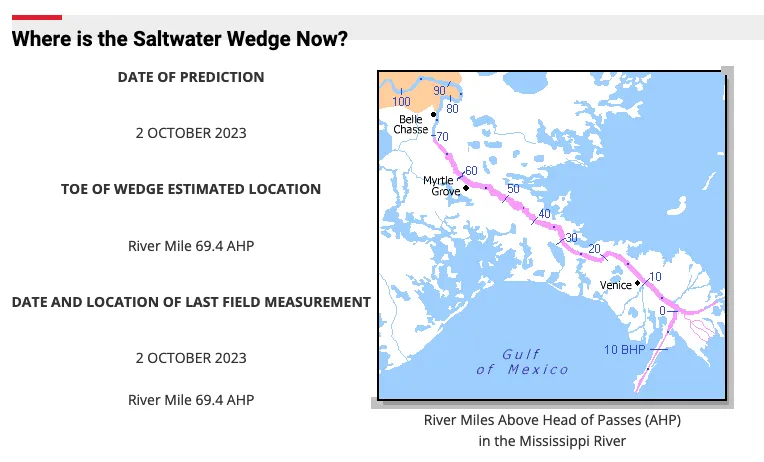
"Saltwater Wedge Intrusion in Lower Mississippi River, 2 October 2023 - Description and Map" for US Army Corps of Engineers / Wikimedia Commons
Earth is often called the "blue planet" because water covers about 71% of its surface. However, not all water is the same. Water exists in two main forms on Earth: freshwater and saltwater. The key difference between these two types is salinity, which measures the amount of dissolved salts in water. Understanding this difference is essential because it determines which water humans and most land animals can use for survival.
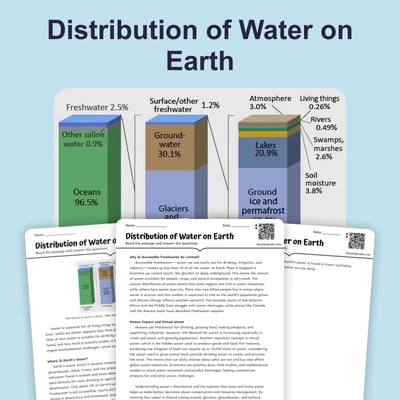
Saltwater contains high concentrations of dissolved salts, primarily sodium chloride, which is common table salt. Ocean water has an average salinity of about 35 parts per thousand, meaning that every kilogram of seawater contains approximately 35 grams of dissolved salts. This high salt content makes saltwater undrinkable for humans and most land animals. When humans drink saltwater, their bodies must use freshwater to flush out the excess salt, leading to dehydration rather than hydration. Saltwater makes up approximately 97% of all water on Earth and fills our oceans, seas, and some lakes like the Great Salt Lake in Utah.
Freshwater, in contrast, contains very low levels of dissolved salts—typically less than 1 part per thousand. This low salinity makes freshwater safe for drinking and suitable for agriculture, industry, and most daily human needs. Freshwater exists in rivers, most lakes, underground aquifers, ice caps, and glaciers. It also falls from the sky as precipitation in the water cycle. Despite being essential for human survival, freshwater represents only about 3% of Earth's total water supply.
Even more limiting is the fact that most freshwater is not readily accessible to humans. Approximately 68% of Earth's freshwater is locked in ice caps and glaciers, primarily in Antarctica and Greenland. Another 30% exists as groundwater deep beneath Earth's surface, much of it too deep or too difficult to extract economically. This means that less than 1% of all water on Earth is readily available freshwater found in lakes, rivers, and shallow groundwater that humans can easily access and use.
The distribution of water on Earth creates significant challenges for human populations. The hydrosphere—all the water on, under, and above Earth's surface—is mostly saltwater that cannot be used directly for drinking or agriculture. While desalination technology can remove salt from ocean water, this process is expensive and requires large amounts of energy. As a result, most communities depend on the limited freshwater available in their regions. Climate, geography, and human activity all affect freshwater availability, making water conservation increasingly important as human populations grow.
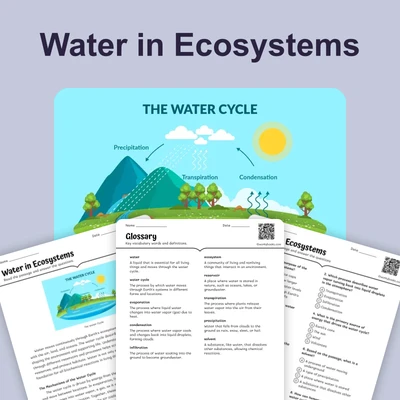
The water cycle continuously moves water between the ocean, atmosphere, and land, but this process does not increase the total amount of freshwater available. When ocean water evaporates, the salt is left behind, and the water vapor eventually falls as freshwater precipitation. However, this natural desalination process happens slowly and unevenly across the planet. Some regions receive abundant rainfall while others face chronic water shortages. Understanding the difference between freshwater and saltwater helps explain why water scarcity remains a critical global issue even on a planet covered mostly by water.
Interesting Fact: If all of Earth's water fit in a gallon jug, the available freshwater would equal just over one tablespoon—demonstrating how precious and limited our usable water supply truly is.
Comprehension quiz (10 questions)
1. What is the main difference between freshwater and saltwater?
2. Approximately what percentage of Earth's water is saltwater?
3. What does the term 'salinity' measure?
4. Why is drinking saltwater dangerous for humans?
5. Where is most of Earth's freshwater located?
6. Based on the passage, why is desalination not widely used to solve water shortages?
7. What can be inferred about the water cycle's role in creating freshwater?
8. If a community wanted to increase its freshwater supply, which approach would be most practical based on the passage?
9. True or False: Less than 1% of all water on Earth is readily available freshwater that humans can easily access.
10. True or False: The water cycle increases the total amount of freshwater available on Earth.
Perfect for the way you teach
- Build comprehension skills
- Auto-graded quiz
- Differentiated reading
- Read together at home
- Improve fluency
- Quiet reading time
- Reading curriculum support
- Independent practice
- Track Lexile growth