How Do Aquifers Store Groundwater
Interactive passage with audio narration, comprehension questions, and printable PDF.
By completing this purchase you agree to our Terms of Use and Privacy Policy. Your subscription renews automatically until you cancel. You can cancel anytime from your account settings. All sales are final and non-refundable. Digital content is available for download in your account immediately upon purchase.
What's included
How Do Aquifers Store Groundwater preview and details
About this printable How Do Aquifers Store Groundwater science reading passage, NGSS-aligned (Grades 6-8)
Sample passage and quiz from How Do Aquifers Store Groundwater
Reading passage and comprehension quiz preview
How Aquifers Store Groundwater
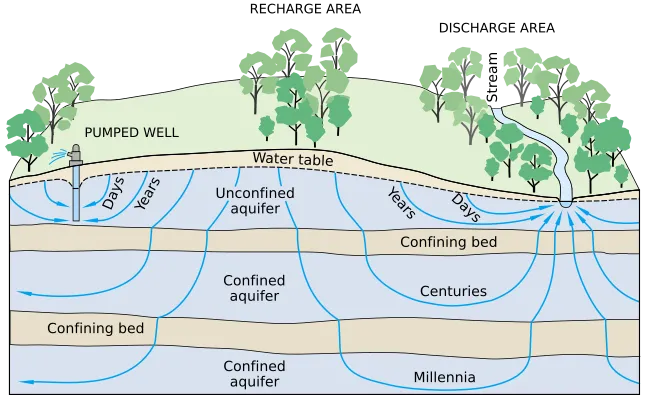
"Groundwater flow" by T.C. Winter, J.W. Harvey, O.L. Franke, and W.M. Alley / Wikimedia Commons (Public domain).
An aquifer is an underground layer of rock or sediment that holds and transmits water. These geological formations serve as natural storage tanks beneath Earth's surface, containing vast amounts of freshwater. Aquifers form when water from precipitation seeps down through soil and rock layers until it reaches zones where all the spaces between particles are filled with water. Understanding how aquifers work requires examining the specific properties that allow certain rock layers to store and move water while others cannot.
Two key geological properties determine whether a rock layer can function as an aquifer: porosity and permeability. Porosity refers to the amount of empty space between particles in a rock or sediment. These spaces, called pores, can hold water like a sponge holds liquid. Materials with high porosity, such as sandstone or gravel, contain many pores and can store large volumes of water. However, porosity alone does not make a good aquifer. The pores must also be connected to allow water to flow through the material.
Permeability describes how easily water can move through a material. A rock layer has high permeability when its pores are connected, creating pathways for water to travel. Sandstone typically has both high porosity and high permeability because its grains are loosely packed with connected spaces between them. In contrast, clay has high porosity but low permeability because its tiny particles pack tightly together, blocking water movement. The best aquifers have both high porosity for storage and high permeability for water transmission.
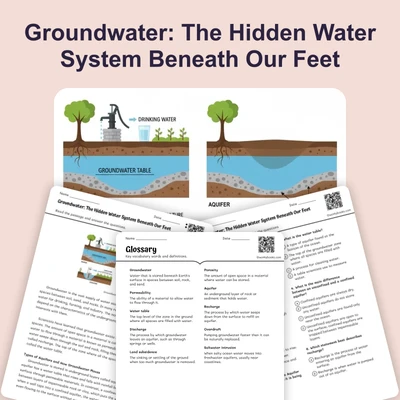
Aquifers exist within a larger groundwater system that includes several distinct zones. The water table marks the upper boundary of the saturated zone, where all pore spaces are filled with water. Above the water table lies the unsaturated zone, where pores contain both air and water. When rain falls, water percolates downward through the unsaturated zone until it reaches the water table and enters the aquifer. Impermeable layers of rock, such as clay or solid granite, often form boundaries above or below aquifers, preventing water from moving beyond these barriers.
Different types of aquifers form based on their geological setting. Unconfined aquifers have the water table as their upper boundary and receive water directly from precipitation above. Confined aquifers are sandwiched between two impermeable layers, trapping water under pressure. When a well is drilled into a confined aquifer, the pressure can push water upward, sometimes even reaching the surface without pumping. The Ogallala Aquifer beneath the Great Plains is an example of a massive unconfined aquifer that supplies water to millions of people and irrigates vast agricultural areas.
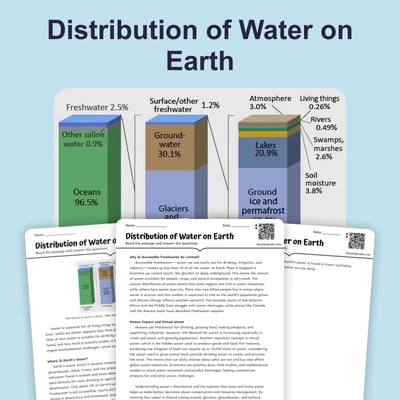
Aquifers function as critical freshwater reservoirs within Earth's water cycle and surface processes. They store approximately 30 percent of Earth's freshwater, far more than all rivers and lakes combined. Water moves slowly through aquifers, sometimes traveling only a few meters per year, which means aquifers can take decades or centuries to refill after water is withdrawn. This slow movement makes aquifers vulnerable to overuse, as pumping water faster than natural recharge rates can deplete these essential resources. Protecting aquifers requires understanding the geological conditions that create them and managing water use sustainably.
Interesting Fact: Some aquifers contain water that fell as rain thousands of years ago. Scientists have found water in certain deep aquifers that is more than 10,000 years old, dating back to the last Ice Age.
Comprehension quiz (10 questions)
1. What is an aquifer?
2. Which two properties determine whether a rock layer can function as an aquifer?
3. What does porosity refer to?
4. Why does clay make a poor aquifer even though it has high porosity?
5. What marks the upper boundary of the saturated zone in an aquifer?
6. How do confined aquifers differ from unconfined aquifers?
7. Approximately what percentage of Earth's freshwater is stored in aquifers?
8. Why are aquifers vulnerable to overuse?
9. True or False: Sandstone typically has both high porosity and high permeability, making it ideal for aquifers.
10. True or False: Water in aquifers moves very quickly, traveling several kilometers per day.
Perfect for the way you teach
- Build comprehension skills
- Auto-graded quiz
- Differentiated reading
- Read together at home
- Improve fluency
- Quiet reading time
- Reading curriculum support
- Independent practice
- Track Lexile growth