How Does Solar Energy Drive the Water Cycle — Reading Comprehension
Rate this
Premium Resource
Present
Present in classroom. No work saved
Assign
Classroom with student accounts, Track progress
Quick Play
No student accounts, assign with a link
Grades
6
7
8
Standards
MS-ESS2-4
PRINT+DIGITAL RESOURCE
This learning resource is available in interactive and printable formats. The interactive worksheet can be played online and assigned to students. The Printable PDF version can be downloaded and printed for completion by hand.
This comprehensive 650-word reading passage explores how solar energy and gravity work together as the dual engines of Earth's water cycle. Students in grades 6-8 will discover how the sun's energy powers evaporation from oceans, lakes, and rivers, as well as transpiration from plants. The passage then explains how gravity takes over, pulling water vapor back to Earth as precipitation and moving water downhill as runoff. Through clear explanations and real-world examples, students understand the cause-and-effect relationships between energy inputs and water movement across Earth's surface. This resource is fully aligned with NGSS standard MS-ESS2-4 and includes audio integration for enhanced accessibility. The passage features bold key vocabulary terms, a comprehensive glossary, and multiple differentiated activities including comprehension quizzes, writing prompts, and graphic organizers. Both standard and simplified versions are provided, along with Spanish translations, making this resource suitable for diverse learners including English Language Learners and struggling readers.
CONTENT PREVIEW
Expand content preview
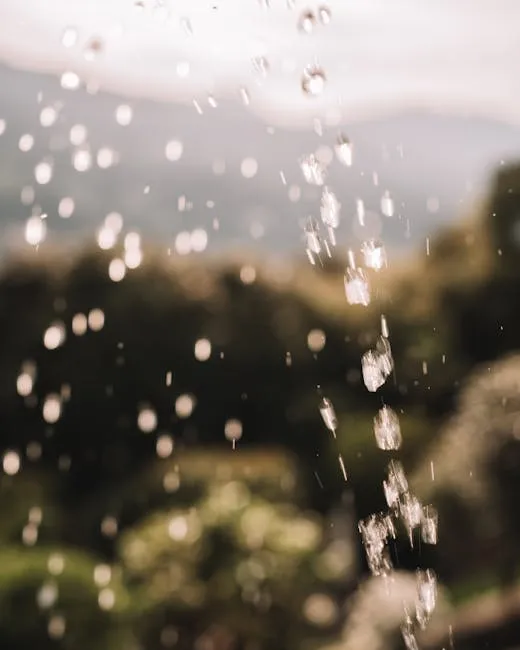
Water droplets falling with a scenic nature view in Stresa, Italy." by Mikita Yo / Pexels. After precipitation reaches the ground, gravity continues to move water through runoff and infiltration.
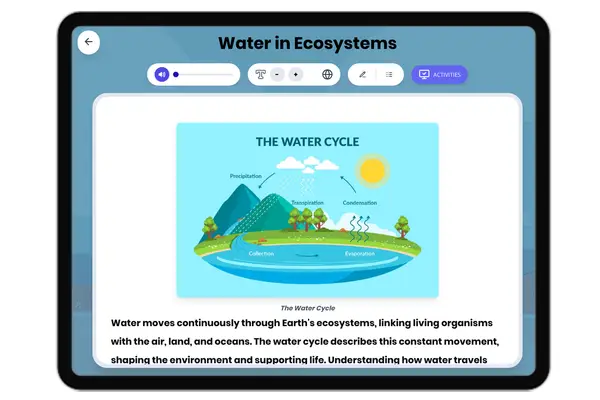
The water cycle is the continuous movement of water on, above, and below Earth's surface. Two powerful forces drive this cycle: solar energy from the sun and the force of gravity. These forces work together like a two-part engine, moving billions of gallons of water around our planet every single day.
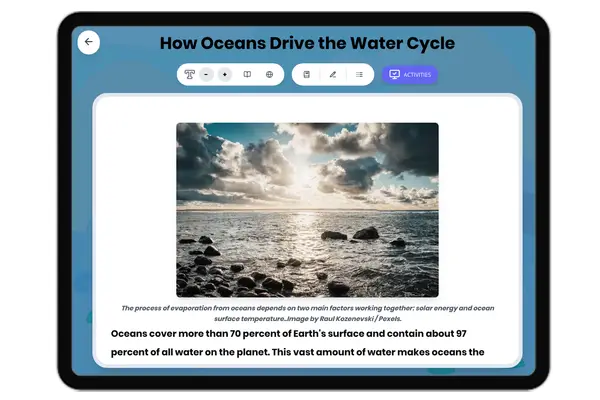
Solar energy is the primary force that lifts water into the atmosphere. When sunlight strikes the surface of oceans, lakes, and rivers, it transfers energy to water molecules. This energy causes evaporation, the process by which liquid water changes into water vapor, an invisible gas. The warmer the temperature, the faster evaporation occurs. On a hot summer day, a puddle disappears quickly because solar energy is converting the liquid water into vapor that rises into the air. Plants also release water vapor through transpiration, a process where water absorbed by roots travels through the plant and exits through tiny pores in leaves. Together, evaporation and transpiration move approximately 1,200 cubic miles of water into the atmosphere each day.
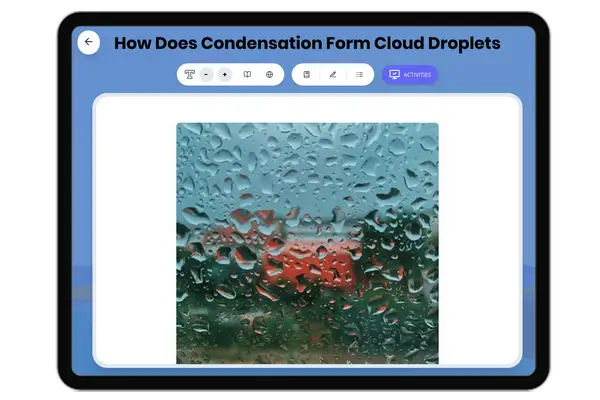
Once water vapor rises into the atmosphere, it cools as it moves higher where temperatures are lower. This cooling causes condensation, the process by which water vapor changes back into tiny liquid droplets. These droplets cluster together to form clouds. Inside clouds, droplets continue to combine and grow larger. When they become too heavy to remain suspended in the air, gravity takes control.
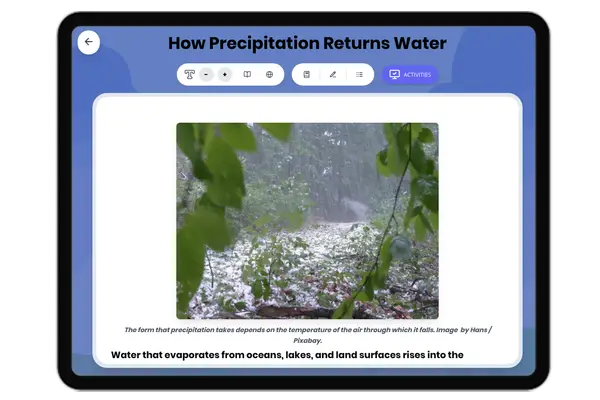
Gravity is the force that pulls all objects toward Earth's center. It acts as the second engine of the water cycle by pulling water back to the surface. When water droplets in clouds become large enough, gravity overcomes the upward air currents, and precipitation falls as rain, snow, sleet, or hail. Every year, approximately 505,000 cubic kilometers of precipitation falls on Earth's surface. Gravity determines where this water goes next.
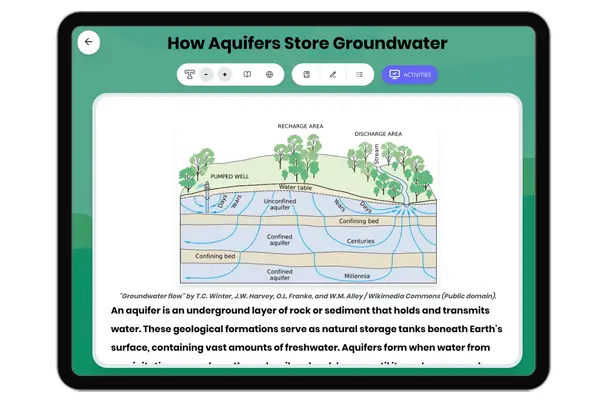
After precipitation reaches the ground, gravity continues to move water through runoff and infiltration. Runoff occurs when water flows downhill across the land surface, moving from higher elevations to lower ones. This water collects in streams, rivers, and eventually returns to oceans and lakes. Infiltration happens when water soaks into the soil and moves downward through rock layers, pulled by gravity into underground storage areas called aquifers. Without gravity, water would not flow downhill, rivers would not exist, and the cycle could not continue.
The interaction between solar energy and gravity creates a balanced system. Solar energy provides the power to lift water against gravity's pull, while gravity ensures that water returns to the surface and flows to collection points. This partnership maintains Earth's water distribution and supports all life. The same water molecules cycle repeatedly through this process—water that falls as rain today might have been part of a cloud last week, ocean water last month, or even a dinosaur's drinking water millions of years ago.
Interesting Fact: A single water molecule spends an average of nine days in the atmosphere before falling back to Earth as precipitation, but it can remain in underground aquifers for thousands of years before returning to the surface.
What are the two main forces that drive the water cycle?
Solar energy and gravityWind and temperatureOceans and cloudsPlants and animals
What happens during evaporation?
Water vapor changes into liquid waterLiquid water changes into water vaporWater falls from clouds as rainWater flows downhill into rivers
Which term describes the process by which plants release water vapor into the air?
EvaporationCondensationTranspirationPrecipitation
Why does water vapor in the atmosphere turn back into liquid droplets?
It gets heated by the sunIt cools as it rises higher in the atmosphereGravity pulls it down immediatelyPlants absorb it from the air
How does gravity contribute to the water cycle?
It heats water to create evaporationIt pulls water vapor up into the atmosphereIt pulls precipitation down and moves water downhillIt creates clouds in the sky
What is the difference between runoff and infiltration?
Runoff flows across the surface while infiltration soaks into the groundRunoff goes into clouds while infiltration falls as rainRunoff is caused by the sun while infiltration is caused by windThere is no difference between them
Based on the passage, what would happen to the water cycle if there were no gravity?
Water would evaporate fasterMore clouds would formWater would not return to Earth's surface and rivers would not flowPlants would release more water vapor
If solar energy increases on a particular day, what is most likely to happen to the rate of evaporation?
Evaporation will decreaseEvaporation will increaseEvaporation will stop completelyEvaporation will stay exactly the same
Solar energy is the only force needed to complete the water cycle.
TrueFalse
Water molecules cycle repeatedly through evaporation, condensation, and precipitation.
TrueFalse
Perfect For:
👩🏫 Teachers
• Reading comprehension practice
• Auto-graded assessments
• Literacy skill development
👨👩👧👦 Parents
• Reading practice at home
• Comprehension improvement
• Educational reading time
🏠 Homeschoolers
• Reading curriculum support
• Independent reading practice
• Progress monitoring
Reading Features:
📖
Reading Passage
Engaging fiction or nonfiction text
❓
Comprehension Quiz
Auto-graded questions
📊
Instant Feedback
Immediate results and scoring
📄
Printable Version
Download for offline reading
🔊
Read Aloud
Voice-over with word highlighting
Reviews & Ratings
No reviews yet. Be the first to share your experience!
Related Content
The Intertropical Convergence Zone (ITCZ): Earth's Weather Belt
This science passage explains the Intertropical Convergence Zone (ITCZ), a key equatorial weather system. Covering NGSS ...
MS-ESS2-5MS-ESS2-4RI.6.7
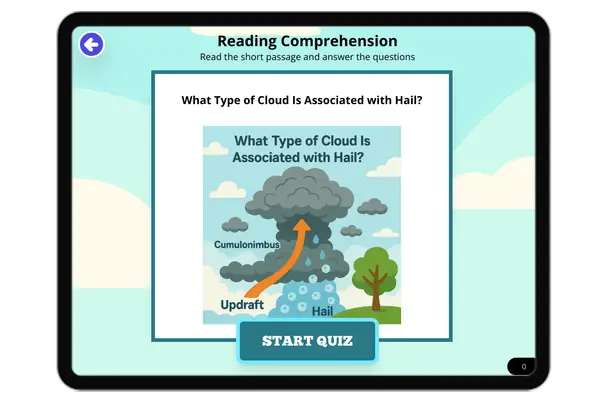
What Type of Cloud Is Associated with Hail?
This NGSS-aligned science reading passage for middle school explains that cumulonimbus clouds are the main cloud type re...
MS-ESS2-4
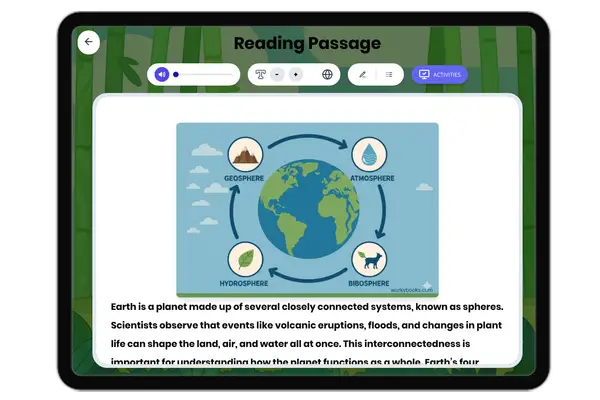
Earth's Spheres
This middle school science passage introduces students to Earth's four major spheres: the geosphere, hydrosphere, atmosp...
MS-ESS2-4MS-ESS2-6
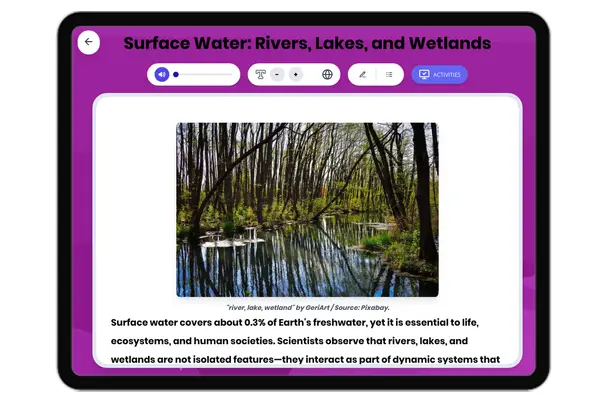
Surface Water: Rivers, Lakes, and Wetlands
This engaging middle school science passage explores the dynamic world of surface water, focusing on the complex systems...
MS-ESS2-4
Groundwater
This middle school science passage explores the essential topic of groundwater, aligned to NGSS standards MS-ESS2-4 and ...
MS-ESS2-4MS-ESS3-1
Distribution of Water on Earth
This middle school science reading passage explores the distribution of water on Earth, aligned with NGSS standards MS-E...
MS-ESS2-4MS-ESS3-1
Water in Ecosystems
This engaging passage for grades 6-8 explores the essential role of water in ecosystems, tracing its movement through va...
MS-LS2-3MS-ESS2-4
The Ozone Layer
This engaging NGSS-aligned passage explores the science and importance of the ozone layer for middle school students (gr...
MS-ESS2-4MS-ESS3-3
Layers of the Atmosphere
This middle school science reading passage, aligned to NGSS standard MS-ESS2-4, guides students through the structure an...
MS-ESS2-4
How Sonar Maps the Ocean Floor
This comprehensive middle school science reading passage explores how sonar technology maps the ocean floor using sound ...
MS-ESS2-4
How Aquifers Store Groundwater
This comprehensive reading passage explores how aquifers store groundwater, aligned with NGSS standard MS-ESS2-4. Studen...
MS-ESS2-4
How Glaciers Store and Release Water
This comprehensive middle school science passage examines how glaciers store and release water, aligned with NGSS MS-ESS...
MS-ESS2-4
How Does Condensation Form Cloud Droplets
This comprehensive middle school science reading passage explores how condensation forms droplets in Earth's atmosphere,...
MS-ESS2-4
How Oceans Drive the Water Cycle
This comprehensive middle school science reading passage examines how oceans drive the water cycle, aligning with NGSS s...
MS-ESS2-4
How Precipitation Returns Water
This comprehensive middle school science reading passage examines how precipitation returns water to Earth's surface and...
MS-ESS2-4
What Is Oceanography
This comprehensive reading passage introduces middle school students to the field of oceanography and how scientists stu...
MS-ESS2-4
Freshwater vs. Saltwater
This comprehensive 650-word science reading passage for middle school students (grades 6-8) examines the critical differ...