How Does Water Evaporate into the Atmosphere — Reading Comprehension
Rate this
Premium Resource
Present
Present in classroom. No work saved
Assign
Classroom with student accounts, Track progress
Quick Play
No student accounts, assign with a link
Grades
6
7
8
Standards
MS-ESS2-4
PRINT+DIGITAL RESOURCE
This learning resource is available in interactive and printable formats. The interactive worksheet can be played online and assigned to students. The Printable PDF version can be downloaded and printed for completion by hand.
This comprehensive 600-word reading passage explores how water enters the atmosphere through evaporation and transpiration, aligned with NGSS standard MS-ESS2-4. Students discover how solar energy drives the conversion of liquid water and plant moisture into water vapor, and identify where evaporation occurs most intensely on Earth's surface. The passage includes audio integration for enhanced accessibility, connecting these processes to water's critical role in Earth's surface processes. Complete with a simplified differentiated version, Spanish translations, glossary of key terms, multiple-choice questions, writing activities, and graphic organizers, this resource provides comprehensive support for grades 6-8 science curriculum. Students examine real-world examples including ocean evaporation and plant transpiration, building understanding of energy transfer and the water cycle's connection to Earth's systems.
CONTENT PREVIEW
Expand content preview
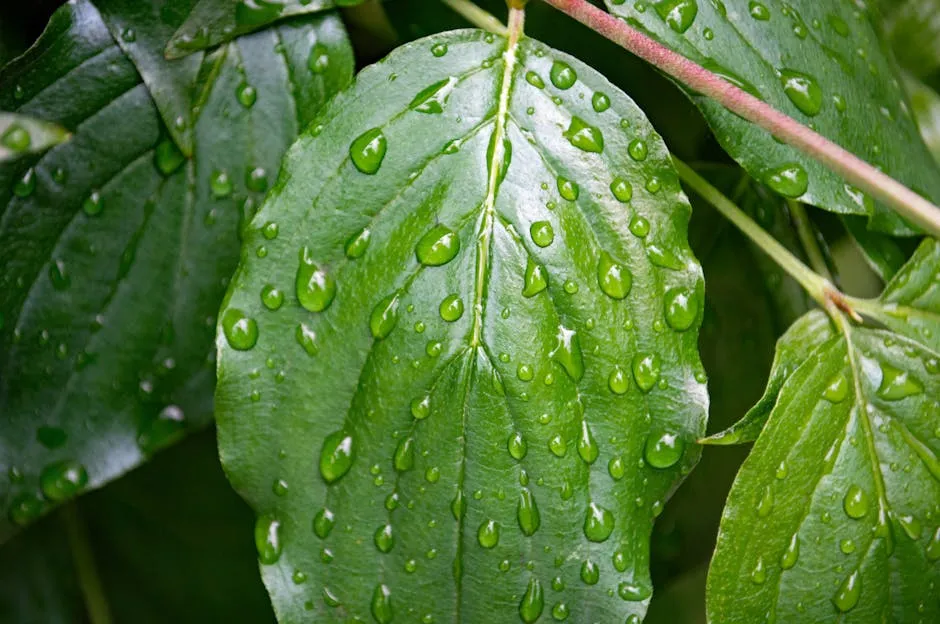
During transpiration, plants release water vapor through tiny openings called stomata in their leaves. Image by Pawel Hordjewicz / Pexels.
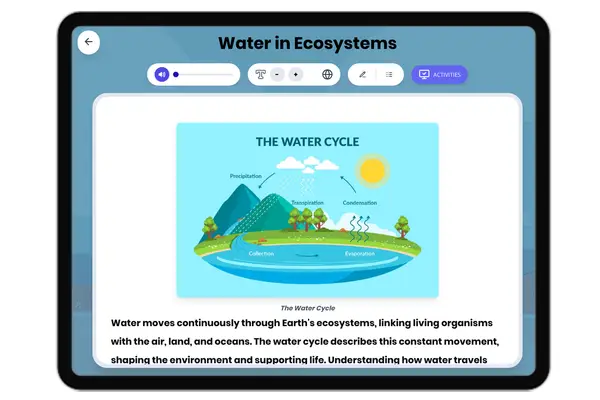
Water constantly moves between Earth's surface and the atmosphere through a process called the water cycle. Two main processes move liquid water into the air as water vapor: evaporation and transpiration. Understanding these processes helps explain how energy from the Sun drives changes in Earth's water distribution and influences weather patterns across the planet.
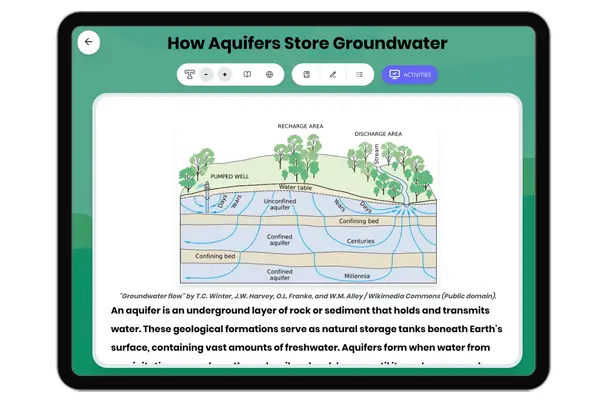
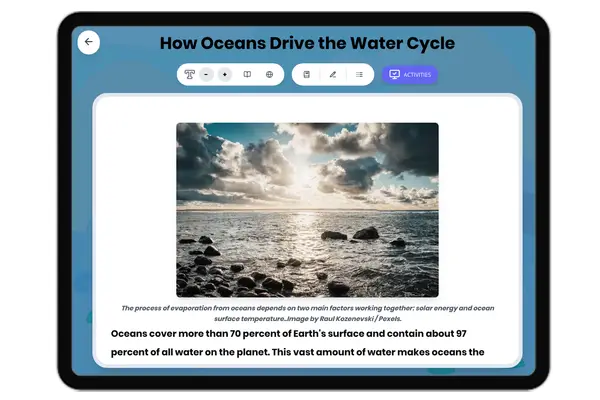
Evaporation occurs when liquid water changes into water vapor, an invisible gas. This process requires energy, which comes primarily from solar energy—the heat and light from the Sun. When solar energy reaches Earth's surface, it heats water molecules in oceans, lakes, rivers, and soil. As these molecules gain energy, they move faster and faster. Eventually, some molecules move fast enough to break free from the liquid surface and escape into the air as water vapor. The warmer the temperature and the more direct the sunlight, the faster evaporation occurs.
Evaporation happens most intensely over Earth's oceans, which cover about 71 percent of the planet's surface. Tropical oceans near the equator receive the most direct solar energy year-round, making them the most active evaporation zones on Earth. These warm ocean waters release enormous amounts of water vapor into the atmosphere daily. Evaporation also occurs from lakes, rivers, soil, and even puddles after a rainstorm, though at lower rates than from oceans.
Transpiration is the second major process that moves water into the atmosphere. During transpiration, plants release water vapor through tiny openings called stomata in their leaves. Plants absorb water from soil through their roots, and this water travels up through the stem to the leaves. Inside the leaves, water participates in photosynthesis, the process plants use to make food. However, plants release most of the water they absorb—about 90 percent—back into the atmosphere as water vapor through their stomata. Solar energy drives transpiration too, because warmth and light cause stomata to open and speed up water release.
Forests and areas with dense vegetation contribute significantly to atmospheric water vapor through transpiration. A single large tree can transpire hundreds of gallons of water per day during the growing season. Tropical rainforests, which receive intense solar energy and contain millions of plants, release massive amounts of water vapor through transpiration. Scientists estimate that transpiration and evaporation from soil and plants together, called evapotranspiration, can return up to 10 percent of atmospheric moisture in some regions.
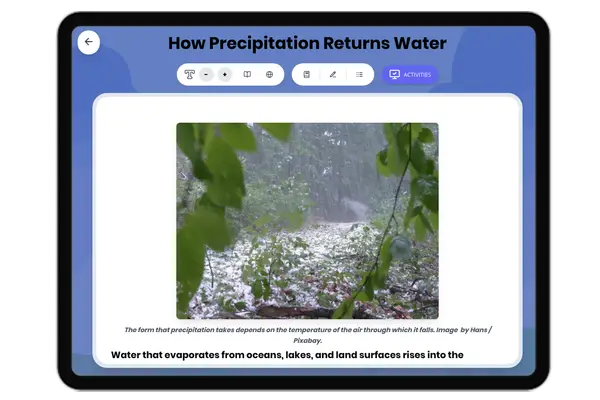
Both evaporation and transpiration connect directly to Earth's surface processes and energy systems. Solar energy provides the power needed to convert liquid water into water vapor, demonstrating how energy from the Sun drives changes in Earth's materials. The water vapor released through these processes rises into the atmosphere, where it eventually cools, condenses into clouds, and returns to Earth's surface as precipitation. This continuous cycle distributes water and energy around the planet, influencing climate, weather, erosion, and the survival of all living things.
Interesting Fact: A single acre of corn can transpire up to 4,000 gallons of water per day during peak growing season, which is enough water to fill a small swimming pool every week.
What is the main source of energy that drives evaporation and transpiration?
Solar energy from the SunWind energy from stormsHeat from Earth's coreEnergy from the Moon
Where does evaporation occur most intensely on Earth?
Over freshwater lakesOver tropical oceans near the equatorOver frozen polar ice capsOver mountain streams
What percentage of water absorbed by plants is released back into the atmosphere through transpiration?
About 25 percentAbout 50 percentAbout 75 percentAbout 90 percent
What are stomata?
Roots that absorb water from soilTiny openings in plant leaves that release water vaporStems that transport water in plantsSeeds that plants produce
Why does evaporation happen faster when temperatures are warmer?
Warm temperatures make water molecules move slowerWarm temperatures create more cloudsWarm temperatures give water molecules more energy to move faster and escape into the airWarm temperatures freeze the water
What happens to water vapor after it rises into the atmosphere?
It disappears foreverIt turns into ice immediatelyIt cools, condenses into clouds, and returns to Earth as precipitationIt escapes into outer space
Which process involves plants releasing water vapor through their leaves?
EvaporationCondensationPrecipitationTranspiration
What term describes the combined process of evaporation and transpiration?