How Does Condensation Form Cloud Droplets — Reading Comprehension
Rate this
Premium Resource
Present
Present in classroom. No work saved
Assign
Classroom with student accounts, Track progress
Quick Play
No student accounts, assign with a link
Grades
6
7
8
Standards
MS-ESS2-4
PRINT+DIGITAL RESOURCE
This learning resource is available in interactive and printable formats. The interactive worksheet can be played online and assigned to students. The Printable PDF version can be downloaded and printed for completion by hand.
This comprehensive middle school science reading passage explores how condensation forms droplets in Earth's atmosphere, aligned with NGSS standard MS-ESS2-4. Students discover how rising water vapor cools at higher altitudes, reaches its dew point, and condenses onto tiny atmospheric particles called condensation nuclei to form clouds and water droplets. The passage connects this process to water's continuous movement through Earth's systems, emphasizing the water cycle and energy transfer. Audio-integrated features support diverse learners, while differentiated versions ensure accessibility for English Language Learners and struggling readers. The passage includes real-world examples, a Spanish translation, glossary of key scientific terms, multiple-choice questions, writing activities, and graphic organizers. Students develop understanding of how temperature, pressure, and atmospheric conditions influence condensation, preparing them to analyze weather patterns and climate processes in Earth's interconnected systems.
CONTENT PREVIEW
Expand content preview
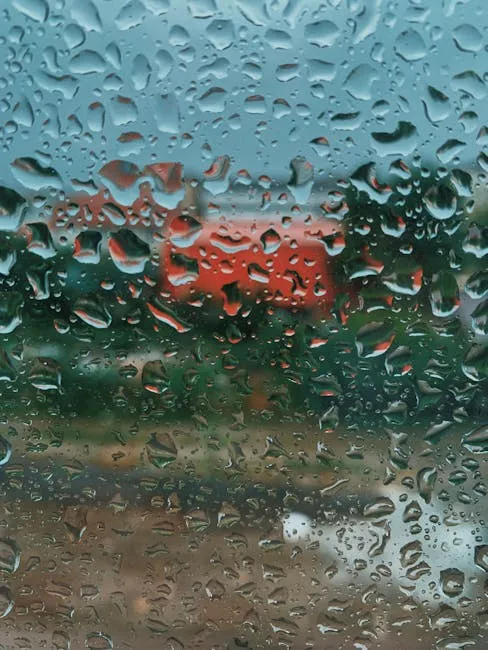
Condensation is the process by which water vapor changes from a gas to a liquid. As more water vapor condenses, droplets grow larger. Image by Diana ✨ / Pexels.
Condensation is the process by which water vapor changes from a gas to a liquid. This process happens constantly in Earth's atmosphere and plays a critical role in the water cycle. Understanding how condensation forms droplets helps explain how clouds develop and why precipitation occurs.
Water vapor enters the atmosphere through evaporation from oceans, lakes, rivers, and soil. As this invisible gas rises into the atmosphere, it encounters different conditions than at Earth's surface. The most important change is temperature. Air temperature decreases with altitude at a rate of about 6.5 degrees Celsius per kilometer. This cooling happens because air pressure decreases at higher altitudes, allowing air molecules to spread out and lose energy.
When rising water vapor cools, it eventually reaches a temperature called the dew point. The dew point is the temperature at which air becomes saturated with water vapor and can no longer hold all the moisture as a gas. At this point, water vapor must change state from gas to liquid. However, water vapor molecules cannot easily form droplets on their own in clean air. They need a surface to condense onto.
Tiny particles floating in the atmosphere provide the necessary surfaces for condensation. These particles, called condensation nuclei, include dust, pollen, salt crystals from ocean spray, and pollution particles. Each particle measures only a few micrometers across, but billions exist in every cubic meter of air. When water vapor molecules contact these particles at or below the dew point, they stick to the surface and form microscopic water droplets. Each droplet contains a condensation nucleus at its center surrounded by liquid water.
As more water vapor condenses, droplets grow larger. When billions of these droplets cluster together in the atmosphere, they become visible as clouds. Different cloud types form at different altitudes depending on temperature, humidity, and air movement patterns. Low clouds form when moist air near the surface cools to its dew point. High clouds form when air rises several kilometers and cools dramatically. The continuous process of water vapor rising, cooling, and condensing connects surface water to atmospheric water, demonstrating how water moves through Earth's systems.
The size of water droplets determines whether they remain suspended in clouds or fall as precipitation. Typical cloud droplets measure about 10-20 micrometers in diameter and are light enough to float on air currents. For precipitation to occur, droplets must grow much larger through additional condensation or by colliding and merging with other droplets. This growth process depends on temperature, the number of condensation nuclei available, and how long droplets remain in the cloud.
Condensation releases energy into the atmosphere. When water vapor changes to liquid, it releases the same amount of energy that was absorbed during evaporation. This latent heat warms the surrounding air, which can fuel weather systems and storms. The energy transfer during condensation demonstrates how the water cycle moves both matter and energy through Earth's atmosphere, oceans, and land surfaces.
Interesting Fact: A single cumulus cloud can contain over one million kilograms of water droplets, yet it floats because the tiny droplets are spread throughout a large volume of air and fall very slowly through updrafts that push them upward.
What is condensation?
The process by which water vapor changes from a gas to a liquidThe process by which liquid water changes into water vaporThe process by which ice melts into liquid waterThe process by which clouds form precipitation
What happens to air temperature as altitude increases?
Temperature increases by 6.5 degrees Celsius per kilometerTemperature stays the same at all altitudesTemperature decreases by about 6.5 degrees Celsius per kilometerTemperature fluctuates randomly at different altitudes
What is the dew point?
The temperature at which water freezesThe temperature at which air becomes saturated with water vapor and condensation beginsThe highest temperature air can reachThe temperature at which clouds disappear
In the passage, what does the term 'condensation nuclei' refer to?
Large water droplets in cloudsIce crystals that form at high altitudesTiny particles in the atmosphere that provide surfaces for water vapor to condense ontoThe center of storm systems
What provides the surfaces needed for water vapor to condense in the atmosphere?
Other water droplets onlyTiny particles like dust, pollen, salt crystals, and pollutionThe ground surfaceOxygen and nitrogen molecules
Why does condensation release energy into the atmosphere?
Because water vapor absorbs sunlightBecause changing from gas to liquid releases the energy that was absorbed during evaporationBecause clouds reflect heat from the sunBecause air pressure increases at higher altitudes
If a city has high levels of air pollution, how would this likely affect cloud formation compared to a city with clean air?
Pollution would prevent all cloud formationPollution particles would provide more condensation nuclei, potentially affecting cloud formationPollution would have no effect on cloud formationPollution would cause clouds to form only at night
Based on the passage, what would happen if there were no condensation nuclei in the atmosphere?
Clouds would form more easilyWater vapor would condense more quicklyWater vapor molecules would have difficulty forming droplets and cloudsPrecipitation would increase
True or False: Cloud droplets are typically large enough to immediately fall as precipitation.
TrueFalse
True or False: The water cycle moves both matter and energy through Earth's systems.
TrueFalse
Perfect For:
👩🏫 Teachers
• Reading comprehension practice
• Auto-graded assessments
• Literacy skill development
👨👩👧👦 Parents
• Reading practice at home
• Comprehension improvement
• Educational reading time
🏠 Homeschoolers
• Reading curriculum support
• Independent reading practice
• Progress monitoring
Reading Features:
📖
Reading Passage
Engaging fiction or nonfiction text
❓
Comprehension Quiz
Auto-graded questions
📊
Instant Feedback
Immediate results and scoring
📄
Printable Version
Download for offline reading
🔊
Read Aloud
Voice-over with word highlighting
Reviews & Ratings
No reviews yet. Be the first to share your experience!
Related Content
The Intertropical Convergence Zone (ITCZ): Earth's Weather Belt
This science passage explains the Intertropical Convergence Zone (ITCZ), a key equatorial weather system. Covering NGSS ...
MS-ESS2-5MS-ESS2-4RI.6.7
What Type of Cloud Is Associated with Hail?
This NGSS-aligned science reading passage for middle school explains that cumulonimbus clouds are the main cloud type re...
MS-ESS2-4
Earth's Spheres
This middle school science passage introduces students to Earth's four major spheres: the geosphere, hydrosphere, atmosp...
MS-ESS2-4MS-ESS2-6
Surface Water: Rivers, Lakes, and Wetlands
This engaging middle school science passage explores the dynamic world of surface water, focusing on the complex systems...
MS-ESS2-4
Groundwater
This middle school science passage explores the essential topic of groundwater, aligned to NGSS standards MS-ESS2-4 and ...
MS-ESS2-4MS-ESS3-1
Distribution of Water on Earth
This middle school science reading passage explores the distribution of water on Earth, aligned with NGSS standards MS-E...
MS-ESS2-4MS-ESS3-1
Water in Ecosystems
This engaging passage for grades 6-8 explores the essential role of water in ecosystems, tracing its movement through va...
MS-LS2-3MS-ESS2-4
The Ozone Layer
This engaging NGSS-aligned passage explores the science and importance of the ozone layer for middle school students (gr...
MS-ESS2-4MS-ESS3-3
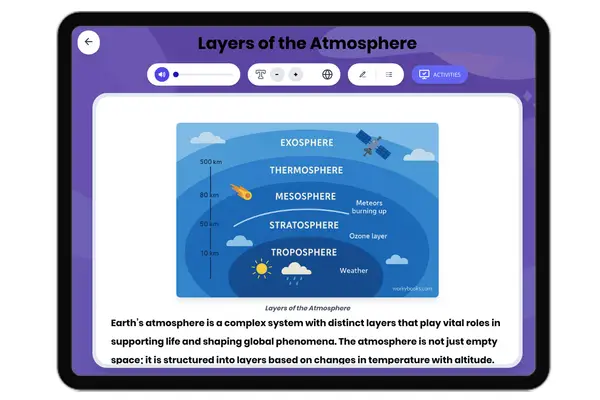
Layers of the Atmosphere
This middle school science reading passage, aligned to NGSS standard MS-ESS2-4, guides students through the structure an...
MS-ESS2-4
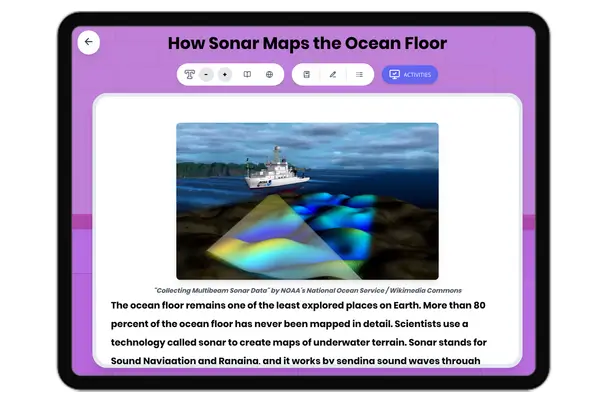
How Sonar Maps the Ocean Floor
This comprehensive middle school science reading passage explores how sonar technology maps the ocean floor using sound ...
MS-ESS2-4
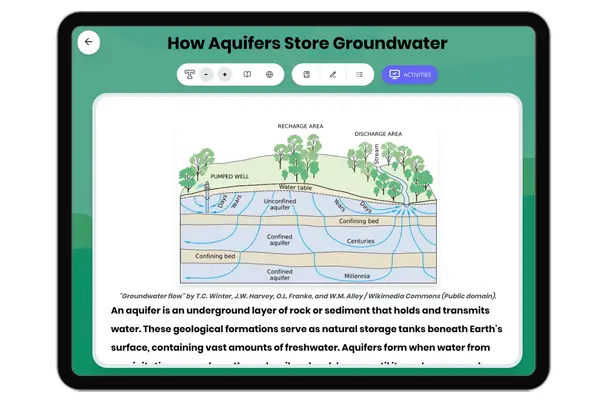
How Aquifers Store Groundwater
This comprehensive reading passage explores how aquifers store groundwater, aligned with NGSS standard MS-ESS2-4. Studen...
MS-ESS2-4
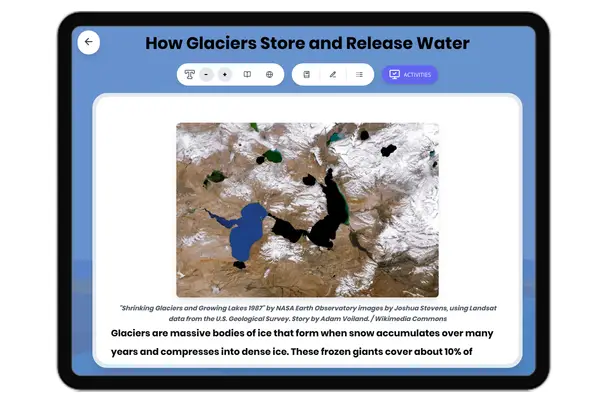
How Glaciers Store and Release Water
This comprehensive middle school science passage examines how glaciers store and release water, aligned with NGSS MS-ESS...
MS-ESS2-4
How Oceans Drive the Water Cycle
This comprehensive middle school science reading passage examines how oceans drive the water cycle, aligning with NGSS s...
MS-ESS2-4
How Does Solar Energy Drive the Water Cycle
This comprehensive 650-word reading passage explores how solar energy and gravity work together as the dual engines of E...
MS-ESS2-4
How Precipitation Returns Water
This comprehensive middle school science reading passage examines how precipitation returns water to Earth's surface and...
MS-ESS2-4
What Is Oceanography
This comprehensive reading passage introduces middle school students to the field of oceanography and how scientists stu...
MS-ESS2-4
Freshwater vs. Saltwater
This comprehensive 650-word science reading passage for middle school students (grades 6-8) examines the critical differ...